Chinese people gathered at war memorials and historical sites across the country to reflect on the tragedies of war on Friday, the 80th anniversary of Japan's unconditional surrender in World War II.
The Exhibition Hall of Evidences of Crime Committed by Unit 731 of the Japanese Imperial Army in Harbin City, northeast China's Heilongjiang Province, has revealed a new batch of evidence related to Unit 731 -- a Japanese germ-warfare unit that operated during World War II.
The new evidence includes 3,010 pages of archive documents, 194 minutes of video footage, 312 photographs, 12 postcards and eight letters, exposing Japanese germ-warfare crimes in detail.
"We insist on letting history speak for itself, using undeniable facts to reveal the atrocities committed by Japanese militarism in its invasion of China. This is to help people remember history, defend peace, and uphold the great spirit of resistance against Japanese aggression," said Jin Shicheng, deputy secretary-general of the Harbin Research Institute on the History of Bacterial and Gas Warfare by the Japanese Invasion of China.
In Nanjing, east China's Jiangsu Province, the Memorial Hall of the Victims in the Nanjing Massacre by Japanese Invaders held a memorial event, recognizing a fourth group of six individuals as inheritors of historical memories regarding the Nanjing Massacre.
For the first time, the group includes descendants of international friends who helped Chinese civilians during the war, highlighting an international dimension to efforts to pass on historical truth across generations.
The Site of the Japanese Surrender in Zhijiang, central China's Hunan Province, marks China's victory in the War of Resistance Against Japanese Aggression (1931-45) and is where the Chinese people accepted the surrender of the Japanese invaders on Aug. 21, 1945. The memorial hall at the site has showcased 61 rare photographs to the public for the first time, offering detailed insights into the formal handover process.
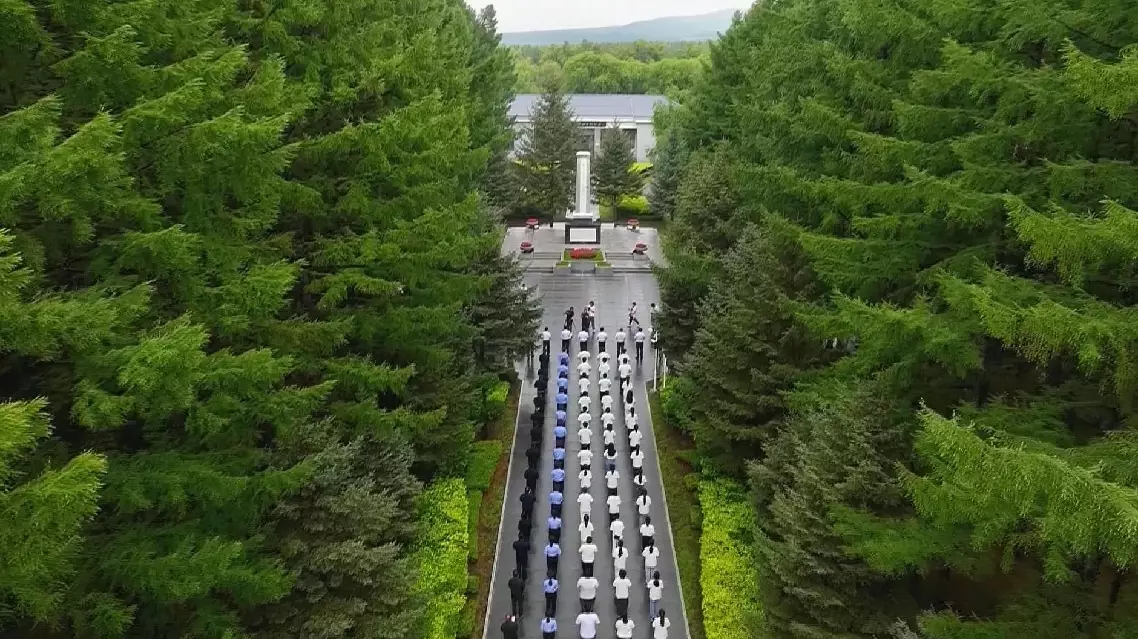
Visitors laid flowers in tribute to martyrs and massacre victims at memorial sites in Tonghua City in northeast China's Jilin Province, Wuxiang County in north China's Shanxi Province, Nanling County in east China's Anhui Province, and Changyuan City in central China's Henan Province.
In Shenyang, northeast China's Liaoning Province, the "Justice Trial – Historical Exhibition on the Trial of Japanese War Criminals in New China" has opened at the 9.18 Historical Museum. The exhibit presents a comprehensive account of the 1956 public trials and the verdicts handed down to 45 Japanese war criminals by the Supreme People's Court's Special Military Tribunal.
In Guangzhou, south China's Guangdong Province, more than ten archive institutions from Guangdong, Hong Kong, and Macao jointly launched an exhibition on wartime school relocations and mutual aid among young people during the resistance.
In Nanchang, east China's Jiangxi Province, visitors at the former headquarters of the New Fourth Army heard moving stories of revolutionary bravery. At the Yan'an Revolutionary Memorial Hall in northwest China's Shaanxi Province, archival photos and artifacts greatly inspired the younger generations.
"It makes me realize how hard-won our peaceful and happy life is today. As young people in the new era, we should work hard, remember the history, and contribute our strength to the country," said Jia Wanting, a memorial hall visitor.
At the Martyrs' Cemetery in Xinyang, central China's Henan Province, soldiers of the Chinese People's Liberation Army (PLA) offered flower baskets and swore solemn oaths before the monument to revolutionary heroes. In Lushan, Jiangxi Province, defense education activities were held for militia members and incoming military recruits at the local war memorial.
At an altitude of over 4,000 meters on the Qinghai-Tibet Plateau, a unit of the 76th Group Army organized events to honor martyrs. At the foot of the Yanshan Mountains, soldiers from the 82nd Group Army of the the PLA Ground Force revisited their oath of enlistment to the Party and reaffirmed their commitment to their mission.
"Countless heroes shed blood and sacrificed their lives for national independence and the liberation of the Chinese people. We must never forget them. With a strong sense of urgency, we are dedicating ourselves to combat readiness and training, injecting momentum into achieving the centenary objectives of the Chinese People's Liberation Army (PLA) of building a strong military," said Zhang Haofeng, a soldier from the 82nd Group Army.
China marks 80th anniversary of Japan's WWII surrender