Skip to Content Facebook Feature Image

Remote mountainous village in Xizang gets prosperous thanks to 'peach blossom economy'

China

China

China

Remote mountainous village in Xizang gets prosperous thanks to 'peach blossom economy'

2025-08-17 13:31 Last Updated At:14:07

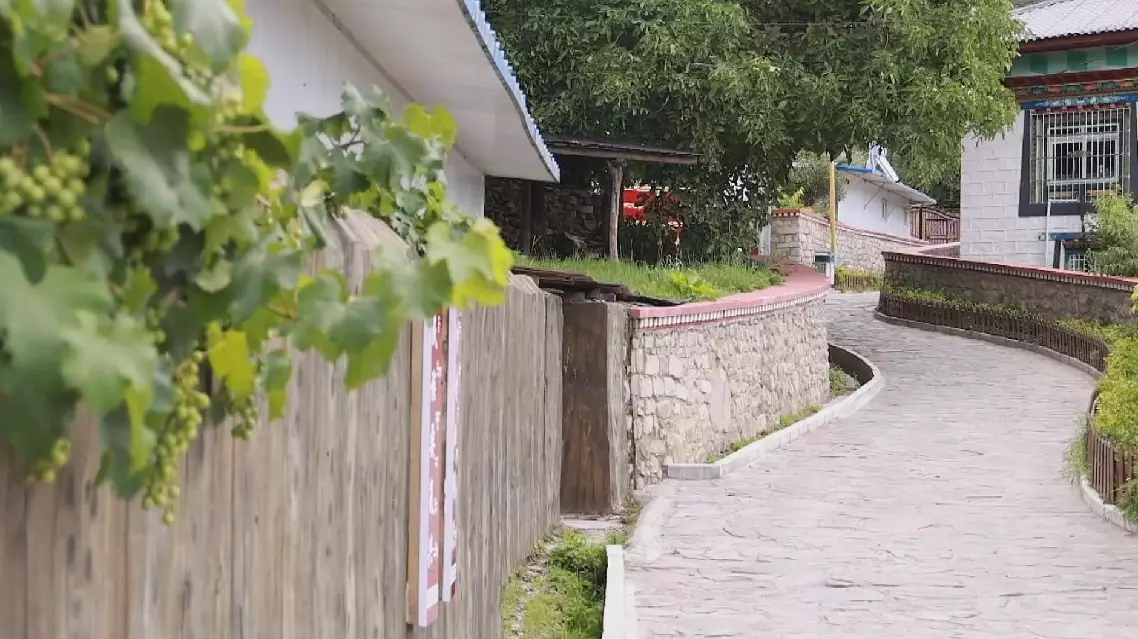
In Nyingchi City of southwest China's Xizang Autonomous Region, a remote mountainous village called Galai has blazed a trail of prosperity by leveraging its abundant natural resource of peach trees to promote a "peach blossom economy," benefiting both local development and ecological protection.

Reputed as the "Peach Blossom Village", Galai is famous for its peach blossoms covering the mountains and fields. Over recent years, Galai Village has significantly shifted from merely relying on the mountains for a living in the past to the current vigorous development of eco-tourism through the "peach blossom economy," boosting income for its villagers.

With a permanent population of only 149, the village received over 110,000 tourist visits savoring the peach blossoms in the travel season this year, with the revenue for scenic spot tickets and tourists' additional consumption topping 3.70 million yuan (about 515,300 U.S. dollars). The village used to face significant poverty, with villagers depending on logging, herding and barley farming for their income, which averaged under 2,000 yuan per capita (about 278 U.S. dollars) annually.

This transformation featuring the development of a "peace blossom economy" began in 2015, when paired-up assistance from south China's Guangdong Province helped the village to develop peach blossom-related tourism, setting the stage for its revitalization.

In 2024, the per capita disposable income in the village soared to over 40,000 yuan (about 5,570 U.S. dollars), with the village's total revenue reaching 14.02 million yuan (about 1.95 million U.S. dollars).

"Tourism income was minimal in the past, and the paths were merely muddy tracks. When I was a five-or-six-year-old child, we were using butter lamps for light. Now, the nights are just as bright as the days thanks to electric lights, and the village trails have also become clean and well-maintained," said Nyima Doje, a villager.

In July 2021, Chinese President Xi Jinping visited Xizang, where he put forward his expectations of advancing rural revitalization on all fronts.

This year, the villagers of Galai wrote a letter to Xi to report on the village's development and changes, and to express their gratitude and determination to forge ahead in creating an even better life.

In a reply letter on June 29 this year, Xi urged the villagers to uphold ethnic unity and create a happier and better life.

Xi also voiced his hope that the villagers will do an even better job in protecting the natural beauty of the plateau region, developing the village's tourist brand, and contributing to building into itself into a prosperous and stable border area.

Xizang, once characterized by extreme poverty and the highest poverty rate in China, had lifted all 628,000 registered impoverished people out of poverty by the end of 2019 largely due to the government's rural revitalization strategy.

In 2024, the per capita net income of those lifted out of poverty in Xizang increased by over 12.5 percent.
Remote mountainous village in Xizang gets prosperous thanks to 'peach blossom economy'

Remote mountainous village in Xizang gets prosperous thanks to 'peach blossom economy'

A former television host from Taiwan, Zhai Xuan, has made a pivotal decision to leave mainstream broadcasting in order to create content that provides a better understanding of the Chinese mainland and cross-strait relations.

Zhai, a seasoned television host with over a decade of experience in Taiwan's media landscape, recently addressed an audience at an event in Beijing, where she revealed her complete transition into independent online media.

In her remarks, she articulated her aspiration to bridge what she perceives as a significant information gap between audiences on both sides of the Strait, highlighting her commitment to fostering a deeper understanding and connection through her new endeavors.

"I was really surprised by all the fake news. There were stories saying people on the mainland can't afford tea eggs or that they live in mud houses and in Taiwan, this was the main information many people received," said Zhai.

Zhai said she initially began producing online videos to challenge such perceptions while continuing her work as a television host.

In April 2025, she travelled to the mainland with her father to fulfill her late grandfather's wish to return to his hometown. The trip, which reunited family members separated since 1949, was recorded in a video series titled "Journey to Find Our Roots", drawing attention from viewers in both Taiwan and the mainland.

"Many people in Taiwan told me that after watching, they wanted to apply for a mainland travel permit immediately and go looking for their relatives. Some had long forgotten these things, but after seeing my story, they began thinking about their hometowns and family members they had never met and decided to search for their roots," Zhai shared her story at the event.

By mid-2025, Zhai said she began to feel increasing pressure amid rising political tensions and a tightening atmosphere around cross-Strait exchanges in Taiwan.

After more than 12 years in the industry, Zhai resigned from her position, believing it was the right thing to do.

"At that moment, I felt this was a major issue,not just for me, but for Chinese people on both sides of the Strait. If I backed down then, I wouldn’t be standing on the right side," said Zhai.

Since leaving television, Zhai has broadened her online programming to encompass a range of daily-life topics, including practical guidance on applying for a mainland travel permit and using commonly employed mobile applications, in addition to content that delves into historical memory and cultural connections across the Strait.

As the debate over cross-Strait relations continues in Taiwan, Zhai said she remains committed to her current path.

Former Taiwan TV host bridges cross-Strait divide via online media

Former Taiwan TV host bridges cross-Strait divide via online media

Recommended Articles