Intelligent machines were tested for their precision, adaptability, and real-world applicability in a pharmacy-themed contest at the ongoing 2025 World Humanoid Robot Games in Beijing.
This year's event introduced the scenario simulation unit to assess how well humanoid robots perform in four real-world settings -- industrial, pharmaceutical, hotel and warehouse.
In the pharmaceutical scene on Friday, robots carefully separated pills and capsules from blister packs and sorted them into boxes. The focus was on the robots' ability to autonomously sort medication, a task demanding high levels of precision, control, and resistance to environmental interference like light reflection from blister packs.
On a mock nursing station, each competing robot was tasked with identifying and extracting capsules of different sizes, then placing them in designated compartments. Judges scored the robots based on how many pills were correctly sorted and how long they took. Higher points were awarded for autonomous execution without human intervention.
"This time, we adopted an autonomous approach. The programmer only needs to send a single instruction to the robot, and from there, it takes care of recognition, extraction, and packaging all by itself," said Liu Tianyu, contestant.
Several teams focused on enhancing the image recognition systems of their robots to deal with the reflective aluminum surfaces of medicine strips. Others worked on fine-tuning robotic arm precision to better mimic human hand movements.
"We developed a smooth operation algorithm that can send up to 60 signals per second. That lets us send highly accurate commands to the robot arm, allowing it to apply just the right amount of force to separate tablets efficiently and drop them perfectly onto the surface," said Zhou Yutian, contestant.
"This competition has shown us the value of lightweight dual-arm collaborative robots. In areas that require highly delicate actions, these machines could play a major role," said Shen Haitao, a contestant.
The 2025 World Humanoid Robot Games opened in Beijing on Thursday, featuring 280 teams from 16 countries competing in 26 events at the National Speed Skating Oval from Friday through Sunday.
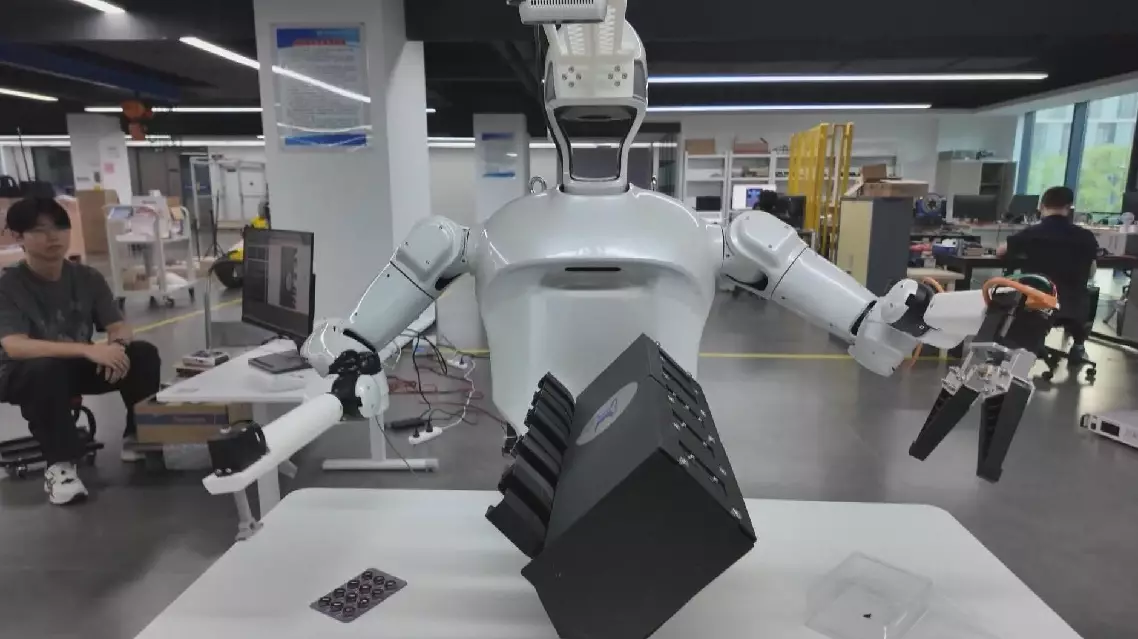
Robots tested for precision, adaptability, real-world applicability at 2025 World Humanoid Robot Games