"Avatar: Fire and Ash," the third installment in the "Avatar" film series, will be the culmination of the story told across the second and third films, director James Cameron told China Central Television (CCTV) in an interview on Monday.
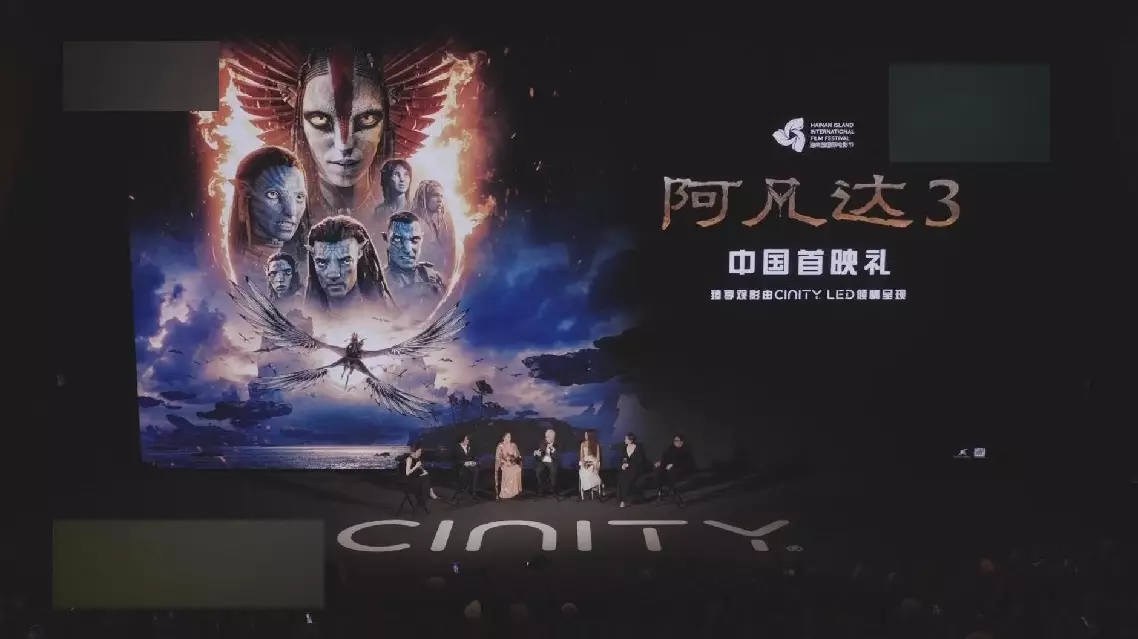
The much-anticipated sci-fi epic had its Chinese premiere at the 7th Hainan Island International Film Festival in Sanya, in south China's Hainan Province, on Monday. It is scheduled for simultaneous release in the Chinese mainland and North America on December 19.
As the latest installment in the highest-grossing film series of all time, it boasts a runtime of 195 minutes, making it the longest entry in the franchise to date.
"Avatar: Fire and Ash" began shooting simultaneously with "Avatar: The Way of Water." Cameron said the two sequels together bring the story to its final climax, adding that there might be no further sequels. "I think they're a continuation of the overall story. So in movie one, we introduced this world and the two main characters of Jake and Neytiri. And then in movie two, we took you out of the rainforest, we took you to the ocean, we saw an equally beautiful, but very, very different part of the planet and a whole different culture. We introduced a whole number of new characters, not just the children of the Sullies, but a whole other set of new characters in the reef community, which we call the Metkayina, the reef people. And now in this film, we introduce yet another two new cultures: the wind traders, who are the traveling kind of nomadic caravan of the sky, and they're just fun. And then obviously the Ash People, who are not fun. So I've been working in the Avatar universe more or less for the last two decades. And this feels like a culmination of that. So movie two and three together form one big story, which ends with this film. And we may start another story or we may not," he said.
The legendary director also explained the significance of the film's title, saying the theme of the third sequel draws on real-world experiences of loss and trauma, reflecting a global reality marked by hatred and violence.
"The story that we are telling of the Sully family continues in movie three, Avatar 3. And they've just had a tragic loss of their eldest son in the battle, so they are reeling from that, they are dealing with that. And so the idea was to make the movie thematically relevant, because we've got a lot of hatred and a lot of dislocation and refugees on the move around the world. We are in a period of kind of dark times. So the theme of the movie is that the violence is propagated by the sense of loss and the sense of trauma. We see that with the Ash People, and we see it with Neytiri. She becomes very dark and full of hate as a result of their loss. So fire represents hatred, loss, violence, chaos, things like that," he said.
Speaking about the importance of family and kinship in the "Avatar" series, Cameron said "Avatar 3" centers on the emotional strain faced by a family as its bonds are put to the test.
"We see the bonds of the family tested. So in the previous films, the enemy has been outside. Now, I don't want say there's an enemy inside the family. There isn't, but the family's bonds are tested. We see them sort of falling apart. Can they pull themselves back together? I like happy endings. It's not a question of if they can, it's a question of how they do it," he said.
Known for pushing the boundaries of film technology and for combining cutting-edge film technology with classical filmmaking techniques, Cameron told CCTV that the new "Avatar" film is among the most expensive ever made, with an estimated production cost of about 400 million U.S. dollars, driven largely by the scale and complexity of its visual effects.
"I think the breakthrough really was in the faces and in the characters, in preserving every bit of performance that the actors created. You could see side by side a video of the actor and the finished render, you would see that nothing is lost. This is their work. Exactly, it's not something created later by animators. It's tremendous amount of work in post production to do 3,500 shots, 3,500 visual effect shots. That's what takes the time. To create that kind of dream state that you have in the movie, which is kind of like a waking dream or a lucid dream, that takes an enormous amount of time to get that level of photo realism in the VFX," he said.
Cameron also commended Oona Chaplin for her impressive acting skills in the new sequel, in which she portrays Varang, a leader of the Ash People.
"It's hard for me to be surprised when I work with some of the best actors I've ever worked with in my life, but I was working for the first time with Oona Chaplin, and she was a very, very pleasant surprise for all of us, because she did an absolutely remarkable performance as Varang. She is a very well-trained actor, and she brought a wonderful performance to this new character, and everybody seems to be responding to her," he said.
Avatar 3 marks story's culmination: director