Fishing boats returned to the coastal port in Yangjiang, south China's Guangdong Province, in the early hours of Sunday, bringing in the season's first batch of seafood from the South China Sea.
As dawn broke over the Zhapo fishing port in Yangjiang City, the first fleet of fishing vessels returned home, marking the start of the new fishing season in the South China Sea.
The bustling pier was filled with voices and activity as workers swiftly unloaded piles of freshly caught crabs, squid, prawns, and a variety of fish straight onto the docks.
"These are usually sold to the Pearl River Delta region. They were caught last night and sold this morning, really fresh and beautiful," said a seafood wholesaler surnamed Feng.
Local consumers were also quick to seize the opportunity to purchase seafood directly from the boat.
"I came to get some crabs and prawns. It's all first-hand supply," said a local consumer surnamed Lin.
The scene also drew curious out-of-town visitors, eager to experience the excitement of the first seafood landing.
"I bought some jumbo prawns. They're big and super fresh," said a tourist surnamed Luo from Foshan, Guangdong.
Some tourists didn't wait long to enjoy their purchases, handing them straight over to nearby food stalls for immediate cooking.
"I got here last night and came straight to the pier this morning looking for good seafood. The prawns are large and really worth the price," said a tourist surnamed Li from Guangdong's Jiangmen.
According to the local fishery authority, the boats arriving on Sunday were all operating in nearshore waters, and many more vessels are expected to return from deeper seas in the coming days.
"More than 20 boats came back today alone. The market is booming. Supply can't keep up with demand right now, but prices will likely drop as more boats return," said Lin Guozhong, president of the Yangjiang Fisheries Association.
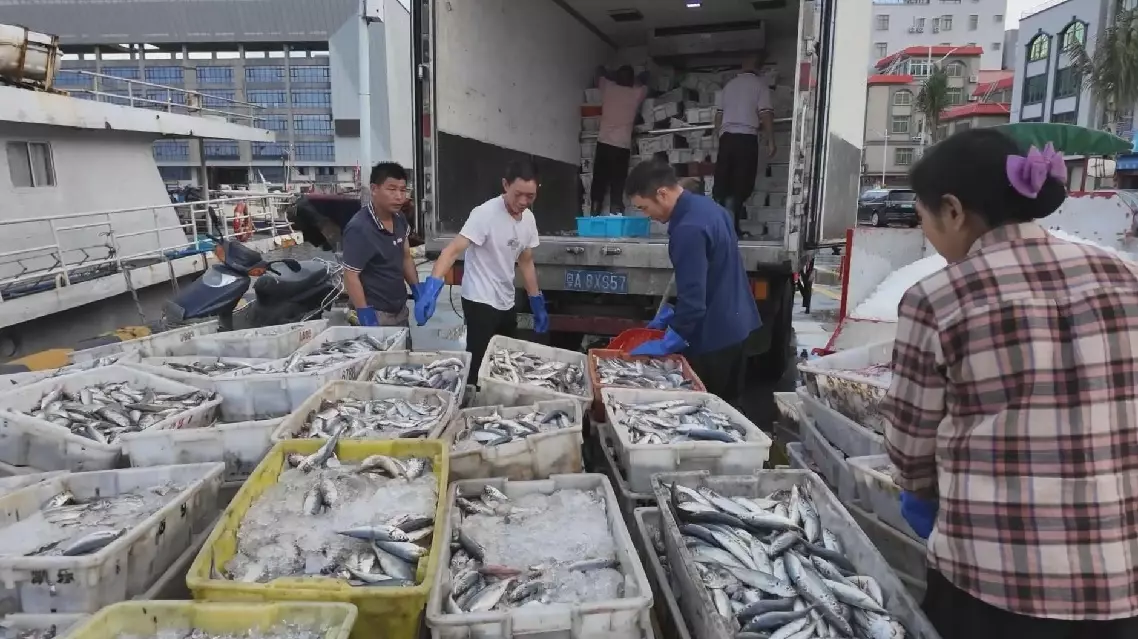
1st batch of seafood from South China Sea lands in Guangdong after fishing moratorium
A beneficial international environment helped boost the development of China's auto industry, and achieving common prosperity with the host countries should be a principle for Chinese auto companies to go overseas, said Li Shufu, chairman of China's leading automaker Geely Holding Group.
Li made the statement in an interview with China Global Television Network (CGTN) in Hangzhou, capital of the eastern province Zhejiang, where Geely is headquartered.
He said that besides the existence of a beneficial international environment, a large inflow of global investment also significantly contributed to boosting China's auto industry in the early years of its development.
"Most importantly, the international environment brought about the opportunities for development and China seized these opportunities. Against this backdrop, international capital, talent and technology, as well as global automotive players, came to invest and develop business in China. Additionally, both upstream and downstream industrial chains also set up operations, made investment and pursued development in China. The national policies were also inclusive and were aimed at expanding opening up, allowing enterprises such as Geely to participate in the development of the automotive industry. The inclusive national policies helped boost the development of China's auto industry," Li said.
"Later on, China's auto industry drew more private and foreign capital. Driven by vigorous competition among all players, the entire industrial chain gradually became China-based, and an ecosystem took shape across the sector," he said.
Li said that over the past few decades, as China's auto industry pursues intelligent and electric transformation, strong supports have been given by both central and local governments.
"Especially over the past decade and more, the Chinese government has offered unprecedented support for intelligent and electrified transformation of the auto industry. I think, few governments around the world have ever given the sector such strong support, and they have been given by both central and local governments. It is because of all these forces that China's auto industry has become what it is today," he said.
Li said that as more and more Chinese automakers choose to set up operations in overseas markets, achieving shared prosperity with the host countries become increasingly critical.
"If Chinese automakers want to go abroad, they must pursue localization, whether entering Europe or other markets. Based on my experience and the lessons I have learned, Chinese brands must deliver prosperity to the local economy, boost local employment, and support the host country's sustainable development," he said.
"As Chinese enterprises expand overseas, they must act in a friendly, law-abiding, compliant, fair and transparent manner. They should not only fulfill social responsibilities and advance corporate sustainable development, but also help generate good economic development, thereby achieving shared prosperity and win-win growth with the host countries. I believe this is a fundamental prerequisite for Chinese auto companies to pursue localization and to compete globally," he noted.
"If we are friendly and cooperative, the host countries can feel that we come to extend support and make contribution, rather than exploit or fight with them," according to Li.

Chairman of China's leading automaker speaks on industry development, overseas market strategy