U.S. stocks ended slightly lower on Friday, as the market grappled with heightened volatility in the bond market and renewed uncertainty regarding the future leadership of the Federal Reserve.
The Dow Jones Industrial Average declined 83.11 points, or 0.17 percent, to 49,359.33. The S and P 500 slipped 4.46 points, or 0.06 percent, to 6,940.01, and the Nasdaq Composite Index lost 14.63 points, or 0.06 percent, to 23,515.39.
Performance across the 11 primary S and P 500 sectors was divided. Real estate and industrials were the top performers, advancing 1.2 percent and 0.65 percent, respectively. Healthcare and communication services sectors led the declines, falling 0.84 percent and 0.72 percent.
Intraday market pressure intensified following remarks by U.S. President Donald Trump suggesting that National Economic Council Director Kevin Hassett, previously considered a top contender for the Fed chairmanship, might remain in his current role instead of succeeding Jerome Powell. This potential shift in the expected succession timeline triggered a dip across the three major benchmarks.
The announcement also sent ripples through the bond market. The yield on the benchmark 10-year U.S. Treasury notes climbed to 4.23 percent, which marks the highest level since early September, reflecting investor anxiety over central bank independence and the implications of recent mixed inflation data.
Despite the volatility, some market analysts noted a degree of underlying resilience. Analysts at ING pointed out that fears of a radical shift in Fed policy have yet to materialize, noting that even Trump-appointed governors have not pushed for aggressive interest rate cuts. Investors are also closely watching a legal battle involving Fed Governor Lisa Cook, which is scheduled to go before the U.S. Supreme Court next week.
In corporate news, the first week of the fourth quarter earnings season concluded for regional lenders with divergent results. PNC Financial saw its shares climb 3.79 percent on the back of strong advisory fees and robust dealmaking activity. Conversely, Regions Financial fell 2.63 percent after the bank issued disappointing guidance and reported quarterly results that missed analyst expectations.
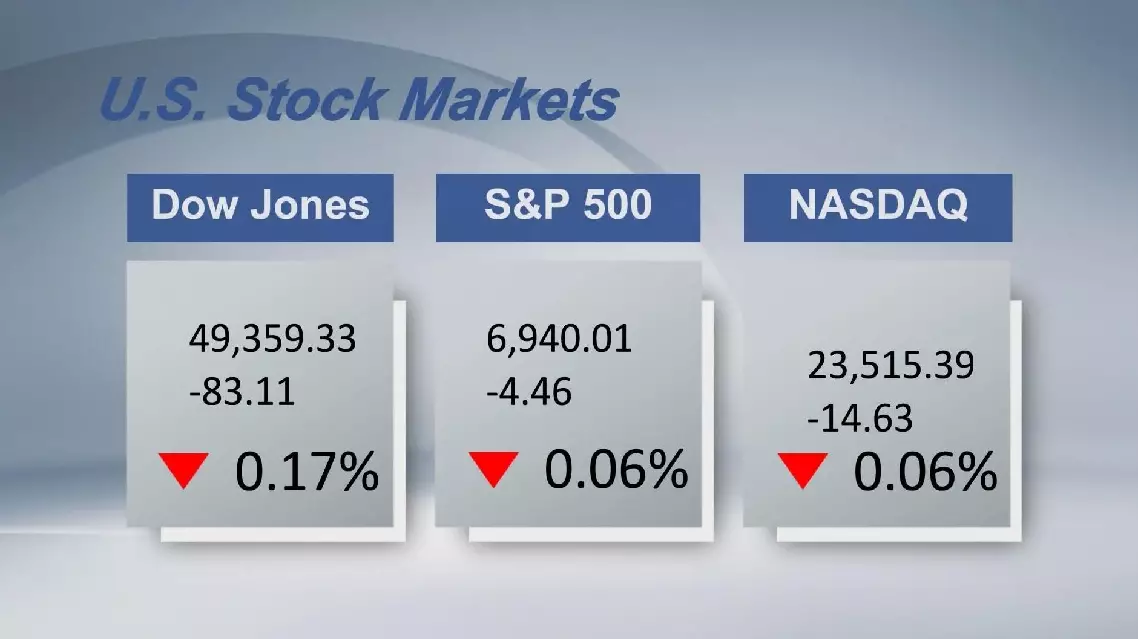
U.S. stocks decline amid Fed leadership uncertainty
China's securities regulator has pledged to prioritize market stability and resolutely prevent sharp fluctuations as a core objective for 2026, aiming to consolidate sound development of the capital market.
The China Securities Regulatory Commission (CSRC) made the commitment at its annual work conference on Thursday, where the regulator reviewed the past year's performance and outlined key tasks for 2026.
In 2025, listed companies distributed a combined total of 2.68 trillion yuan (about 380 billion U.S. dollars) in cash dividends and share buybacks throughout the year, further consolidating the momentum for high-quality development.
Initial public offerings (IPOs) and follow-on offerings reached a combined 1.26 trillion yuan, while the exchange bond market issued various bonds totaling 16.3 trillion yuan.
Eighteen futures and options products were smoothly listed, demonstrating the robust functioning of the multi-tiered capital market.
The meeting emphasized that while the capital market currently shows stable and sound performance, it still faces complex and severe challenges posed by intertwined domestic and external risks as well as the overlapping of persisting and emerging issues.
Efforts will be made to effectively enhance the intrinsic stability of the market, the CSRC said, adding that it will rigorously investigate and punish excessive speculation, market manipulation, and other illegal activities to prevent sharp market fluctuations.
It will work to foster a market ecosystem where "long-term capital engages in long-term investment," the regulator said, pledging efforts to broaden the channels for medium and long-term capital inflows, introduce various products and risk management tools suited to long-term investment, and actively guide long-term, rational and value-based investment.
It also vowed to enhance the inclusiveness and adaptability of the multi-tiered equity market, crack down on illegal activities such as financial fraud, price manipulation and insider trading, and enhance corporate governance among listed firms.
The CSRC will advance the two-way opening up of the capital market in 2026.
Efforts will be made to expedite the implementation of the optimized Qualified Foreign Institutional Investor scheme, expand the scope of futures products accessible to foreign investors, and enhance the facilitation of cross-border investment and financing, the regulator said.
China's securities regulator stresses market stability in 2026 work plan