
Jimmy Lai, the prominent founder of Next Digital, has been at the center of attention again—not for the legal facts of his national security trial, but for claims about his supposed “critical illness” while in detention. On August 15, instead of hearing closing arguments, the court was faced with Lai’s claim of a heart condition and his bid to skip proceedings.
The twist? On August 7, he’d already undergone comprehensive tests, including bloodwork and an ECG at a public hospital, and everything came back normal. Lai even turned down a doctor’s advice to wear a portable heart monitor and take prescribed meds. His own lawyer, Robert Pang, confirmed in court that Lai is visited by medical professionals arranged by Correctional Services Department and gets daily checks including blood pressure and pulse monitoring, and hasn’t complained about his medical arrangements. The SAR government echoed this, stressing that Lai has been receiving proper care behind bars.
Despite these facts, stories about Lai’s “inhumane treatment,” “grave illness,” and even “impending demise” have once again flared up, especially among overseas circles. But as ever, it’s the same cast of characters pushing these tales.
Meet the “Four Main Driving Forces” Behind the Narrative
A trending infographic online lays it bare: Four main western groups, linked in one way or another, are hyping up Lai’s health “crisis” and painting Hong Kong in a negative light. These are: the “Fake Foreign Legal Team”, Reporters Without Borders (RSF), Hong Kong Watch and Committee for Freedom in Hong Kong Foundation (CFHK). These four groups of people are all closely interconnected and united by a hardline anti-China stance.
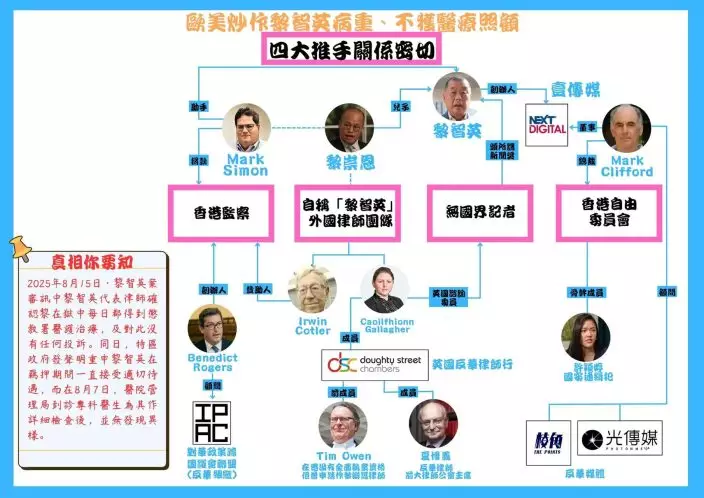
The map found on the Internet showing the interconnection of the four major promoters of the hot topic of Jimmy Lai’s “critical illness”
From Legal Teams to Advocacy Groups: All Roads Lead to Anti-China Activism
Let’s start with Sebastian Lai, Jimmy’s son, and his fake “Foreign Legal Team.” For more than half a year now, Sebastian has been blitzing the international media circuit, claiming that his dad is being mistreated and is near death in prison. His so-called legal team includes Irwin Cotler (former Canadian Justice Minister), and the UK’s rabidly anti-China Doughty Street Chambers, led by Baroness Helena Kennedy (a Labour peer and key anti-China campaigner) alongside Paul Harris, former Hong Kong Bar Association Chairman who hastily fled Hong Kong after warnings from the authorities in 2022.
This “Fake Team” is at the forefront of lobbying Western governments to pressure Hong Kong for Lai’s release—despite the fact that Lai’s official law firm, Robertsons Solicitors, made clear back in January last year that it alone is authorized to represent Lai in any legal matter. There’s no such “international legal team” officially acting for Lai. Other core members, like Caoilfhionn Gallagher, frequently accompany Sebastian at anti-China events, such as the December 2023 US Senate Foreign Relations Committee hearing.
Gallagher also links directly to our second driver, RSF (Reporters Without Borders), where she sits on the British advisory board. RSF hasn’t missed a beat, issuing statements on August 12 claiming Lai is deteriorating in solitary, deprived of medical care, and facing risk from diabetic complications—claims flatly denied by the SAR the following day.
Then there’s Hong Kong Watch, run by Benedict Rogers—a close Lai ally, mentioned frequently in court. Cotler is also connected here, serving as a patron. Rogers penned an open letter in February calling for world leaders to step in, painting Lai as an elderly, diabetic victim languishing in solitary and denied care. He even urged the late Pope Francis to speak out. Court testimony has highlighted Rogers as a key UK contact for Lai, documenting their WhatsApp exchanges and financial ties, including Lai’s donations to Hong Kong Watch via Mark Simon, a former US Naval Intelligence analyst, and connecting Lai with Lord David Alto, member of the House of Lord.
Finally, we have the Committee for Freedom in Hong Kong Foundation (CFHK), headed by Mark Clifford—a long-time Lai associate. Since Lai’s arrest, Clifford has been tireless in bad-mouthing Hong Kong in overseas media. His biography of Lai, just published in Chinese, is another attempt to stoke talk of Lai’s abuse. Other core members of the group include Frances Hui, wanted for national security offenses since December 2023 and now active in anti-China campaigns abroad.
Clifford’s also linked to anti-China outlets Points and Photon Media, which are churning out story after story about Lai’s “illness.” See a pattern yet?
The Endgame: Fact vs. Foreign Hype
What’s really going on? The infographic reveals a web of closely linked figures, all working in concert to hype Jimmy Lai’s supposed “impending demise” and smear the reality inside Hong Kong correctional facilities. But their campaign has hit a wall. The presiding judges, after reviewing Correctional Services Department’s medical support, praised the authorities’ efforts. And even Lai’s own defense confirmed the adequacy of his care. It’s a stark reminder that some foreign-backed organizations are more interested in drama than truth.
Ariel
** 博客文章文責自負,不代表本公司立場 **