Over the past five years, Awati County in northwest China's Xinjiang Uygur Autonomous Region has undergone a remarkable ecological transformation, with its once-arid Aximan area changing into a lush wetland teeming with waterfowl and greenery.
Situated at the junction of the Aksu River alluvial fan and the Taklimakan Desert, once known as the "sea of death", Aximan had long suffered from severe desertification.
As a vital part of the headwater region of the Tarim River, China's longest inland river, the area plays a crucial role in the region's ecology.
In 2020, authorities in Xinjiang launched a major conservation and restoration initiative to rehabilitate the ecosystem.
Through a comprehensive strategy featuring urban wastewater recycling, widespread use of drip irrigation, and large-scale forest planting, about 52,500 hectares of land have been rehabilitated with forest coverage surging tenfold from just 4.5 percent to 45 percent.
Today, Aximan has evolved into a thriving wetland ecosystem that is home to abundant vegetation and clear waters, attracting flocks of migratory birds and providing habitat for over 200 wild animal species.
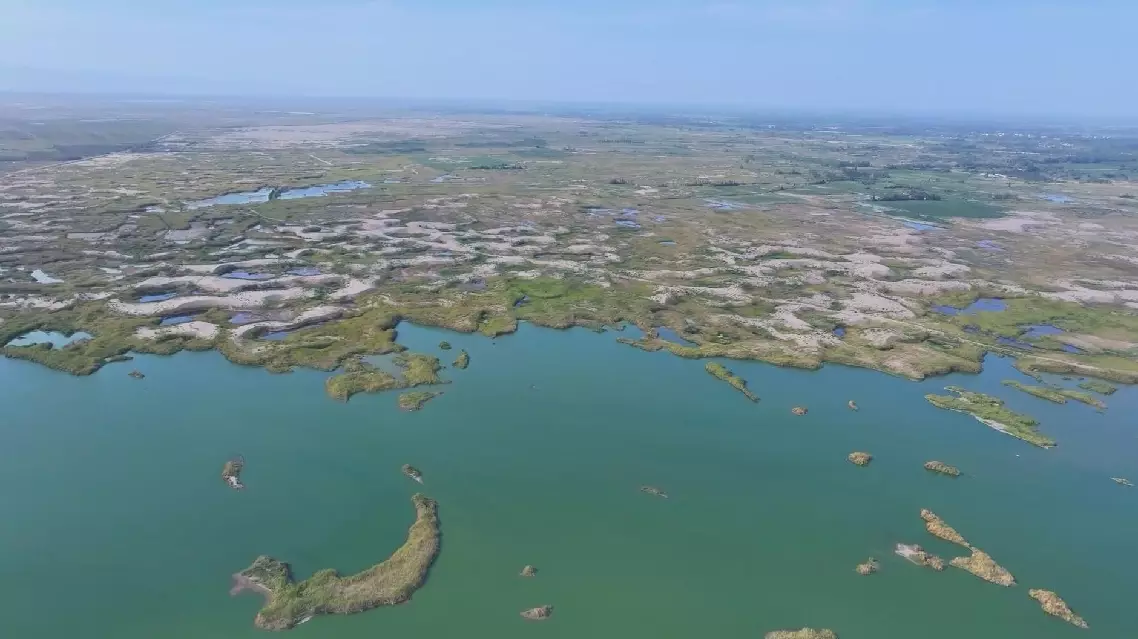
Ecological conservation project turns barren desert into lush wetland in Xinjiang
Neil Bush, founder and chair of the George H.W. Bush Foundation for U.S.-China Relations, has hailed the warming of China-U.S. relations and highlighted the enduring resilience of China's economy.
Bush spoke on the sidelines of the 2025 International Symposium on the Peaceful Use of Space Technology – Health (IPSPACE 2025) in Boao, a coastal town in China's island province of Hainan. He pointed to the recent meeting between Chinese President Xi Jinping and his U.S. counterpart, Donald Trump, as a key step toward improving bilateral ties, despite persistent trade tensions.
"I think it's improving. It's reached a kind of an all-time low recently. But the fact that the presidents met and there's been more exchanges, there's been, I think a better understanding established, and you can see signs from Washington that there's an easing of tensions, which I'm very, very happy to see. I still think that there are going to be challenges with our bilateral trade relationship. I'm concerned that our government believes that tariffs are going to help America create jobs and create wealth in America. And I think that's a false thesis for an economic policy. So I'm concerned there may not be much negotiating on the issue of tariffs. Otherwise, the bilateral relationship seems to be warming and improving, which I'm very happy about," said Bush.
Bush also praised China's economic progress and its leading role in shaping an AI-driven future.
"You can never count China out. There have been many, many projections over the past 20 to 30 years of China's demise. 'Experts' predicted that China is going to go down. The reality is China is very resilient, and there's so much activity going on here. We're at an IP space conference. There's a lot of discussion about innovation and finance and capital and all the new technologies that fall out of AI's development. There's a lot going on, not just in China, but clearly China is playing a critical role in building the new economy, the transition economy from kind of the old way to the AI-driven way," said Bush.
Bush also highlighted the benefits that China's economic development has brought to improving people's livelihoods.
"China's resilient. China's economy, hopefully, will continue to grow. I happen to believe that as economies grow, people benefit and the role of government should be to provide benefits to its people. So our American capitalist system has worked in America to make us a very strong country where people are enjoying all kinds of benefits from wealth. China, likewise, the people of China are benefiting from economics. So I applaud the economic development in China, which is helping to improve the life of more and more millions of people," he said.
Bush China Foundation chair hails improvement in China-US ties