More than a decade of intense ecological efforts have helped transform a once-barren county in northwest China's Xinjiang Uygur Autonomous Region into a vibrant oasis which now attracts wildlife and visitors from afar.
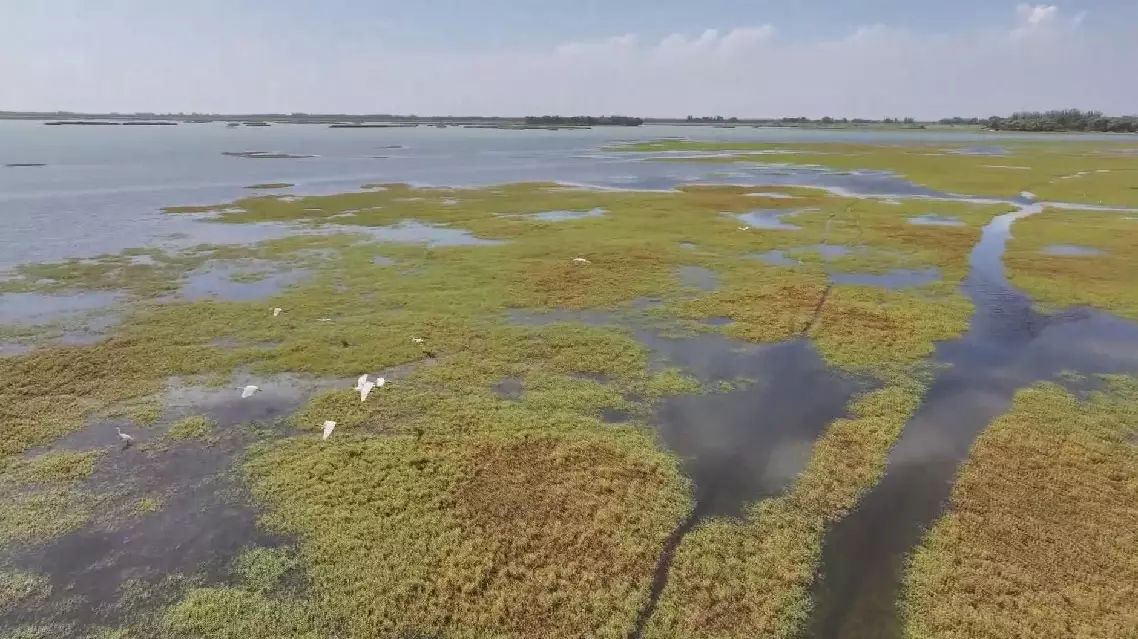
Situated on the western rim of China's Taklamakan desert, Xinjiang's Makit County has turned more than 1,500 hectares of shifting sand into a bird-thronged lake ringed by lotus plants and trees.
Now, the stunning scenery at the Daolang Qiandao Lake scenic area is drawing ever-larger crowds of visitors keen to soak up its tranquil setting and pleasant green surroundings.
In 2013, leveraging ecological water releases from the Yarkant River and rising groundwater, engineers excavated a chain of lakes on low-lying salt marsh, creating a 15-square-kilometer lake with a storage capacity of 30 million cubic meters.
After years of ecological management and science-based development, more than 30 species of water birds including swans and egrets have made this place their home.
Once a realm of drifting sand, the area has become a beautiful ecological landscape, and as the lake's renown grows, it has already provided employment for 30 residents from the surrounding villages.
"When we first arrived, there was nothing here. We dug the ponds and built the roads ourselves. Once the environment improved, birds started coming. The better environment has also brought nearby farmers more income," said Chen Jianjun, the head of the scenic spot.
"It used to be a place of wind and sand, but now there's plenty of water. More and more visitors are coming. We have a steady income and life is getting better," said another local man.
Ecological efforts turn once-barren Xinjiang desert into vibrant oasis
China has been accelerating its pace of green development in recent years under the visions laid out by Chinese President Xi Jinping, with residents across the country hailing the positive impact of the changes which have already taken place and are being seen in everyday life.
Guided by Xi Jinping Thought on Ecological Civilization, China has set its sights on achieving a comprehensive green transition, and is making concerted efforts to advance this agenda. Green development is also among the key objectives of the country's 15th Five-Year Plan (2026-2030), a key blueprint mapping out the main development priorities for the coming years ahead.
The green foundation of high-quality development is becoming increasingly distinct while forming a new vision of the "Beautiful China" initiative, where humanity and nature coexist in harmony. It comes as part of wider efforts to modernize the country's ecological environment through a comprehensive transition to green production, promoting low-carbon lifestyles, and undertaking large-scale nature restoration. In Rui'an City of east China's Zhejiang Province, the once heavily-polluted Wenruitang River has been transformed into a beautiful waterway weaving through the city, which will serve as a stage for boat races during the upcoming Dragon Boat Festival period and remains a popular leisure spot for local residents year round.
"We used to avoid walking along the riverbank, but now it is lush with greenery and the water is crystal clear. The best scenery is right outside our front door," said local resident Jin Xiongguang.
Since the 18th National Congress of the Communist Party of China (CPC) in 2012, President Xi, also general secretary of the CPC Central Committee, has always stressed the need for ensuring the sustainable development of the Chinese nation and the progress of human civilization as a whole, and established green development as a key component of the new development philosophy.
As China's economy transitions from a phase of high-speed growth to a phase of high-quality development, Xi has put forward a series of strategic proposals on the comprehensive transition to green and low-carbon economic and social development. He emphasized the need to properly balance economic development with ecological and environmental protection, and to firmly establish the concept that protecting the ecological environment is tantamount to protecting productive forces and vice versa.
Xi also personally directed the integration of carbon peaking and carbon neutrality into the overall framework of economic and social development and the construction of an ecological civilization, and called for the establishment of a sound economic system for green, low-carbon, and circular development to drive the comprehensive green transformation of economic and social development.
Analysts say that this approach has set a key example to the rest of the world of the need to face these challenges head on. "Addressing climate change through a comprehensive green transition and working together to build a clean and beautiful world demonstrates Xi's global vision and sense of responsibility as a major country's leader. It also contributes Chinese wisdom to the sustainable development of human civilization," said Huang Chengliang, head of a research center for Xi Jinping Thought on Ecological Civilization under the Chinese Academy of Social Sciences.
Guided by Xi Jinping Thought on Ecological Civilization, China has accelerated its transition toward a green and low-carbon economy, showing continued improvement in its ecological environment.
Over the past 10 years, the proportion of surface water with a good quality rating surpassed 90 percent for two consecutive years, while water quality in the main stems of the Yangtze River and the Yellow River has remained stable at Class II, the second highest in China's five-tier water quality rating system.
Meanwhile, the last decade has seen the national average PM2.5 concentration fall by 33.3 percent, and the proportion of days with good or excellent air quality has reached 88.1 percent, the highest level since official monitoring began.
In the same period, China has also contributed to a quarter of the world's new green space, with its total forest coverage now exceeding 25 percent.
These positive changes in the ecological environment are inextricably linked to the green transformation of the country's main production methods in recent years.
The development of offshore wind power and photovoltaic bases in China continues to accelerate and the installed capacity of solar power is expected to surpass that of coal-fired power for the first time in 2026.
Work is also ongoing to accelerate the green transformation in the industrial and agricultural sectors. Starting this year, the focus is shifting from "energy consumption control" to the more precise "carbon emissions control."
Construction of 52 national-level zero-carbon industrial parks is being expedited, and green factories and industrial parks are evolving from pilot projects into powerful clusters.
Today, more people up and down the country are increasingly pursuing more green lifestyles on a daily basis.
Fifteen Chinese provinces and municipalities have achieved zero landfill for daily solid waste, and 27 provinces have introduced carbon incentive policies.
The idea that people should all work together to protect the environment by starting with small actions in daily life, such as choosing eco-friendly transportation, conserving electricity and water, finishing meals, reducing the use of single-use items, and recycling and reusing old items has become a social consensus.
"We take the subway when going out, bring a reusable bag when grocery shopping, and turn the air conditioner up by one degree. These small actions all represent changes. As the environment around us improves day by day, our life also becomes more comfortable. This sense of happiness is something we can see and feel," said Wang Yan, a resident of Guangzhou City in south China's Guangdong Province.
China is using carbon peaking and carbon neutrality as a driving force to advance carbon reduction, pollution control, ecological restoration, and economic growth in a coordinated manner. Through tangible achievements in building a beautiful China, the country is striving to write a new chapter in Chinese modernization characterized by harmony between humanity and nature.

China accelerates green development under Xi's guidance