The sixth trilateral foreign ministers' dialogue among China, Afghanistan and Pakistan was held in Kabul, Afghanistan, on Wednesday.
Chinese Foreign Minister Wang Yi, also a member of the Political Bureau of the Communist Party of China Central Committee, Afghan Foreign Minister Amir Khan Muttaqi, and Pakistani Deputy Prime Minister and Foreign Minister Mohammad Ishaq Dar attended the meeting.
During the talks, Wang said that since the trilateral foreign ministers' dialogue mechanism was restarted in 2022, the three parties have adhered to the principles of mutual respect, equal consultation and mutual benefit, continuously advancing cooperation in the fields of politics, development and security, safeguarding regional peace and stability, and addressing various risks and challenges.
He said China has proposed the important concept of building a community with a shared future for mankind, as well as the Global Development Initiative, the Global Security Initiative and the Global Civilization Initiative, which provide important guidance for the three countries to jointly build a beautiful home and lay the foundation for security.
Wang said China is willing to deepen trust with Afghanistan and Pakistan, mutually understand and support each other on issues involving each other's core interests, firmly oppose any external forces interfering in this region, and firmly oppose any organization or individual engaging in activities within their own territories that harm each other's national sovereignty, security and territorial integrity.
He pointed out that China and Pakistan have taken the lead in the international community and among regional neighbors in assisting Afghanistan with its stabilization and reconstruction efforts, as well as with the expansion of its foreign relations.
China will continue to advocate for Afghanistan's interests in multilateral forums, promote constructive engagement and exchanges between the international community and Afghanistan, and support Afghanistan's efforts to normalize its diplomatic relations, Wang said.
He said that the three parties should expand development cooperation, improve security dialogue mechanisms, deepen law enforcement and security cooperation, strengthen efforts to combat transnational terrorist activities, and address the root causes of terrorism through comprehensive measures based on consensus.
Muttaqi and Dar praised the positive progress achieved by the trilateral foreign ministers' dialogue mechanism and commended China's contributions to promoting trilateral cooperation.
Muttaqi said that Afghanistan hopes to deepen friendly relations, strengthen coordination and cooperation, and promote greater development of trilateral cooperation.
Dar said trilateral cooperation has enormous potential and should be strengthened across various fields to achieve common development.
As Afghanistan's neighbor, Dar said, Pakistan is willing to make greater contributions to advancing the Afghan peace process and improving the livelihood of the Afghan people.
Pakistan called for the release of frozen Afghan overseas assets, said Dar. He also called on the three sides to jointly combat all forms of terrorist activities, including cross-border terrorist attacks.
The three sides agreed to fully use the trilateral foreign ministers' dialogue mechanism, strengthen exchanges and cooperation across all fields, and promote regional peace, stability, development and prosperity.
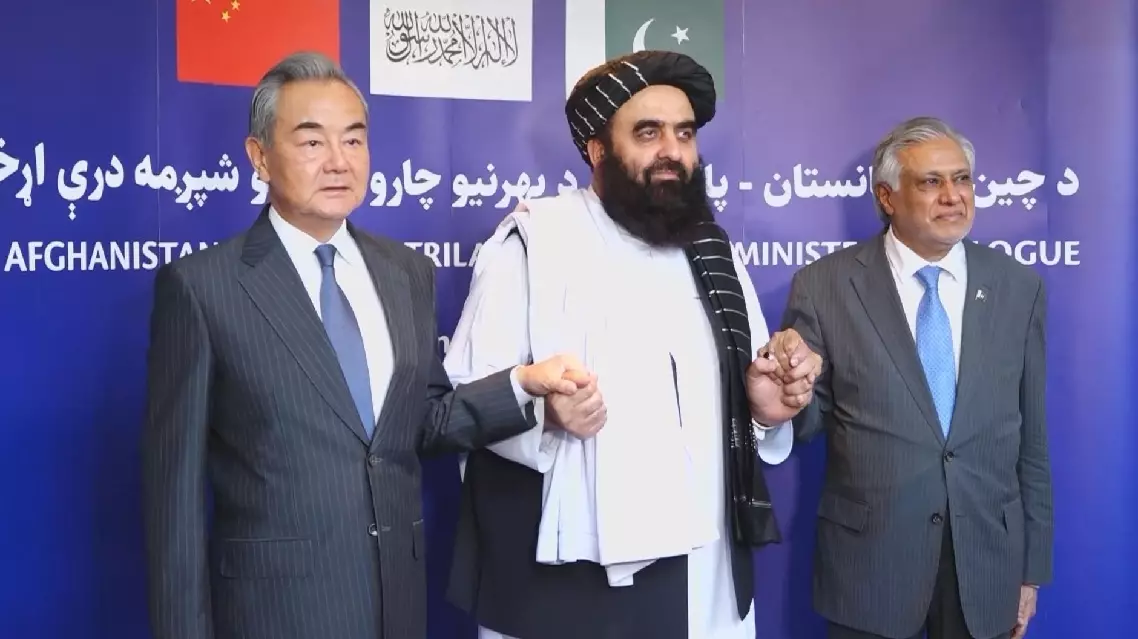
China-Afghanistan-Pakistan foreign ministers' dialogue held in Kabul