Skip to Content Facebook Feature Image

Judge says former Trump lawyer Alina Habba has been unlawfully serving as US attorney in New Jersey

News

Judge says former Trump lawyer Alina Habba has been unlawfully serving as US attorney in New Jersey
News

News

Judge says former Trump lawyer Alina Habba has been unlawfully serving as US attorney in New Jersey

2025-08-22 07:16 Last Updated At:07:20

A federal judge ruled Thursday that President Donald Trump’s former lawyer, Alina Habba, has been unlawfully serving as the the top federal prosecutor in New Jersey since last month.

U.S. District Judge Matthew Brann held that Habba’s term as the interim U.S. attorney ended in July, and the Trump administration’s “novel series of legal and personnel moves” to keep her in the role without getting confirmation from the U.S. Senate didn’t follow procedures required by federal law.

“Faced with the question of whether Ms. Habba is lawfully performing the functions and duties of the office of the United States Attorney for the District of New Jersey, I conclude that she is not,” wrote Chief U.S. District Judge Matthew Brann wrote.

The judge said Habba's actions since July “may be declared void," though he put his order on hold so the Justice Department could appeal.

It wasn’t immediately clear if that meant Habba would remain in charge of the U.S. attorney’s office temporarily, or who would make key decisions in the prosecutor's office if she was sidelined. A message seeking comment was sent to Habba’s office.

In a social media post, Attorney General Pam Bondi said the administration would appeal, saying Habba was “doing incredible work in New Jersey — and we will protect her position from activist judicial attacks.”

If upheld, the ruling could lead to challenges against a handful of other U.S. attorneys who have been similarly installed by the Trump administration without Senate approval after their temporary assignments have expired.

At its core, Brann’s opinion took aim at the administration's strategy of using a string of temporary appointments to allow Trump's favored candidates to bypass the usual requirement that U.S. attorneys be confirmed by the Senate — something that requires a degree of bipartisan support.

“Taken to the extreme, the President could use this method to staff the United States Attorney’s office with individuals of his personal choice for an entire term without seeking the Senate’s advice and consent,” wrote Brann, a Republican appointed to a federal court in Pennsylvania by President Barack Obama.

Brann’s decision came after several people charged with federal crimes in New Jersey challenged the legality of Habba's tenure. They sought to block the charges against them, arguing Habba didn’t have the authority to prosecute their cases after her 120-day term as interim U.S. attorney expired.

Lawyers for one of those defendants applauded the court's ruling.

“Prosecutors wield enormous power, and with that comes the responsibility to ensure they are qualified and properly appointed," attorneys Abbe D. Lowell and Gerald Krovatin said in statement. "We challenged the authority of Alina Habba because her appointment ignored the rules that give legitimacy to the U.S. Attorney’s office. We appreciate the thoroughness of the court’s opinion, and its decision underscores that this Administration cannot circumvent the congressionally mandated process for confirming U.S. Attorney appointments.”

Habba represented Trump in criminal and civil proceedings before he was elected to a second term. She briefly served as a White House adviser before Trump appointed her as a federal prosecutor in March.

Shortly after her appointment, she said in an interview that she hoped to help “turn New Jersey red,” a rare overt political expression from a prosecutor, and said she planned to investigate the state’s Democratic governor and attorney general.

She then brought a trespassing charge, which was eventually dropped, against Newark Mayor Ras Baraka stemming from his visit to a federal immigration detention center. Habba later charged Democratic U.S. Rep. LaMonica McIver with assault stemming from the same incident, a rare federal criminal case against a sitting member of Congress other than for corruption. McIver denied the charges and pleaded not guilty.

Questions about whether Habba would continue in the job arose in late July when her temporary appointment was coming to a close and it became clear that New Jersey's two Democratic U.S. senators, Cory Booker and Andy Kim, would block her nomination.

With her appointment expiring, federal judges in New Jersey exercised their power under the law to replace Habba with a career prosecutor who had served as her second in-command.

Bondi then retaliated by firing the prosecutor installed by the judges and renaming Habba as acting U.S. attorney. The Justice Department said the judges acted prematurely and said Trump had the authority to appoint his preferred candidate to enforce federal laws in the state.

Brann's ruling said the president's appointments are still subject to the time limits and power-sharing rules laid out in federal law.

Associated Press writer Alanna Durkin Richer in Washington contributed to this report.
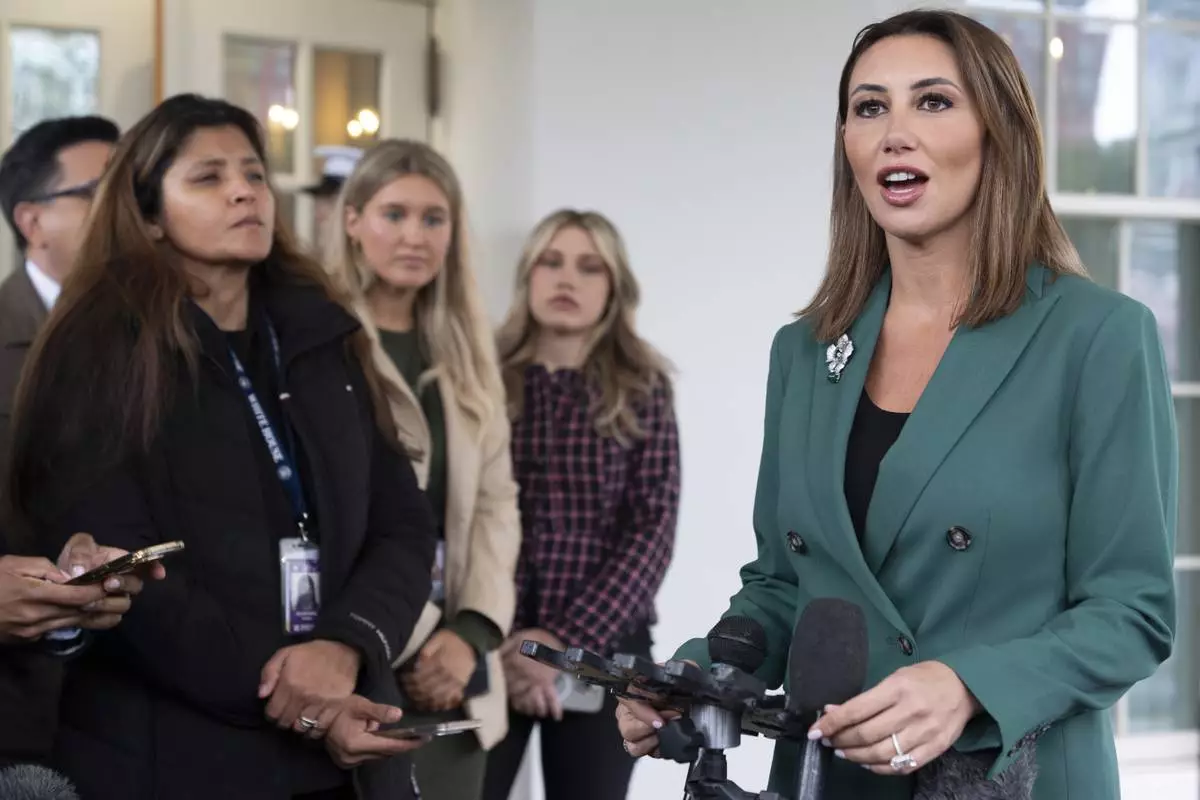
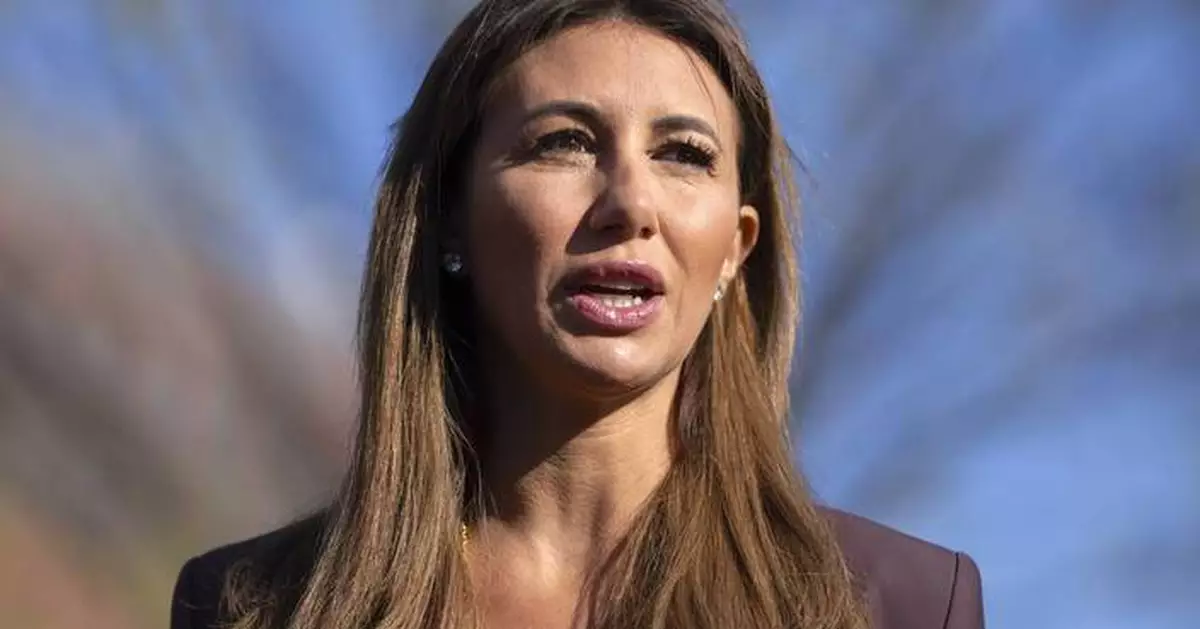
FILE - Alina Habba, a former defense lawyer for President Donald Trump , shown March 24, 2025, outside the White House in Washington. (AP Photo/Jacquelyn Martin, File)
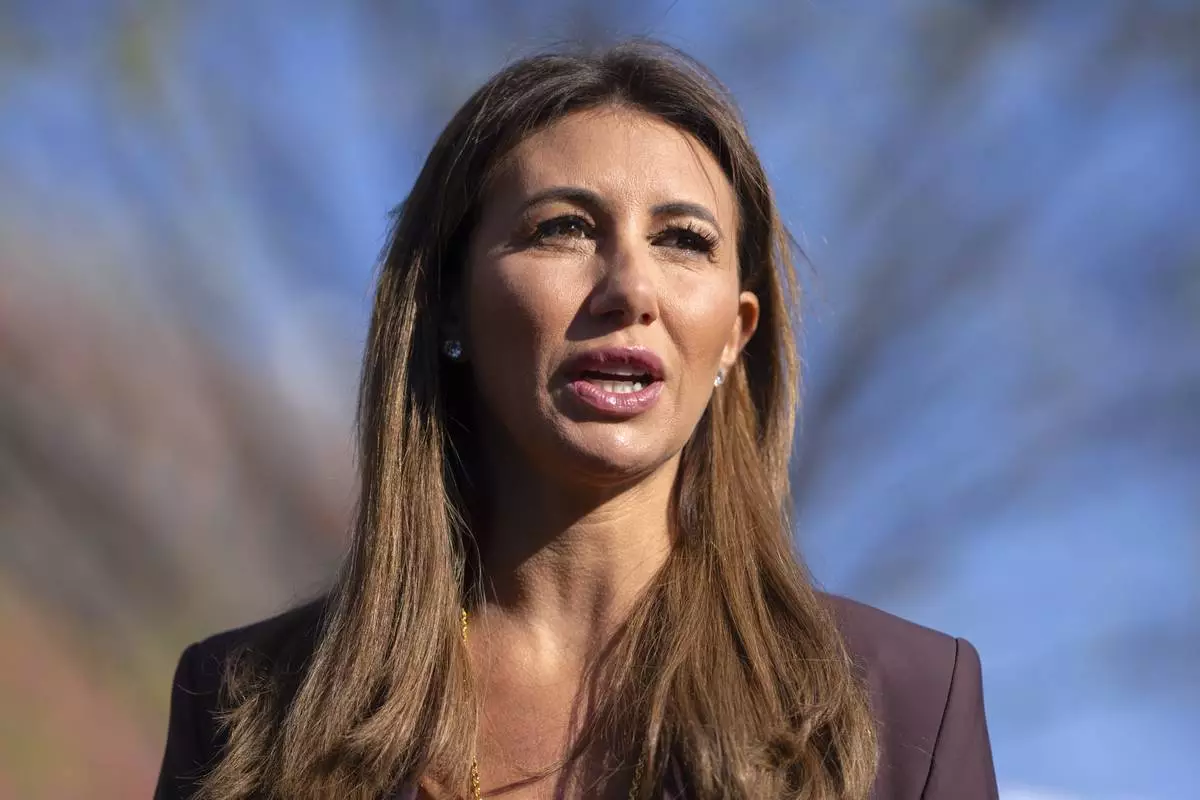
FILE - Alina Habba, a former defense lawyer for President Donald Trump , shown March 24, 2025, outside the White House in Washington. (AP Photo/Jacquelyn Martin, File)

FILE - Alina Habba, President Donald Trump's pick to be the interim U.S. Attorney for New Jersey, speaks with reporters outside the White House, March 26, 2025, in Washington. (AP Photo/Mark Schiefelbein, File)

FILE - Alina Habba, President Donald Trump's pick to be the interim U.S. Attorney for New Jersey, speaks with reporters outside the White House, March 26, 2025, in Washington. (AP Photo/Mark Schiefelbein, File)
BEIJING (AP) — Breaking with the United States, Canada has agreed to cut its 100% tariff on Chinese electric cars in return for lower tariffs on Canadian farm products, Prime Minister Mark Carney said Friday.

Carney made the announcement after two days of meetings with Chinese leaders. He said there would be an initial cap of 49,000 vehicles on Chinese EV exports to Canada, growing to 70,000 over five years. China will reduce its tariff on canola seeds, a major Canadian export, from about 84% to about 15%, he told reporters.

“It has been a historic and productive two days,” Carney said, speaking outside against the backdrop of a traditional pavilion and a frozen pond at a Beijing park. “We have to understand the differences between Canada and other countries, and focus our efforts to work together where we’re aligned.”

Earlier Friday, he and Chinese leader Xi Jinping pledged to improve relations between their two nations after years of acrimony.

Xi told Carney in a meeting at the Great Hall of the People that he is willing to continue working to improve ties, noting that talks have been underway on restoring and restarting cooperation since the two held an initial meeting in October on the sidelines of a regional economic conference in South Korea.

“It can be said that our meeting last year opened a new chapter in turning China–Canada relations toward improvement,” China's top leader said.

Carney, the first Canadian prime minister to visit China in eight years, said better relations would help improve a global governance system that he described as “under great strain.”

He called for a new relationship “adapted to new global realities” and cooperation in agriculture, energy and finance.

Those new realities reflect in large part the so-called America-first approach of U.S. President Donald Trump. The tariffs he has imposed have hit both the Canadian and Chinese economies. Carney, who has met with several leading Chinese companies in Beijing, said ahead of his trip that his government is focused on building an economy less reliant on the U.S. at what he called “a time of global trade disruption.”

A Canadian business owner in China called Carney's visit game-changing, saying it re-establishes dialogue, respect and a framework between the two nations.

“These three things we didn’t have,” said Jacob Cooke, the CEO of WPIC Marketing + Technologies, which helps exporters navigate the Chinese market. “The parties were not talking for years.”

Canada had followed the U.S. in putting tariffs of 100% on EVs from China and 25% on steel and aluminum under former Prime Minister Justin Trudeau, Carney’s predecessor.

China responded by imposing duties of 100% on Canadian canola oil and meal and 25% on pork and seafood. It added a 75.8% tariff on canola seeds last August. Collectively, the import taxes effectively closed the Chinese market to Canadian canola, an industry group has said. Overall, China's imports from Canada fell 10.4% last year to $41.7 billion, according to Chinese trade data.

China is hoping Trump’s pressure tactics on allies such as Canada will drive them to pursue a foreign policy that is less aligned with the United States. The U.S. president has suggested Canada could become America's 51st state.

Carney departs China on Saturday and visits Qatar on Sunday before attending the annual gathering of the World Economic Forum in Switzerland next week. He will meet business leaders and investors in Qatar to promote trade and investment, his office said.

Associated Press business writer Chan Ho-him in Hong Kong contributed to this report.

Canada's Prime Minister Mark Carney, center, arrives to meet with Chinese President Xi Jinping, at the Great Hall of the People in Beijing, China, Friday, Jan. 16, 2026. (AP Photo/Vincent Thian, Pool)

Canada's Prime Minister Mark Carney, center, arrives to meet with Chinese President Xi Jinping, at the Great Hall of the People in Beijing, China, Friday, Jan. 16, 2026. (AP Photo/Vincent Thian, Pool)

Canada's Prime Minister Mark Carney, left, meets with Chinese President Xi Jinping at the Great Hall of the People in Beijing Friday, Jan. 16, 2026. (Sean Kilpatrick/The Canadian Press via AP)

Canada's Prime Minister Mark Carney, left, meets with Chinese President Xi Jinping at the Great Hall of the People in Beijing Friday, Jan. 16, 2026. (Sean Kilpatrick/The Canadian Press via AP)

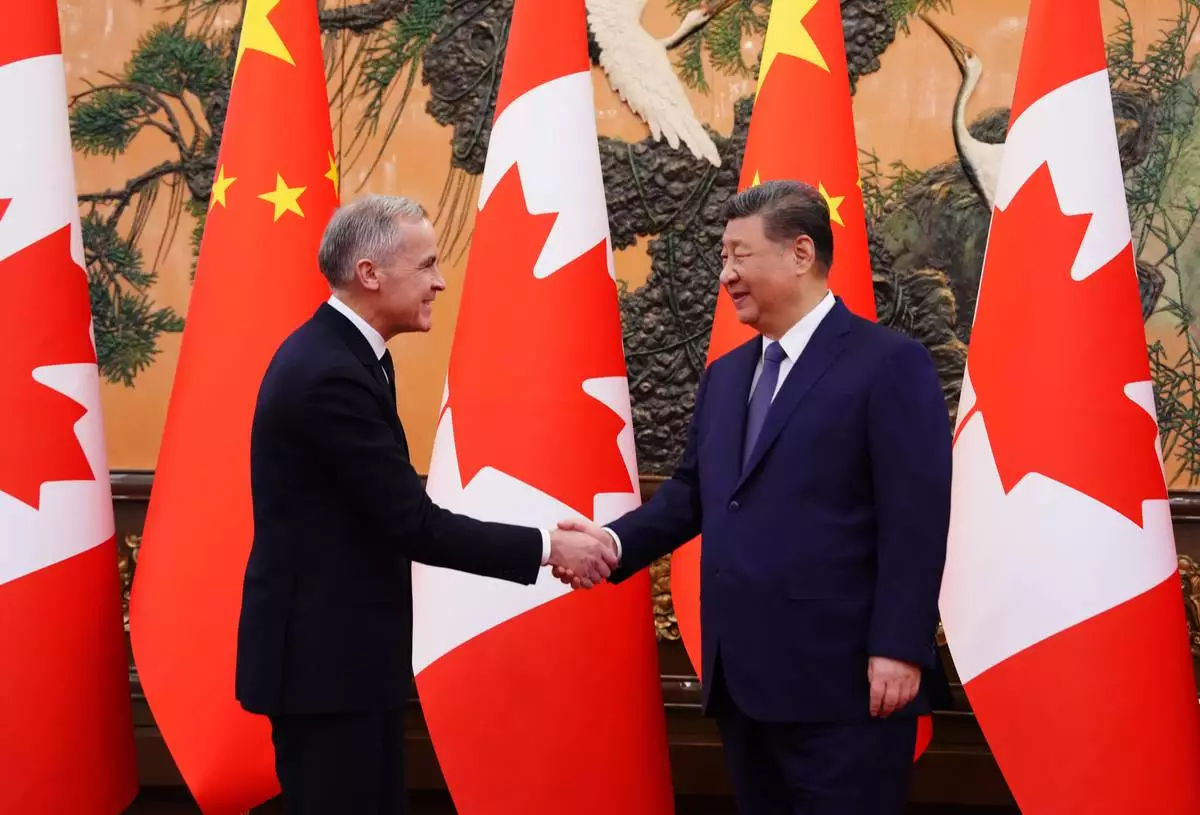
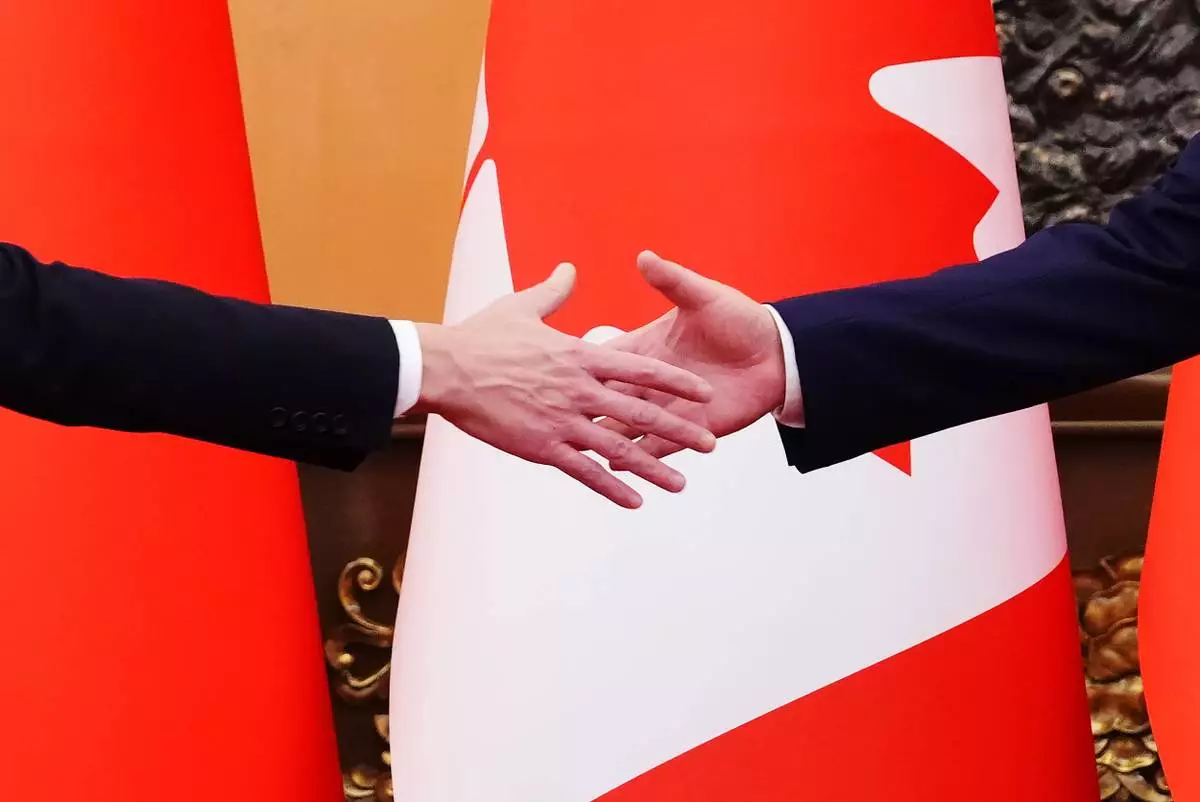
Canada's Prime Minister Mark Carney, left, shakes hands with China's President Xi Jinping at the Great Hall of the People in Beijing Friday, Jan. 16, 2026. (Sean Kilpatrick/The Canadian Press via AP)

Canada's Prime Minister Mark Carney, left, shakes hands with China's President Xi Jinping at the Great Hall of the People in Beijing Friday, Jan. 16, 2026. (Sean Kilpatrick/The Canadian Press via AP)

Recommended Articles