Skip to Content Facebook Feature Image

Inside the facility where ICE is training recruits to take on Trump's deportation goals

News

Inside the facility where ICE is training recruits to take on Trump's deportation goals
News

News

Inside the facility where ICE is training recruits to take on Trump's deportation goals

2025-08-22 13:33 Last Updated At:13:41

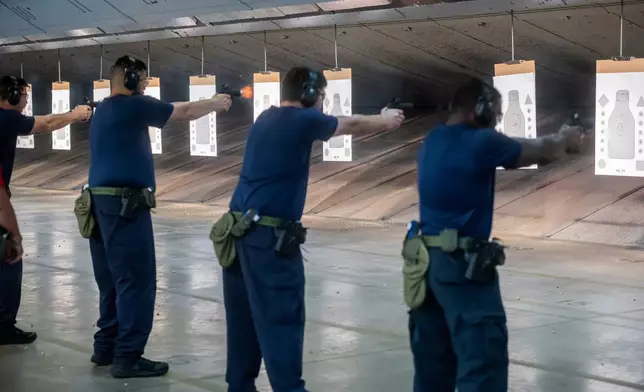
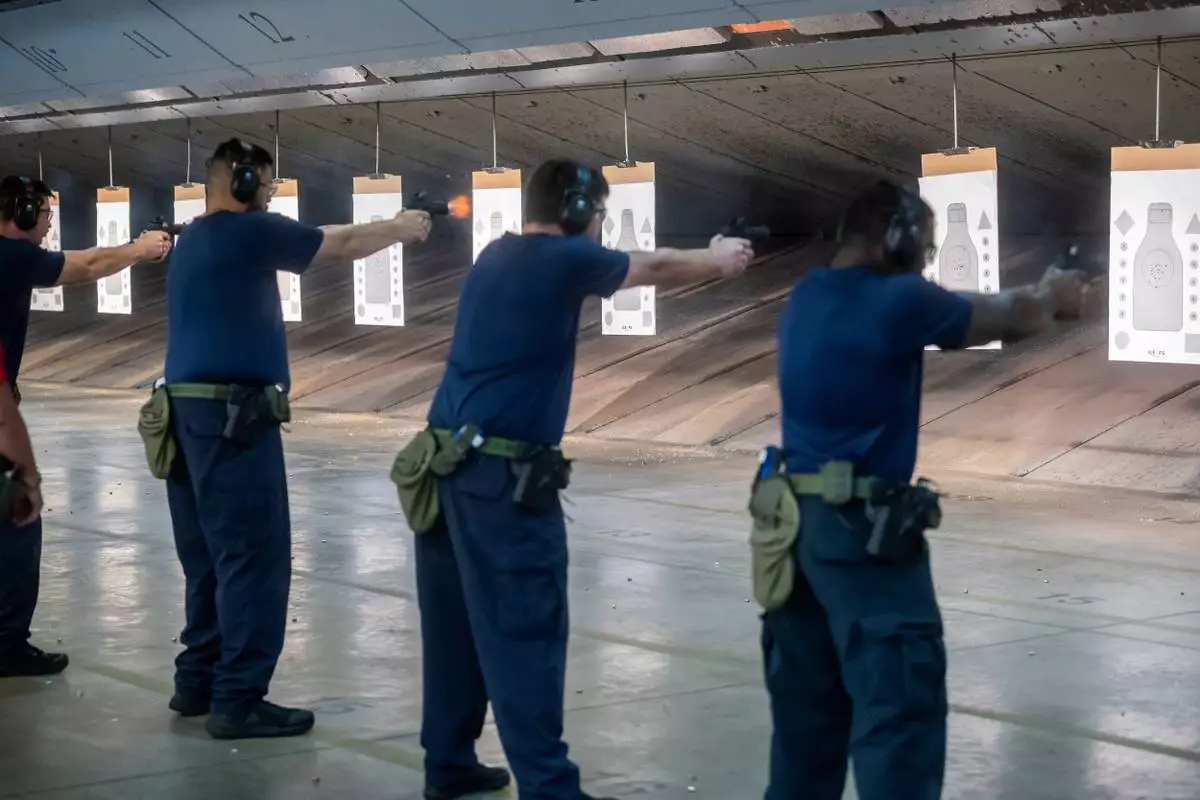
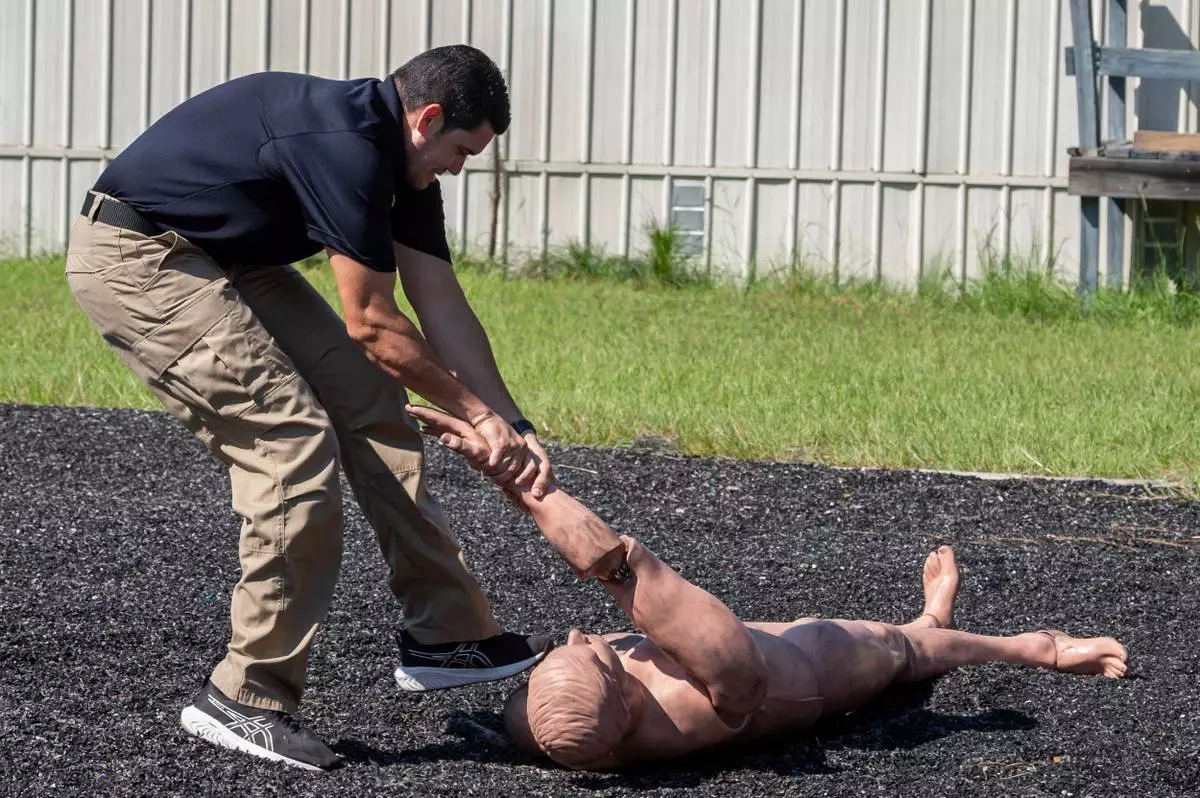
BRUNSWICK, Ga. (AP) — At an obstacle course in the humid Georgia heat, an instructor shows recruits how to pull a wounded partner out of danger. In a classroom with desks cluttered with thick legal books about immigration law, recruits learn about how the Fourth Amendment governs their work. And on a firing range littered with shell casings, new recruits for Immigration and Customs Enforcement practice shooting their handguns.

“Instructors, give me a thumbs up when students are ready to go,” a voice over the loudspeaker said before a group of about 20 ICE recruits practiced drawing and firing their weapons.

More Images
Immigration and Customs Enforcement (ICE) trainees practice shooting a handgun at the indoor firing range at the Federal Law Enforcement Training Centers (FLETC) in Brunswick, Ga. on Thursday, Aug. 21, 2025. (AP Photo/Fran Ruchalski)

Immigration and Customs Enforcement (ICE) trainees practice shooting a handgun at the indoor firing range at the Federal Law Enforcement Training Centers (FLETC) in Brunswick, Ga. on Thursday, Aug. 21, 2025. (AP Photo/Fran Ruchalski)

Caleb Bitello, left, ICE Enforcement and Removal Operations (ERO) Academy assistant director and Todd Lyons, second left, acting director of U.S. Immigration and Customs Enforcement (ICE) speak to the press at the Federal Law Enforcement Training Centers (FLETC) in Brunswick, Ga. on Thursday, Aug. 21, 2025 about the training program ICE officers go through. (AP Photo/Fran Ruchalski)
Caleb Bitello, left, ICE Enforcement and Removal Operations (ERO) Academy assistant director and Todd Lyons, second left, acting director of U.S. Immigration and Customs Enforcement (ICE) speak to the press at the Federal Law Enforcement Training Centers (FLETC) in Brunswick, Ga. on Thursday, Aug. 21, 2025 about the training program ICE officers go through. (AP Photo/Fran Ruchalski)

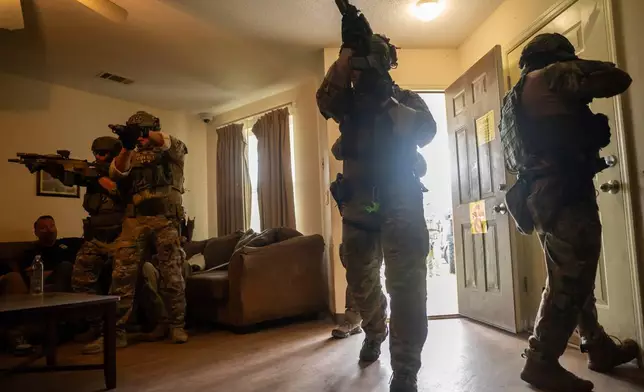
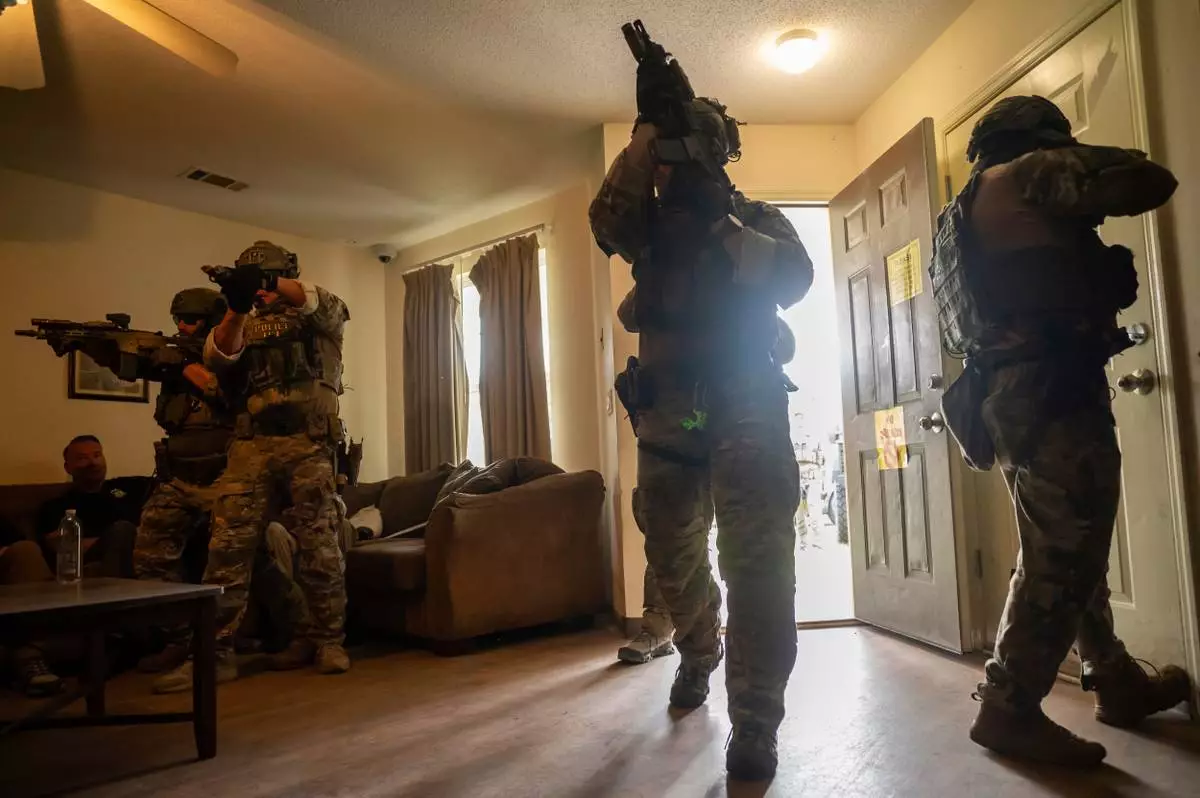
Immigration and Customs Enforcement (ICE) Special Response Team members demonstrate how the team enters a residence in the pursuit of a wanted subject at the Federal Law Enforcement Training Centers (FLETC) in Brunswick, Ga. on Thursday, Aug. 21, 2025. (AP Photo/Fran Ruchalski)
Immigration and Customs Enforcement (ICE) Special Response Team members demonstrate how the team enters a residence in the pursuit of a wanted subject at the Federal Law Enforcement Training Centers (FLETC) in Brunswick, Ga. on Thursday, Aug. 21, 2025. (AP Photo/Fran Ruchalski)
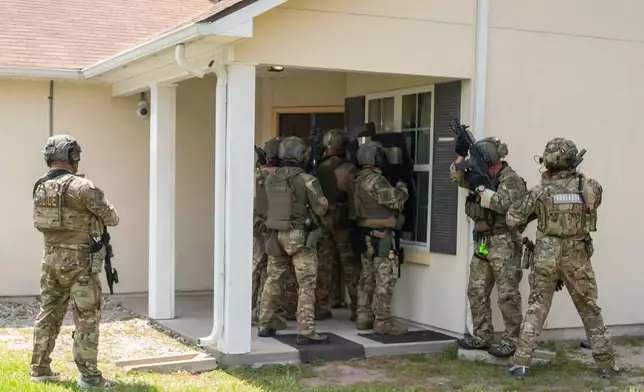
Immigration and Customs Enforcement (ICE) Special Response Team members demonstrate how the team enters a residence in the pursuit of a wanted subject at the Federal Law Enforcement Training Centers (FLETC) in Brunswick, Ga. on Thursday, Aug. 21, 2025. (AP Photo/Fran Ruchalski)
Immigration and Customs Enforcement (ICE) Special Response Team members demonstrate how the team enters a residence in the pursuit of a wanted subject at the Federal Law Enforcement Training Centers (FLETC) in Brunswick, Ga. on Thursday, Aug. 21, 2025. (AP Photo/Fran Ruchalski)

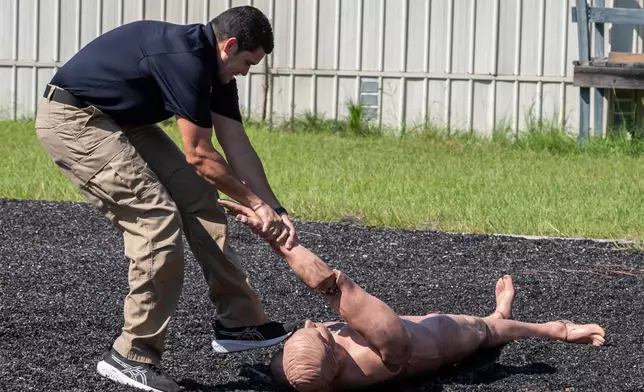
An Immigration and Customs Enforcement (ICE) instructor demonstrates getting a 170 lb. dummy into a position to be handcuffed on the agility course at the Federal Law Enforcement Training Centers (FLETC) in Brunswick, Ga. on Thursday, Aug. 21, 2025. (AP Photo/Fran Ruchalski)

An Immigration and Customs Enforcement (ICE) instructor demonstrates getting a 170 lb. dummy into a position to be handcuffed on the agility course at the Federal Law Enforcement Training Centers (FLETC) in Brunswick, Ga. on Thursday, Aug. 21, 2025. (AP Photo/Fran Ruchalski)

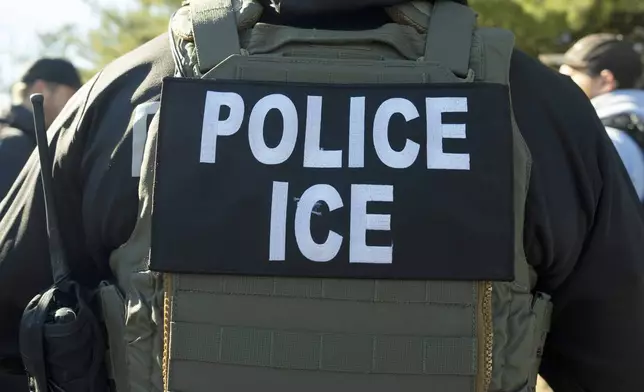
FILE - A U.S. Immigration and Customs Enforcement officer listens during a briefing, Jan. 27, 2025, in Silver Spring, Md. (AP Photo/Alex Brandon, File)

FILE - A U.S. Immigration and Customs Enforcement officer listens during a briefing, Jan. 27, 2025, in Silver Spring, Md. (AP Photo/Alex Brandon, File)

The Federal Law Enforcement Training Center in Brunswick, Georgia, is the epicenter of training for almost all federal law enforcement officers, including the Immigration and Customs Enforcement officers who are at the center of President Donald Trump's mass deportation efforts.

Now, with lots of money approved by Congress this summer starting to flow into ICE, the agency is in midst of a huge hiring effort as it aims to get thousands of new deportation officers into the field in the coming months.

On Thursday, The Associated Press and other news organizations got a rare look at the Basic Immigration Law Enforcement Training Program that new ICE recruits — specifically those in the Enforcement and Removal Operations unit responsible for finding, arresting and removing people from the country — go through and what they learn.

ICE is getting $76.5 billion in new money from Congress to help it meet Trump's mass deportation goal. That's nearly 10 times the agency's current annual budget. Nearly $30 billion of that money is for new staff.

They're hiring across the agency, including investigators and lawyers, but the numbers they're hiring in those areas pale in comparison to how many deportation officers are coming on board. Todd Lyons, the acting director of ICE, was at the training demonstration Thursday. He said the agency currently has about 6,500 deportation officers and is aiming to hire 10,000 more by the end of the year.

With that hiring surge has come concerns that vetting or training of new recruits will be shortchanged. The Border Patrol went through a similar hiring surge in the early 2000s when hiring and training standards were changed; arrests for employee misconduct rose.

Lyons pushed back on concerns that ICE might cut corners when it comes to training. although he said they have made changes designed to streamline the process.

“I wasn’t going to water down training,” said Lyons.

Caleb Vitello, the assistant director of ICE in charge of training, says new recruits will go through about eight weeks of training at the Georgia facility. But they also have training before and after they come here.

One key change, Vitello noted: ICE cut out five weeks of Spanish-language training because he said recruits were only getting to the point of being “moderately” competent in Spanish. He said language translation technology can help fill that void in the field.

During the six-days-a-week training, new recruits live on the grounds of the sprawling facility, which is covered with pine forests and sits near the Atlantic Ocean a little less than an hour's drive north of the Florida state line. Hundreds have gone through the training here in recent months.

During the course, new recruits train on firearms in a large indoor shooting range that looks as big as a football field. On Thursday, the floor was littered with spent shell casings as roughly 20 new recruits wearing blue shirts and blue pants practiced shooting from a bent-elbow position and transitional shooting — involving transferring their guns from one hand to another. Instructors in red shirts walked behind them, occasionally giving them instruction. Everyone wore eye protection and red, noise-reducing earmuffs with earplugs underneath.

Dean Wilson, who oversees the firearms training, compared some of the operations that ICE agents face to a haunted house where they don't know what might be coming at them.

"We do our very best to make sure that even though they’re in that environment, that they have the wherewithal to make the proper decision," said Wilson. “Nobody wants to be the one to make a bad shot, and nobody wants to be the one that doesn’t make it home.”

In a big field with various driving tracks and courses, they also train on driving techniques — how to recover from a skid on wet pavement or how to navigate a winding course similar to an urban environment where they have to come to a full stop or navigate blind corners.

The curriculum also includes de-escalation techniques designed to prevent the use of force in the first place, Lyons said.

“In any type of law enforcement situation," he said, “you’d rather de-escalate with words before you have to use any use of force."

Not all of the training is in the field.

ICE agents like to point out that when it comes to complexity, immigration law is second only to the tax code.

At the training academy, they get about 12 hours of classroom instruction on things like the Fourth Amendment — the part of the Constitution that protects against unreasonable searches and seizures — and the Immigration and Nationality Act of 1952, which has evolved over the decades and governs all facets of immigration. Those legal lessons are also interspersed throughout the rest of the training.

On the desks in one classroom are training manuals and immigration law handbooks roughly two to three inches thick. Recruits learn about how to determine if someone is removable from the country, under what circumstances they can go into someone's house to search and when they have to leave.

ICE staff pushed back on accusations that they are indiscriminately pulling people over or setting up checkpoints in Washington, D.C., or elsewhere as part of immigration enforcement.

They said they have to have probable cause to go after someone, and they do targeted operations. They said they can't — and don't — do traffic stops but can work with local authorities who are.

“Once local law enforcement makes a stop, and then they contact ICE saying we have somebody that we possibly think might be an alien,“ said Greg Hornsby, an associate legal adviser at ICE. ”And that’s where we step in."
Immigration and Customs Enforcement (ICE) trainees practice shooting a handgun at the indoor firing range at the Federal Law Enforcement Training Centers (FLETC) in Brunswick, Ga. on Thursday, Aug. 21, 2025. (AP Photo/Fran Ruchalski)

Immigration and Customs Enforcement (ICE) trainees practice shooting a handgun at the indoor firing range at the Federal Law Enforcement Training Centers (FLETC) in Brunswick, Ga. on Thursday, Aug. 21, 2025. (AP Photo/Fran Ruchalski)

Caleb Bitello, left, ICE Enforcement and Removal Operations (ERO) Academy assistant director and Todd Lyons, second left, acting director of U.S. Immigration and Customs Enforcement (ICE) speak to the press at the Federal Law Enforcement Training Centers (FLETC) in Brunswick, Ga. on Thursday, Aug. 21, 2025 about the training program ICE officers go through. (AP Photo/Fran Ruchalski)
Caleb Bitello, left, ICE Enforcement and Removal Operations (ERO) Academy assistant director and Todd Lyons, second left, acting director of U.S. Immigration and Customs Enforcement (ICE) speak to the press at the Federal Law Enforcement Training Centers (FLETC) in Brunswick, Ga. on Thursday, Aug. 21, 2025 about the training program ICE officers go through. (AP Photo/Fran Ruchalski)

Immigration and Customs Enforcement (ICE) Special Response Team members demonstrate how the team enters a residence in the pursuit of a wanted subject at the Federal Law Enforcement Training Centers (FLETC) in Brunswick, Ga. on Thursday, Aug. 21, 2025. (AP Photo/Fran Ruchalski)
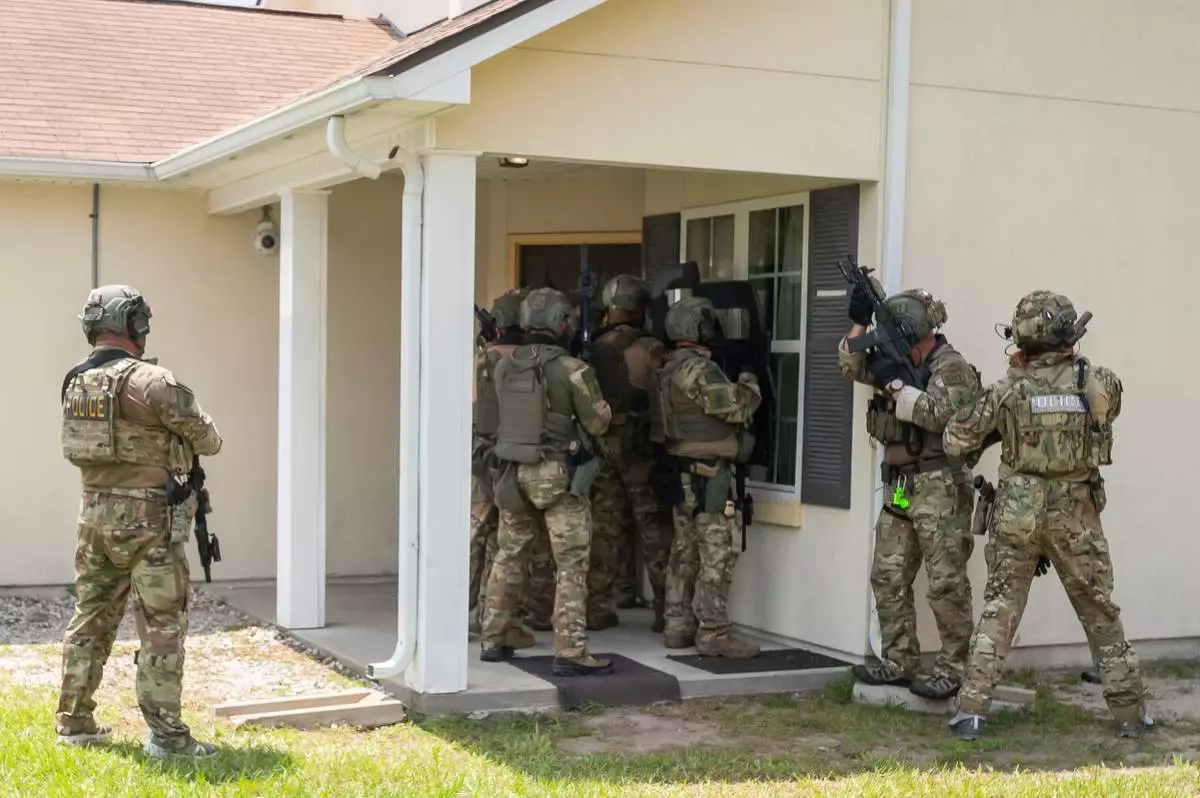
Immigration and Customs Enforcement (ICE) Special Response Team members demonstrate how the team enters a residence in the pursuit of a wanted subject at the Federal Law Enforcement Training Centers (FLETC) in Brunswick, Ga. on Thursday, Aug. 21, 2025. (AP Photo/Fran Ruchalski)
Immigration and Customs Enforcement (ICE) Special Response Team members demonstrate how the team enters a residence in the pursuit of a wanted subject at the Federal Law Enforcement Training Centers (FLETC) in Brunswick, Ga. on Thursday, Aug. 21, 2025. (AP Photo/Fran Ruchalski)

Immigration and Customs Enforcement (ICE) Special Response Team members demonstrate how the team enters a residence in the pursuit of a wanted subject at the Federal Law Enforcement Training Centers (FLETC) in Brunswick, Ga. on Thursday, Aug. 21, 2025. (AP Photo/Fran Ruchalski)

An Immigration and Customs Enforcement (ICE) instructor demonstrates getting a 170 lb. dummy into a position to be handcuffed on the agility course at the Federal Law Enforcement Training Centers (FLETC) in Brunswick, Ga. on Thursday, Aug. 21, 2025. (AP Photo/Fran Ruchalski)

An Immigration and Customs Enforcement (ICE) instructor demonstrates getting a 170 lb. dummy into a position to be handcuffed on the agility course at the Federal Law Enforcement Training Centers (FLETC) in Brunswick, Ga. on Thursday, Aug. 21, 2025. (AP Photo/Fran Ruchalski)

FILE - A U.S. Immigration and Customs Enforcement officer listens during a briefing, Jan. 27, 2025, in Silver Spring, Md. (AP Photo/Alex Brandon, File)


FILE - A U.S. Immigration and Customs Enforcement officer listens during a briefing, Jan. 27, 2025, in Silver Spring, Md. (AP Photo/Alex Brandon, File)

The U.N. Security Council scheduled an emergency meeting Thursday to discuss Iran's deadly protests at the request of the United States, even as President Donald Trump left unclear what actions he would take against the Islamic state.

Tehran appeared to make conciliatory statements in an effort to defuse the situation after Trump threatened to take action to stop further killing of protesters, including the execution of anyone detained in Tehran’s bloody crackdown on nationwide protests.

Iran’s crackdown on the demonstrations has killed at least 2,615, the U.S.-based Human Rights Activists News Agency reported. The death toll exceeds any other round of protest or unrest in Iran in decades and recalls the chaos surrounding the country’s 1979 Islamic Revolution.

Iran closed its airspace to commercial flights for hours without explanation early Thursday and some personnel at a key U.S. military base in Qatar were advised to evacuate. The U.S. Embassy in Kuwait also ordered its personnel to “temporary halt” travel to the multiple military bases in the small Gulf Arab country.

Iran previously closed its airspace during the 12-day war against Israel in June.

Here is the latest:

In a joint statement, the foreign ministers of Canada, France, Germany, Italy, Japan, the United Kingdom, the United States and the European Union’s main foreign policy chief said the G7 members were “gravely concerned” by the developments surrounding the protests, and that they “strongly oppose the intensification of the Iranian authorities’ brutal repression of the Iranian people.”

The statement, published on the EU’s website Thursday, said the G7 were “deeply alarmed at the high level of reported deaths and injuries” and condemned “the deliberate use of violence” by Iranian security forces against protesters.

The G7 members “remain prepared to impose additional restrictive measures if Iran continues to crack down on protests and dissent in violation of international human rights obligations,” the statement said.

China’s Foreign Minister Wang Yi has spoken with his counterpart in Iran, who said the situation was “now stable,” China’s Ministry of Foreign Affairs said.

Abbas Araghchi said “he hoped China will play a greater role in regional peace and stability” during the talks, according to the statement from the ministry.

“China opposes imposing its will on other countries, and opposes a return to the ‘law of the jungle’,” Wang said.

“China believes that the Iranian government and people will unite, overcome difficulties, maintain national stability, and safeguard their legitimate rights and interests,” he added. “China hopes all parties will cherish peace, exercise restraint, and resolve differences through dialogue. China is willing to play a constructive role in this regard.”

“We are against military intervention in Iran,” Turkish Foreign Minister Hakan Fidan told journalists in Istanbul on Thursday. “Iran must address its own internal problems… They must address their problems with the region and in global terms through diplomacy so that certain structural problems that cause economic problems can be addressed.”

Ankara and Tehran enjoy warm relations despite often holding divergent interests in the region.

Fidan said the unrest in Iran was rooted in economic conditions caused by sanctions, rather than ideological opposition to the government.

Iranians have been largely absent from an annual pilgrimage to Baghdad, Iraq, to commemorate the death of Imam Musa al-Kadhim, one of the twelve Shiite imams.

Many Iranian pilgrims typically make the journey every year for the annual religious rituals.

Streets across Baghdad were crowded with pilgrims Thursday. Most had arrived on foot from central and southern provinces of Iraq, heading toward the shrine of Imam al-Kadhim in the Kadhimiya district in northern Baghdad,

Adel Zaidan, who owns a hotel near the shrine, said the number of Iranian visitors this year compared to previous years was very small. Other residents agreed.

“This visit is different from previous ones. It lacks the large numbers of Iranian pilgrims, especially in terms of providing food and accommodation,” said Haider Al-Obaidi.

Europe’s largest airline group said Thursday it would halt night flights to and from Tel Aviv and Jordan's capital Amman for five days, citing security concerns as fears grow that unrest in Iran could spiral into wider regional violence.

Lufthansa — which operates Swiss, Austrian Airlines, Brussels Airlines and Eurowings — said flights would run only during daytime hours from Thursday through Monday “due to the current situation in the Middle East.” It said the change would ensure its staff — which includes unionized cabin crews and pilots -- would not be required to stay overnight in the region.

The airline group also said its planes would bypass Iranian and Iraqi airspace, key corridors for air travel between the Middle East and Asia.

Iran closed its airspace to commercial flights for several hours early Thursday without explanation.

A spokesperson for Israel’s Airport Authority, which oversees Tel Aviv’s Ben Gurion Airport, said the airport was operating as usual.

Iranian state media has denied claims that a young man arrested during Iran’s recent protests was condemned to death. The statement from Iran’s judicial authorities on Thursday contradicted what it said were “opposition media abroad” which claimed the young man had been quickly sentenced to death during a violent crackdown on anti-government protests in the country.

State television didn’t immediately give any details beyond his name, Erfan Soltani. Iranian judicial authorities said Soltani was being held in a detention facility outside of the capital. Alongside other protesters, he has been accused of “propaganda activities against the regime,” state media said.

New Zealand’s Foreign Minister Winston Peters said Thursday that his government was “appalled by the escalation of violence and repression” in Iran.

“We condemn the brutal crackdown being carried out by Iran’s security forces, including the killing of protesters,” Peters posted on X.

“Iranians have the right to peaceful protest, freedom of expression, and access to information – and that right is currently being brutally repressed,” he said.

Peters said his government had expressed serious concerns to the Iranian Embassy in Wellington.

A demonstrator lights a cigarette with a burning poster depicting Supreme Leader Ayatollah Ali Khamenei during a rally in support of Iran's anti-government protests, in Holon, Israel, Wednesday, Jan. 14, 2026. (AP Photo/Ohad Zwigenberg)

A demonstrator lights a cigarette with a burning poster depicting Supreme Leader Ayatollah Ali Khamenei during a rally in support of Iran's anti-government protests, in Holon, Israel, Wednesday, Jan. 14, 2026. (AP Photo/Ohad Zwigenberg)

Protesters participate in a demonstration in support of the nationwide mass protests in Iran against the government, in Berlin, Germany, Wednesday, Jan. 14, 2026. (AP Photo/Ebrahim Noroozi)

Protesters participate in a demonstration in support of the nationwide mass protests in Iran against the government, in Berlin, Germany, Wednesday, Jan. 14, 2026. (AP Photo/Ebrahim Noroozi)

Protesters participate in a demonstration in support of the nationwide mass protests in Iran against the government, in Berlin, Germany, Wednesday, Jan. 14, 2026. (AP Photo/Ebrahim Noroozi)

Protesters participate in a demonstration in support of the nationwide mass protests in Iran against the government, in Berlin, Germany, Wednesday, Jan. 14, 2026. (AP Photo/Ebrahim Noroozi)

Recommended Articles