DAKAR, Senegal (AP) — A major cybercrime crackdown coordinated by Interpol has led to the arrest of 1,209 suspects across Africa and the recovery of nearly $97.4 million, the organization announced Friday.
Dubbed Operation Serengeti 2.0, the operation took place between June and August. It brought together investigators from 18 African countries and the United Kingdom to fight harmful cybercrimes including inheritance scams, ransomware and business email compromise.
Altogether, the scams targeted nearly 88,000 victims, the international police organization said in a statement.
Interpol said that authorities in Angola dismantled 25 cryptocurrency mining centers where 60 Chinese nationals had been mining cryptocurrency. The operation resulted in the confiscation of equipment worth over $37 million; the government now plans to use the equipment to support power distribution in vulnerable areas.
In Zambia, the operation dismantled an online investment scheme that defrauded more than 65,000 victims of an estimated $300 million through a fraudulent high-return cryptocurrency scam.
“The scammers lured victims into investing in cryptocurrency through extensive advertising campaigns promising high-yield returns. Victims were then instructed to download multiple apps to participate,” Interpol said. It said that 15 people had been arrested and that authorities seized evidence including domains, mobile numbers and bank accounts.
In locating the scam center in Zambia, authorities also disrupted a suspected human trafficking network, Interpol said.
Interpol also said it dismantled a transnational inheritance scam in the Ivory Coast which had originated in Germany. Victims of that scam were tricked into paying fees to claim fake inheritances, causing $1.6 million in losses.
“Despite being one of the oldest-running internet frauds, inheritance scams continue to generate significant funds for criminal organizations,” it said.
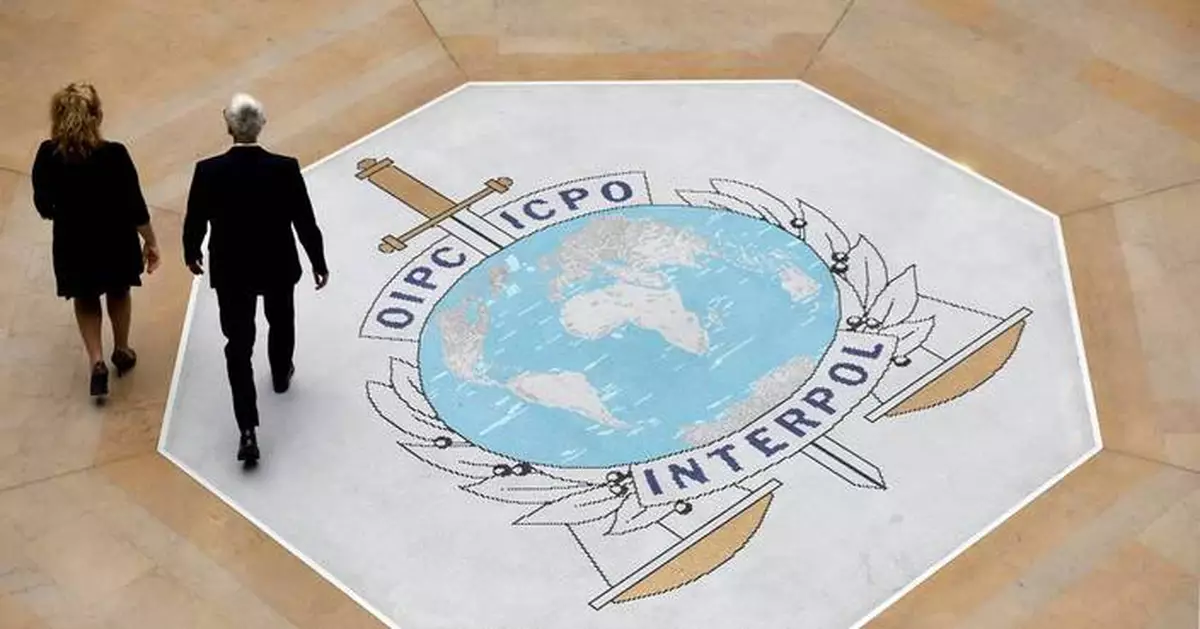
Interpol, which has 196 member countries and celebrated its centennial last year, is the world’s largest international police network to combat international crime. Headquartered in Lyons, France, it works to help national police forces communicate with each other and track suspects and criminals in areas like counterterrorism, financial crime, child pornography, cybercrime and organized crime.
In recent years it has grappled with new challenges including a growing caseload of cybercrime and child sex abuse, and increasing divisions among its member countries.
Last year in the first Operation Serengeti, Interpol arrested over 1,000 people in operations that had targeted 35,000 victims.
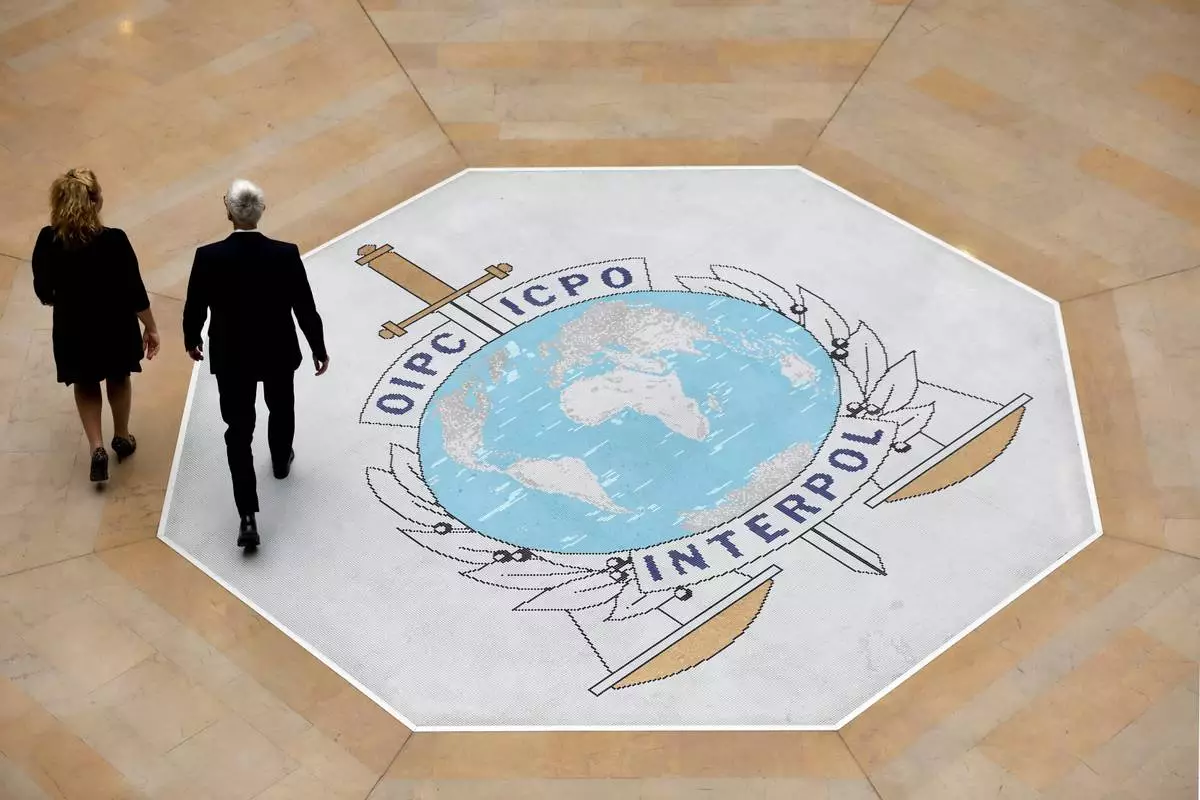
FILE - People walk on the Interpol logo at the international police agency headquarters in Lyon, France, on Nov. 8, 2018. (AP Photo/Laurent Cipriani, File)
BEIJING (AP) — Breaking with the United States, Canada has agreed to cut its 100% tariff on Chinese electric cars in return for lower tariffs on Canadian farm products, Prime Minister Mark Carney said Friday.
Carney made the announcement after two days of meetings with Chinese leaders. He said there would be an initial cap of 49,000 vehicles on Chinese EV exports to Canada, growing to 70,000 over five years. China will reduce its tariff on canola seeds, a major Canadian export, from about 84% to about 15%, he told reporters.
“It has been a historic and productive two days,” Carney said, speaking outside against the backdrop of a traditional pavilion and a frozen pond at a Beijing park. “We have to understand the differences between Canada and other countries, and focus our efforts to work together where we’re aligned.”
Earlier Friday, he and Chinese leader Xi Jinping pledged to improve relations between their two nations after years of acrimony.
Xi told Carney in a meeting at the Great Hall of the People that he is willing to continue working to improve ties, noting that talks have been underway on restoring and restarting cooperation since the two held an initial meeting in October on the sidelines of a regional economic conference in South Korea.
“It can be said that our meeting last year opened a new chapter in turning China–Canada relations toward improvement,” China's top leader said.
Carney, the first Canadian prime minister to visit China in eight years, said better relations would help improve a global governance system that he described as “under great strain.”
He called for a new relationship “adapted to new global realities” and cooperation in agriculture, energy and finance.
Those new realities reflect in large part the so-called America-first approach of U.S. President Donald Trump. The tariffs he has imposed have hit both the Canadian and Chinese economies. Carney, who has met with several leading Chinese companies in Beijing, said ahead of his trip that his government is focused on building an economy less reliant on the U.S. at what he called “a time of global trade disruption.”
A Canadian business owner in China called Carney's visit game-changing, saying it re-establishes dialogue, respect and a framework between the two nations.
“These three things we didn’t have,” said Jacob Cooke, the CEO of WPIC Marketing + Technologies, which helps exporters navigate the Chinese market. “The parties were not talking for years.”
Canada had followed the U.S. in putting tariffs of 100% on EVs from China and 25% on steel and aluminum under former Prime Minister Justin Trudeau, Carney’s predecessor.
China responded by imposing duties of 100% on Canadian canola oil and meal and 25% on pork and seafood. It added a 75.8% tariff on canola seeds last August. Collectively, the import taxes effectively closed the Chinese market to Canadian canola, an industry group has said. Overall, China's imports from Canada fell 10.4% last year to $41.7 billion, according to Chinese trade data.
China is hoping Trump’s pressure tactics on allies such as Canada will drive them to pursue a foreign policy that is less aligned with the United States. The U.S. president has suggested Canada could become America's 51st state.
Carney departs China on Saturday and visits Qatar on Sunday before attending the annual gathering of the World Economic Forum in Switzerland next week. He will meet business leaders and investors in Qatar to promote trade and investment, his office said.
Associated Press business writer Chan Ho-him in Hong Kong contributed to this report.

Canada's Prime Minister Mark Carney, center, arrives to meet with Chinese President Xi Jinping, at the Great Hall of the People in Beijing, China, Friday, Jan. 16, 2026. (AP Photo/Vincent Thian, Pool)
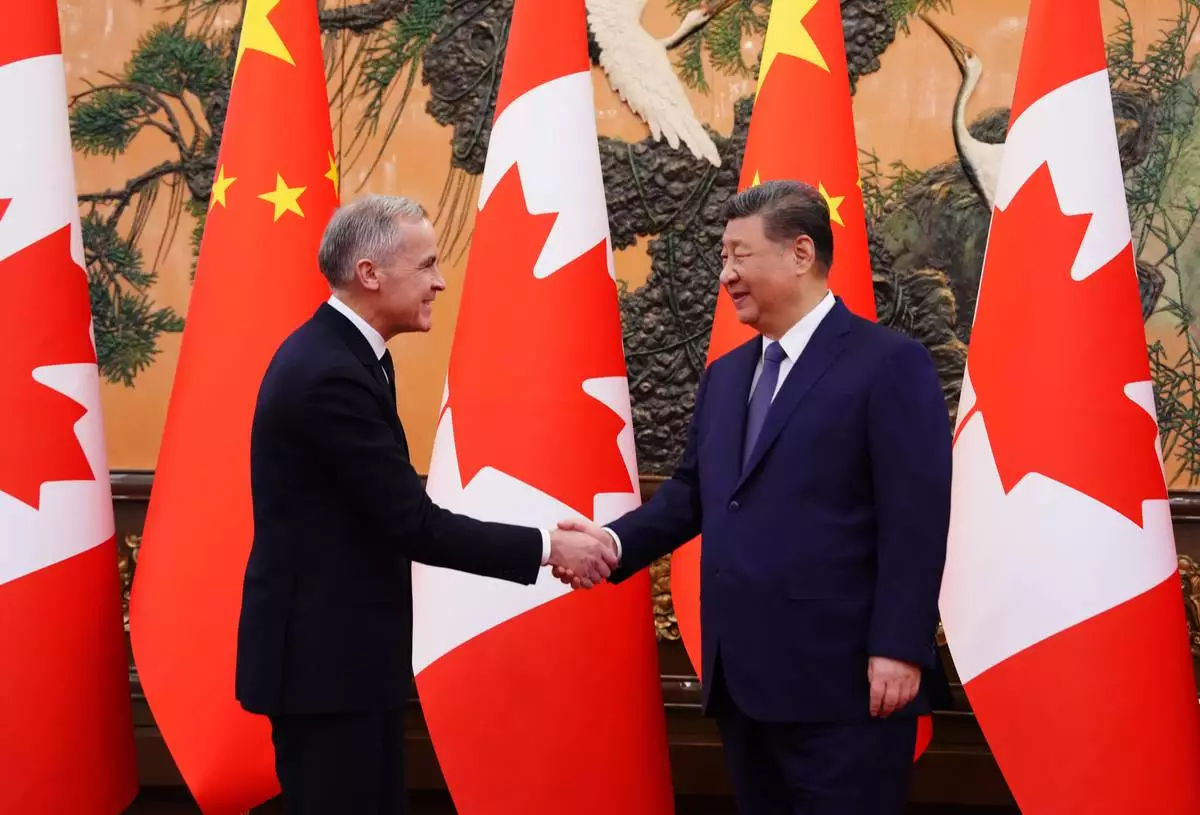
Canada's Prime Minister Mark Carney, left, meets with Chinese President Xi Jinping at the Great Hall of the People in Beijing Friday, Jan. 16, 2026. (Sean Kilpatrick/The Canadian Press via AP)
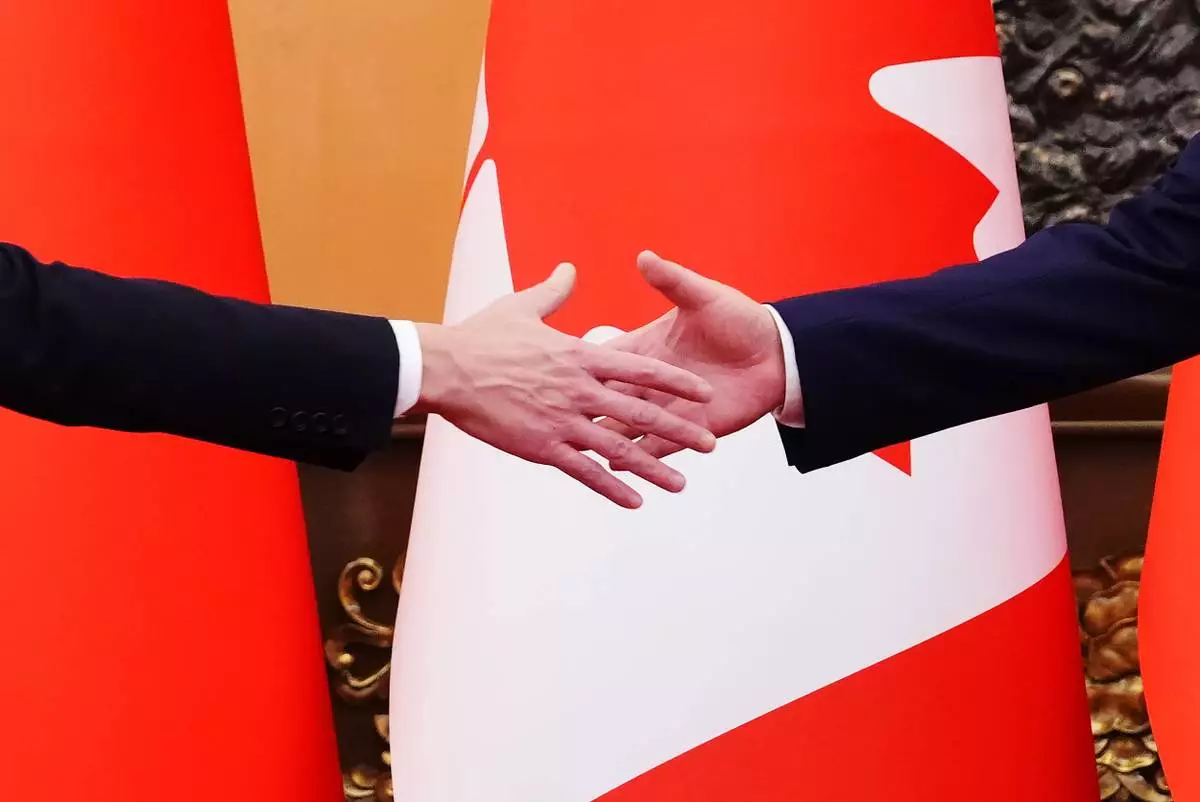
Canada's Prime Minister Mark Carney, left, shakes hands with China's President Xi Jinping at the Great Hall of the People in Beijing Friday, Jan. 16, 2026. (Sean Kilpatrick/The Canadian Press via AP)