Skip to Content Facebook Feature Image

Sun Island Panda House in north China features innovative design for giant pandas' comfort

China

China

China

Sun Island Panda House in north China features innovative design for giant pandas' comfort

2025-08-23 17:45 Last Updated At:20:07

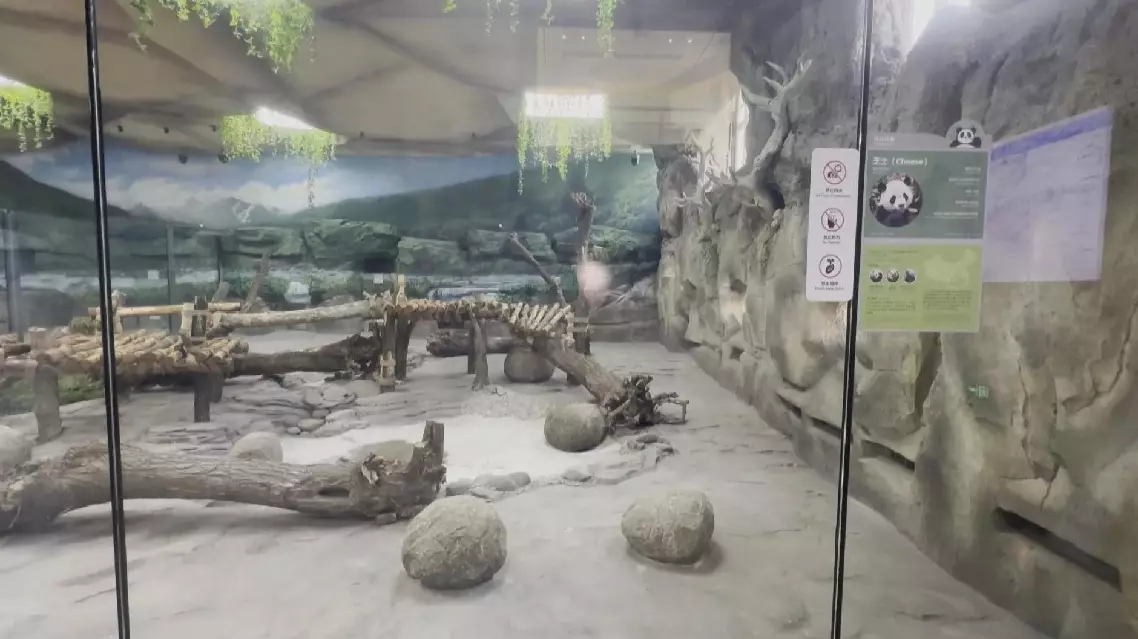
The newly constructed Sun Island Panda House in Harbin City, northeast China's Heilongjiang Province, officially opened to the public on Saturday, showcasing its innovative design tailored to meet the specific needs of giant pandas.

Visitors can now meet the eight-year-old male panda twins, Zhi Shi and Zhi Ma, who were transported from the southwestern Chinese city of Chengdu.

Harbin is well-known as one of the coldest cities in China, but the Panda House was meticulously designed with the local climate in mind. It attempts to fully replicate the habitats that giant pandas enjoy in their natural environment, with considerations for temperature, humidity, wind, and light, ensuring a healthy and comfortable living space for the animals.

"The ideal temperature for giant pandas is between 7 and 20 degrees Celsius. They naturally prefer cooler temperatures, are sensitive to heat, and enjoy humidity. To keep them warm in winter, we have implemented an external insulation system for the entire building. In summer, when outdoor temperatures are high, they can return indoors, where we have created areas with adjustable temperatures of 20, 22, and 25 degrees Celsius, allowing them to choose their comfort level," said Zhao Yue, a staff member at the Harbin Sun Island Panda House.

Air circulation and ventilation are also crucial for the well-being of giant pandas, Zhao said.

The Sun Island Panda House features an advanced air system that ensures optimal ventilation and air cleanliness. The lighting in both the indoor area and enclosure replicates the natural light conditions of pandas' habitats, simulating the light spectrum and intensity of sunlight as well as moonlight. Smart controllers manage gradual brightening and dimming to avoid abrupt changes in light, which could cause stress to the pandas.

These comprehensive measures create a complete environmental control system, providing a comfortable living environment for the giant pandas in Harbin's harsh climate. The facility has been approved by experts from the National Forestry and Grassland Administration (NFGA).

The introduction of the giant pandas commenced in October 2024, a collaborative effort led by the NFGA and other departments.
Sun Island Panda House in north China features innovative design for giant pandas' comfort
Sun Island Panda House in north China features innovative design for giant pandas' comfort

A former television host from Taiwan, Zhai Xuan, has made a pivotal decision to leave mainstream broadcasting in order to create content that provides a better understanding of the Chinese mainland and cross-strait relations.

Zhai, a seasoned television host with over a decade of experience in Taiwan's media landscape, recently addressed an audience at an event in Beijing, where she revealed her complete transition into independent online media.

In her remarks, she articulated her aspiration to bridge what she perceives as a significant information gap between audiences on both sides of the Strait, highlighting her commitment to fostering a deeper understanding and connection through her new endeavors.

"I was really surprised by all the fake news. There were stories saying people on the mainland can't afford tea eggs or that they live in mud houses and in Taiwan, this was the main information many people received," said Zhai.

Zhai said she initially began producing online videos to challenge such perceptions while continuing her work as a television host.

In April 2025, she travelled to the mainland with her father to fulfill her late grandfather's wish to return to his hometown. The trip, which reunited family members separated since 1949, was recorded in a video series titled "Journey to Find Our Roots", drawing attention from viewers in both Taiwan and the mainland.

"Many people in Taiwan told me that after watching, they wanted to apply for a mainland travel permit immediately and go looking for their relatives. Some had long forgotten these things, but after seeing my story, they began thinking about their hometowns and family members they had never met and decided to search for their roots," Zhai shared her story at the event.

By mid-2025, Zhai said she began to feel increasing pressure amid rising political tensions and a tightening atmosphere around cross-Strait exchanges in Taiwan.

After more than 12 years in the industry, Zhai resigned from her position, believing it was the right thing to do.

"At that moment, I felt this was a major issue,not just for me, but for Chinese people on both sides of the Strait. If I backed down then, I wouldn’t be standing on the right side," said Zhai.

Since leaving television, Zhai has broadened her online programming to encompass a range of daily-life topics, including practical guidance on applying for a mainland travel permit and using commonly employed mobile applications, in addition to content that delves into historical memory and cultural connections across the Strait.

As the debate over cross-Strait relations continues in Taiwan, Zhai said she remains committed to her current path.

Former Taiwan TV host bridges cross-Strait divide via online media

Former Taiwan TV host bridges cross-Strait divide via online media

Recommended Articles