China's 2025 summer movie season has delivered a robust performance, with box office topping 11 billion yuan and merchandise sales soaring.
The box office, including presales, reached 11.035 billion yuan (about 1.54 billion U.S. dollars) as of 10:35 Beijing time Monday, according to box office tracker Dengta Data.
Over 150 films were released during the summer movie season, which runs from June 1 to August 31, with domestic movies driving significant revenue.
War epics such as "Dead To Rights," "Dongji Rescue" and "Mountains and Rivers Bearing Witness" resonated deeply with audiences.
Leading the charts is "Dead To Rights" which tells the story of a group of Chinese civilians who took refuge in a photography studio during the Japanese aggressors' brutal occupation of Nanjing in 1937.
As of Sunday, the film grossed over 2.75 billion yuan since its release on July 25. It is projected to gross up to 4.2 billion yuan in total.
Meanwhile, the animated films "Nobody" and "The Legend of Hei 2" have won both acclaim and commercial success.
"Nobody," a spinoff from the popular "Yao-Chinese Folktales" series, shattered the record for Chinese-made 2D animated films. Debuting on August 2, it has already grossed over 1.26 billion yuan, securing the second spot on the summer box office chart.
"The Legend of Hei 2," the sequel to the 2019 animated hit, also performed well, grossing nearly 472 million yuan since its July 18 release.
The summer movie season also has seen a surge in movie merchandise sales, translating on-screen success into a 120 percent year-on-year growth in revenue.
"Nobody" alone contributed nearly 30 percent to this growth. The film has launched 207 branded merchandise items and also collaborated with over 30 brands to create a diverse array of 400 licensed products, ranging from plush toys and stationery sets to puzzles and cards.

China's 2025 summer box office tops 11 billion yuan, merchandise sales soar

China's 2025 summer box office tops 11 billion yuan, merchandise sales soar
Computing power services are gaining momentum as artificial intelligence (AI) technology evolves, opening new avenues for the development of trade in services and becoming a highlight of the ongoing 2026 China International Fair for Trade in Services (CIFTIS) in Beijing.
The five-day CIFTIS opened on Wednesday, drawing participants from 90 countries, regions and international organizations, with over 1,800 companies showcasing their service products on-site.
Exhibitors at the 2026 Thematic Exhibition: Telecommunications, Computers and Information Services are shifting their focus from traditional communication offerings to integrated services combining computing power and AI.
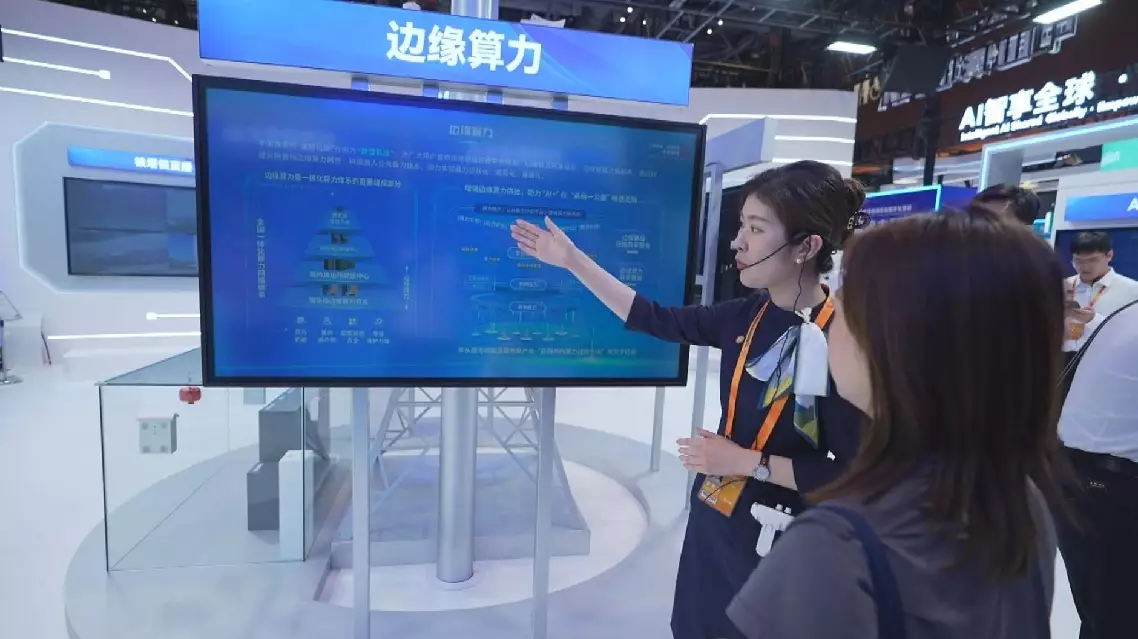
"Currently, we operate over 2 million base stations, and each base station has a supporting communication machine room. We have integrated computing facilities into these machine rooms, upgrading them into data centers that can provide localized, distributed computing services. This enables real-time computing support for applications such as AI-powered forest fire prevention, disaster mitigation, and water quality monitoring in local areas," said Qiao Zhi, a staff member of China Tower Beijing Branch.
Beyond these application services, China's industry chain leaders are showcasing a broad array of innovative solutions at the upstream segment, including chip design, testing, verification, and technical licensing. Chinese service providers are offering tailored solutions for a diverse range of regions and markets.
"For example, European and American clients tend to prefer large-model, high-performance chips, while clients from the Middle East and Southeast Asia focus more on edge-side AI chips, mainly to assist their smart city projects and robotics initiatives. Chinese enterprises can meet the customized demands of different regions, different customers and different scenarios," said Wang Wenqian, head of research and development of the Joinsilicon, which provides customized products and solutions for the semiconductor industry.
Services that can be digitally delivered, including those related to computing power, are becoming an important engine driving the growth of services trade. According to China's Trade in Services Development Index Report 2026 released at the CIFTIS, the share of digitally deliverable services in global services exports rose to 57.9 percent in 2025.
Computing power services emerge as new growth driver for trade in services