China's Long March-8A carrier rocket has made rapid progress since its maiden flight in February, showcasing its ability to support high-density launches for large-scale satellite constellations.
Its success is driven by optimized launch procedures and technological upgrades that enable multiple parallel missions in low and medium Earth orbits.
As a new generation medium-lift liquid-propellant carrier rocket, the Long March-8A has completed three missions this year, including the launch of a new batch of low Earth orbit satellites early Tuesday.
With a 7-ton payload capacity to sun-synchronous orbit, the Long March-8A retains the core first stage and boosters of the Long March-8, but upgrades its second stage with a newly developed universal hydrogen-oxygen final stage and a 5.2-meter-diameter fairing atop a 3.35-meter core.
This unique configuration gives the Long March-8A a distinctive, large-headed appearance, providing more room for satellites. As a result, the rocket can support a wider variety and larger volume of satellites, significantly enhancing its mission adaptability.
"As a new kind of rocket, its maiden flight carried commercial satellites, and within this year, it has achieved a high launch frequency, which is quite rare in the history of international spaceflight," said Song Zhengyu, an engineer at China Aerospace Science and Technology Corporation (CASC).
The Long March-8A development team has also optimized the launch process, enabling a pulsed work flow that integrates assembly, testing, and launch efficiently.
According to the designers, a new Long March-8A rocket with enhanced automation capabilities is ready for upcoming missions.
"In traditional launch modes, limited by the technology available at the time, many operations required manual manipulation and verification, which posed certain risks. With this new rocket, we are committed to transitioning from manual to automated operations. Once the process is correctly set up, it will execute accurately, greatly reducing the operators' workload and lowering the skill threshold required," explained Sun Haifeng, another engineer at CASC.
To enhance the safety of launching, the development team has adopted a new technology which allows the rocket to smoothly drift away from the launch tower during liftoff, thus eliminate collision risks, said Sun.
"Leveraging the advantages of our control system, we use algorithms to guide the rocket to fly away from the tower immediately after liftoff, reducing the risk of collision. We have conducted extensive simulations to ensure that even with certain deviations, the rocket still can safely clear the tower," Sun said.
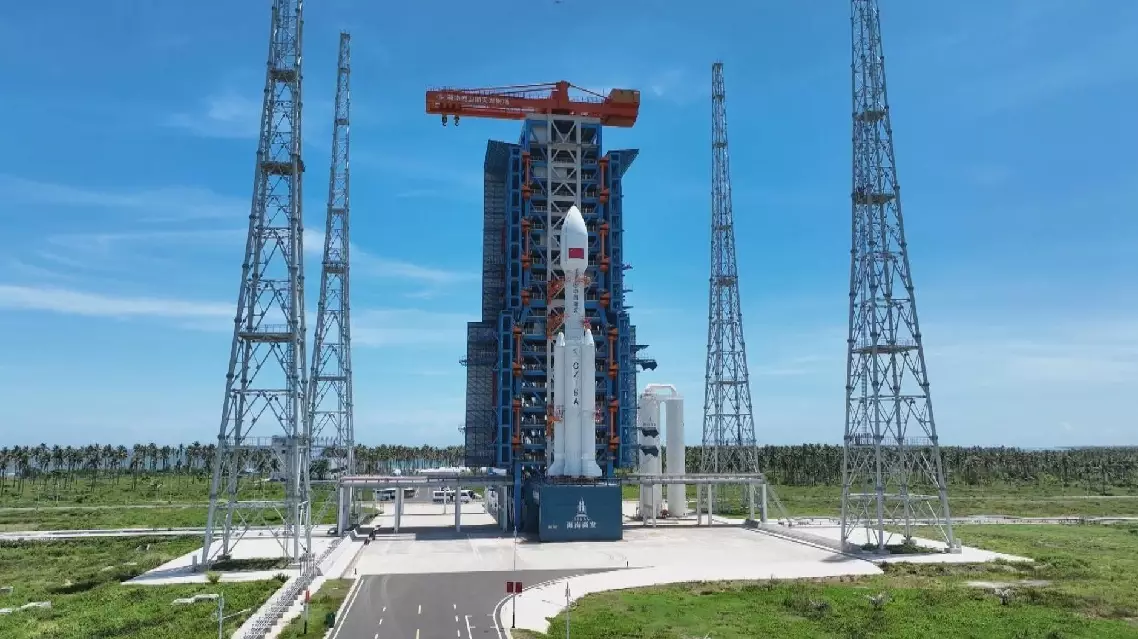
China’s Long March-8A rocket makes strides in multi-mission launch efficiency