COPENHAGEN, Denmark (AP) — Denmark and Greenland on Wednesday officially apologized for their roles in the historic mistreatment of Greenlandic Indigenous girls and women, including forced contraception, in cases that date back to the 1960s.
Jens-Frederik Nielsen, the prime minister of Greenland, said the issue represented “a dark chapter in our history." Danish Prime Minister Mette Frederiksen said that although the past could not be changed, “we can take responsibility.”
Nearly 150 Inuit women last year sued Denmark and filed compensation claims against its health ministry, saying Danish health authorities violated their human rights when they fitted them with intrauterine contraceptive devices, known as IUDs or coils. The devices, fitted in the uterus, prevent sperm from fertilizing an egg.
Some of the women — including many who were teenagers at the time — said they were not told details about the procedure or did not give their consent. Danish authorities last year said as many as 4,500 women and girls — reportedly half of the fertile women in Greenland at the time — received IUDs between the 1960s and mid-1970s.
The alleged purpose was to limit population growth in Greenland by preventing pregnancies. The population on the Arctic island was rapidly increasing at the time because of better living conditions and better health care.
The governments' apology, issued in a joint statement, comes ahead of a report expected next month and related to an investigation into the mistreatment.
“We cannot change what has happened. But we can take responsibility," Frederiksen said in the statement. "That is why I would like to say, on behalf of Denmark: Sorry.”
Frederiksen said her apology also included Denmark's systematic discrimination and other failures and mistreatments against Greenlanders “because they were Greenlanders.” She acknowledged that the forced contraception led to physical and psychological harm.
Nielsen said the government of Greenland, which took over control of its health sector from Copenhagen in 1992, had acknowledged its own responsibility in the forced contraception cases and plans to award compensation to the victims.
“Far too many women were affected in a way that left deep imprints on lives, families and communities,” he wrote in a social media post. “I feel for the women and their loved ones. And I share in their sorrow and anger.”
“It’s sad that an apology only comes now — it’s too late and too bad,” he said.
Mads Pramming, a lawyer representing the women, welcomed the apology but said the case was far from over. What matters is whether the government recognizes that the women's human rights were violated and offers compensation, he said.
“Today they decided to make an apology, to apologize formally. And that’s a big thing, I think," he said. “But they haven’t yet said anything about the lawsuit, and potentially they won’t agree to the lawsuit.”
He added that he was hopeful the apology represented the start of an attempt to repair relations between Denmark and Greenland.
Greenland, which is part of the Danish realm, was a colony under Denmark’s crown until 1953, when it became a province in the Scandinavian country. In 1979 the island was granted home rule, and 30 years later Greenland became a self-governing entity.
Dwayne Menezes, managing director of the Polar Research and Policy Initiative, said the case highlights centuries of Danish policies that dehumanized Greenlanders and their families.
The policies included the forced contraception, as well as the removal of young Inuit children from their parents to be given to Danish foster families for reeducation and controversial parental competency tests that resulted in the forced separation of families.
He said that while most people believe colonialism and its abuses occurred in the “distant past,” the victims of the forced contraception are still alive.
“If we don’t recognize the important lesson this teaches us, we will not recognize in time the manifestations and recurrences of such divisive and dehumanizing policies when they resurface," he said.

FILE - Denmark's Prime Minister Mette Frederiksen, right, and Greenland's Prime Minister Jens-Frederik Nielsen, right, during a statement at Marienborg, Denmark, April 27, 2025. (Mads Claus Rasmussen/Ritzau Scanpix via AP, file)
CAPE CANAVERAL, Fla. (AP) — An ailing astronaut returned to Earth with three others on Thursday, ending their space station mission more than a month early in NASA’s first medical evacuation.
SpaceX guided the capsule to a middle-of-the-night splashdown in the Pacific near San Diego, less than 11 hours after the astronauts exited the International Space Station.
“It’s so good to be home,” said NASA astronaut Zena Cardman, the capsule commander.
It was an unexpected finish to a mission that began in August and left the orbiting lab with only one American and two Russians on board. NASA and SpaceX said they would try to move up the launch of a fresh crew of four; liftoff is currently targeted for mid-February.
Cardman and NASA’s Mike Fincke were joined on the return by Japan’s Kimiya Yui and Russia’s Oleg Platonov. Officials have refused to identify the astronaut who had the health problem or explain what happened, citing medical privacy.
While the astronaut was stable in orbit, NASA wanted them back on Earth as soon as possible to receive proper care and diagnostic testing. The entry and splashdown required no special changes or accommodations, officials said, and the recovery ship had its usual allotment of medical experts on board. It was not immediately known when the astronauts would fly from California to their home base in Houston. Platonov’s return to Moscow was also unclear.
NASA stressed repeatedly over the past week that this was not an emergency. The astronaut fell sick or was injured on Jan. 7, prompting NASA to call off the next day’s spacewalk by Cardman and Fincke, and ultimately resulting in the early return. It was the first time NASA cut short a spaceflight for medical reasons. The Russians had done so decades ago.
The space station has gotten by with three astronauts before, sometimes even with just two. NASA said it will be unable to perform a spacewalk, even for an emergency, until the arrival of the next crew, which has two Americans, one French and one Russian astronaut.
The Associated Press Health and Science Department receives support from the Howard Hughes Medical Institute’s Department of Science Education and the Robert Wood Johnson Foundation. The AP is solely responsible for all content.
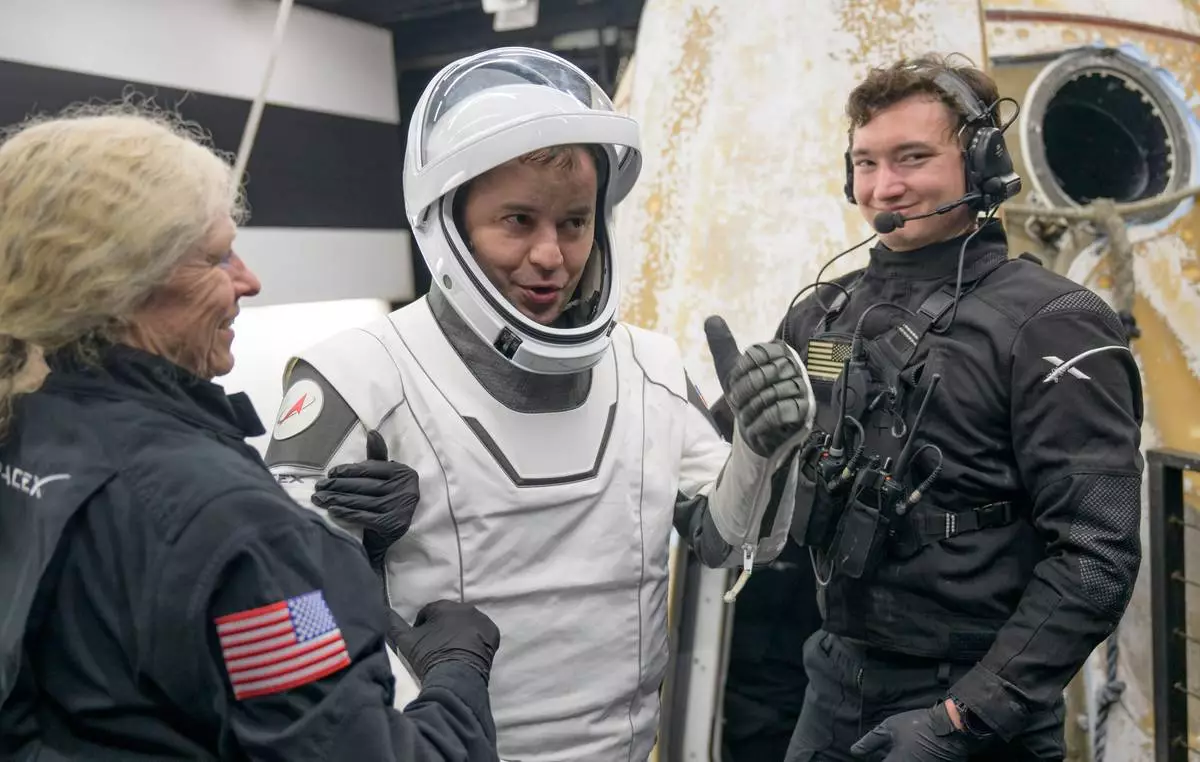
Roscosmos cosmonaut Oleg Platonov is helped out of the SpaceX Dragon Endeavour spacecraft onboard the SpaceX recovery ship SHANNON after they re-entered the earth in a middle-of-the-night splashdown near San Diego, Calif., Thursday, Jan. 15, 2026. (NASA via AP)
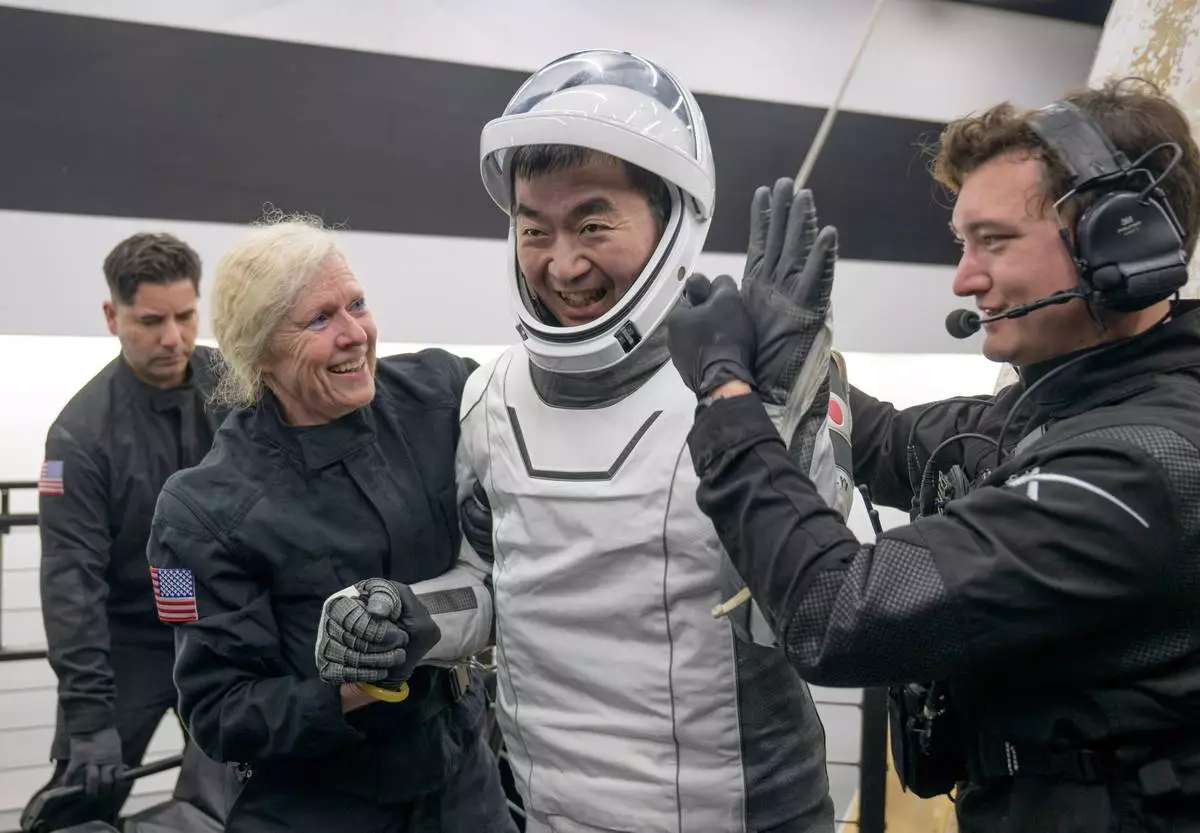
JAXA (Japan Aerospace Exploration Agency) astronaut Kimiya Yui is helped out of the SpaceX Crew-11 capsule after they re-entered the earth in a middle-of-the-night splashdown near San Diego, Calif., Thursday, Jan. 15, 2026. (NASA via AP)
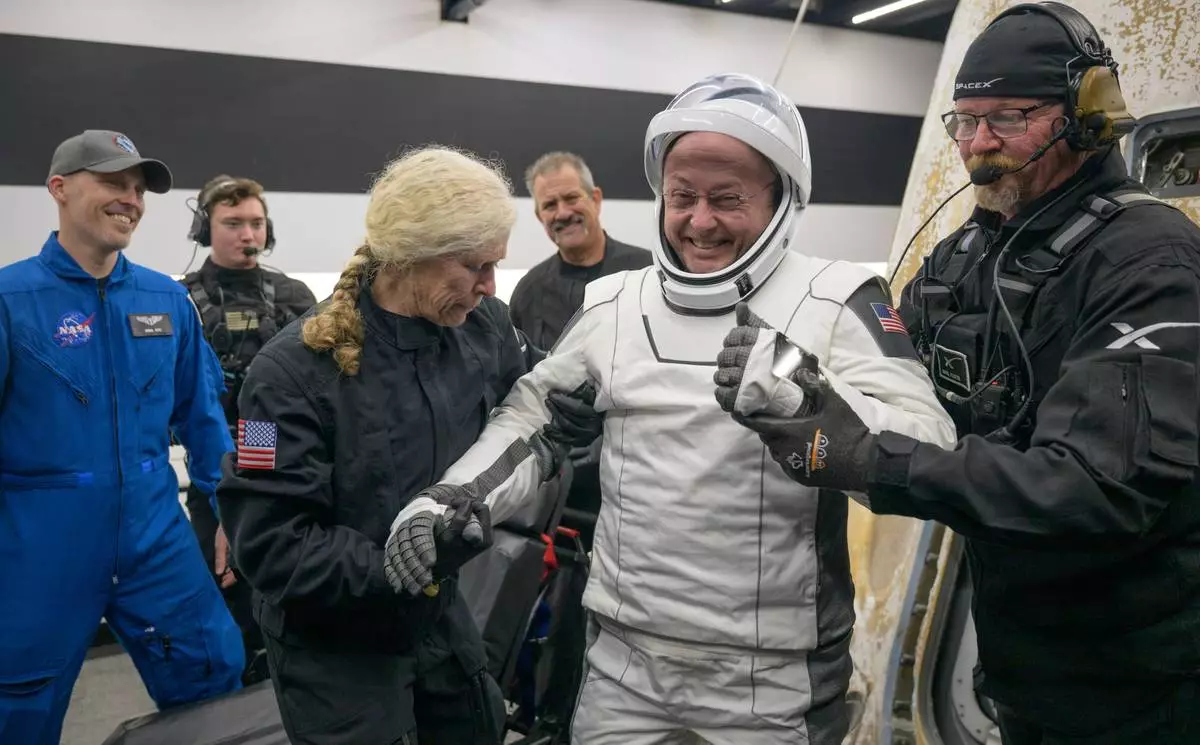
NASA astronaut Mike Fincke is helped out of the SpaceX Crew-11 capsule after they re-entered the earth in a middle-of-the-night splashdown near San Diego, Calif., Thursday, Jan. 15, 2026. (NASA via AP)

NASA astronaut Zena Cardman is helped out of the SpaceX Crew-11 capsule after they re-entered the earth in a middle-of-the-night splashdown near San Diego, Calif., Thursday, Jan. 15, 2026. (NASA via AP)

This screengrab from video provided by NASA shows the NASA's SpaceX Crew-11 capsule being taken into the recovery vessel after crew members re entered the earth in a middle-of-the-night splashdown near San Diego, Calif., Thursday, Jan. 15, 2026. (NASA via AP)
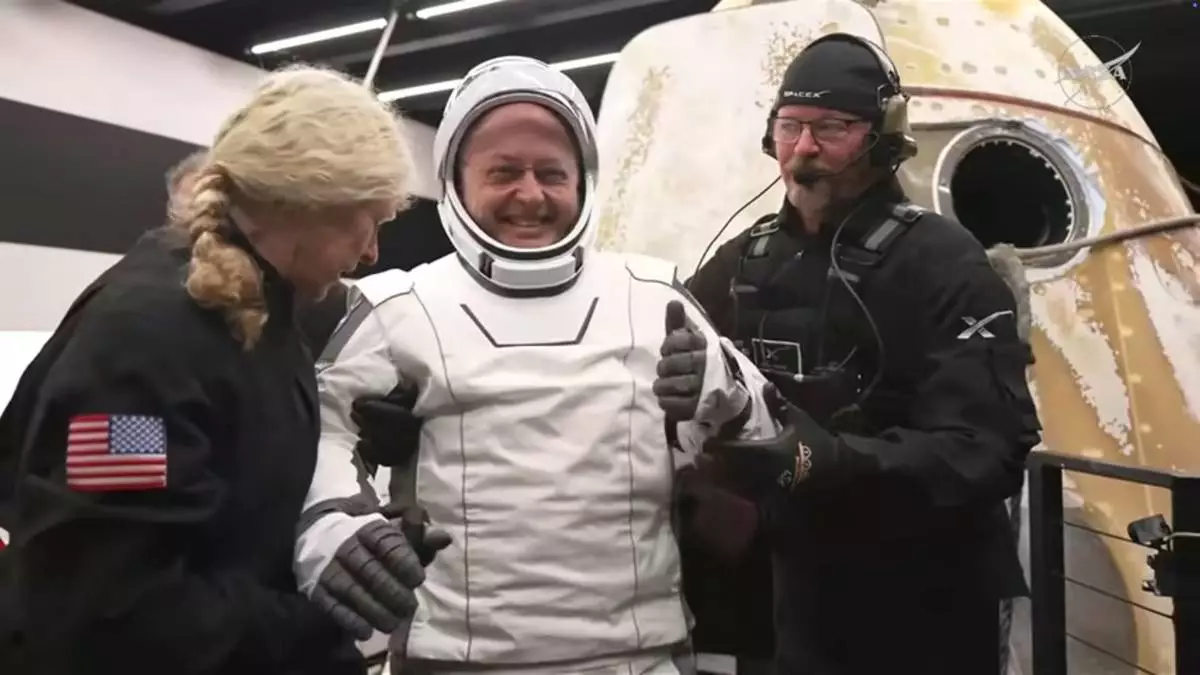
This screengrab from video provided by NASA shows NASA astronaut Mike Fincke getting helped out of the SpaceX Crew-11 capsule after they re-entered the earth in a middle-of-the-night splashdown near San Diego, Calif., Thursday, Jan. 15, 2026. (NASA via AP)

This screengrab from video provided by NASA shows NASA Japanese astronaut Kimiya Yui being helped out of the SpaceX Crew-11 capsule after they re-entered the earth in a middle-of-the-night splashdown near San Diego, Calif., Thursday, Jan. 15, 2026. (NASA via AP)

This screengrab from video provided by NASA shows Russian astronaut Oleg Platonov being helped out of the SpaceX Crew-11 capsule after they re-entered the earth in a middle-of-the-night splashdown near San Diego, Calif., Thursday, Jan. 15, 2026. (NASA via AP)

Roscosmos cosmonaut Oleg Platonov, left, NASA astronauts Mike Fincke, Zena Cardman, and JAXA (Japan Aerospace Exploration Agency) astronaut Kimiya Yui are seen inside the SpaceX Dragon Endeavour spacecraft onboard the SpaceX recovery ship SHANNON shortly after having landed in the Pacific Ocean off the coast of Long Beach, Calif., Thursday, Jan. 15, 2026. (NASA via AP)

This screengrab from video provided by NASA shows NASA astronaut Zena Cardman being helped out of the SpaceX Crew-11 capsule after they re-entered the earth in a middle-of-the-night splashdown near San Diego, Calif., Thursday, Jan. 15, 2026. (NASA via AP)
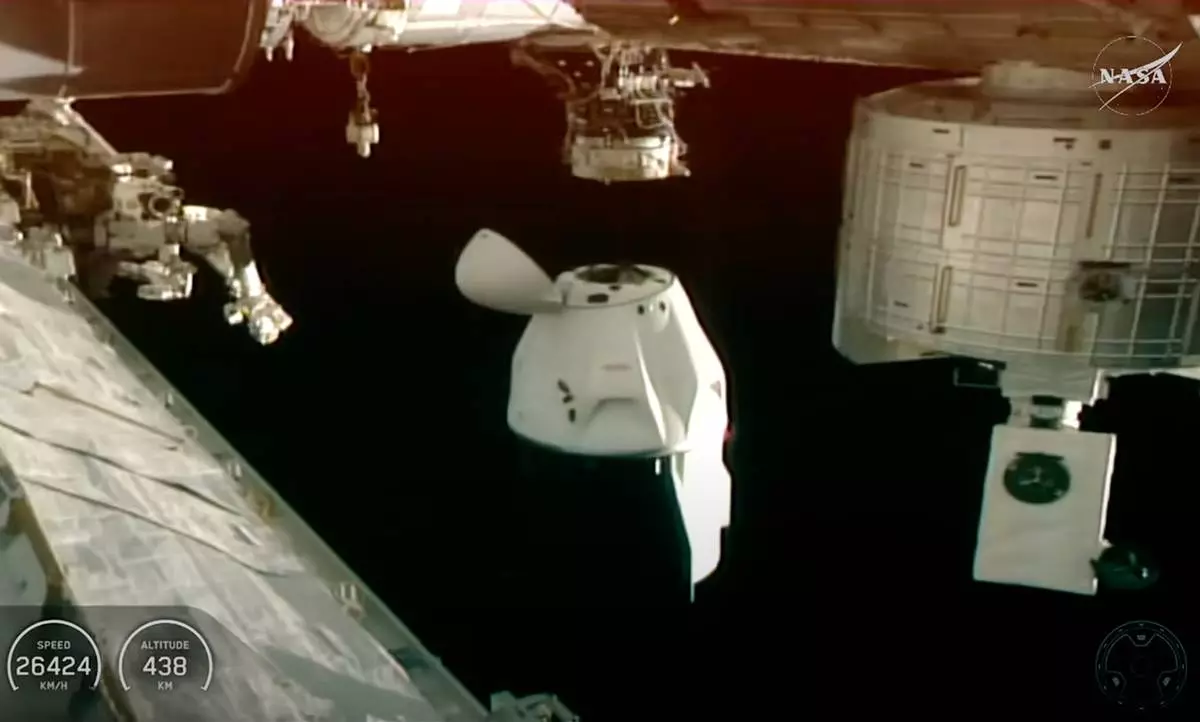
This screengrab from video provided by NASA TV shows the SpaceX Dragon departing from the International Space Station shortly after undocking with four NASA Crew-11 members inside on Wednesday, Jan. 14, 2026. (NASA via AP)
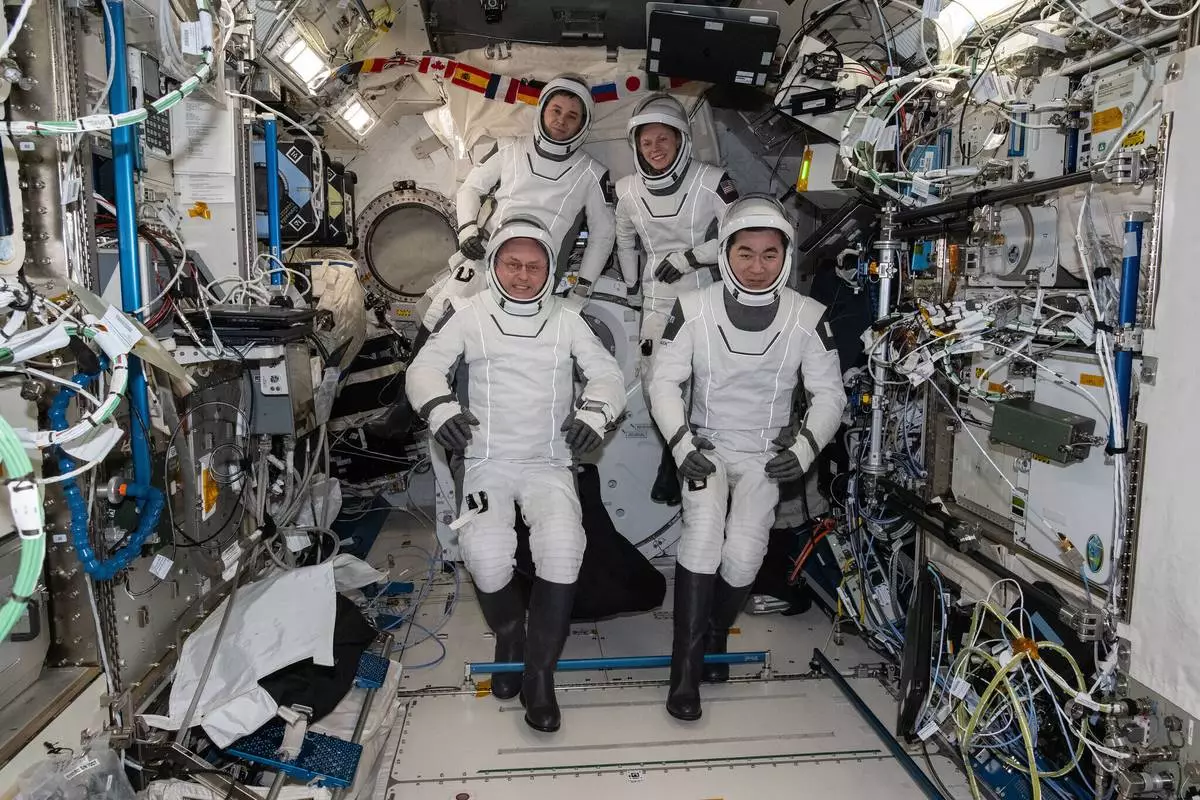
This photo provided by NASA shows clockwise from bottom left are, NASA astronaut Mike Fincke, Roscosmos cosmonaut Oleg Platonov, NASA astronaut Zena Cardman, and JAXA (Japan Aerospace Exploration Agency) astronaut Kimiya Yui gathering for a crew portrait wearing their Dragon pressure suits during a suit verification check inside the International Space Station’s Kibo laboratory module, Wednesday, Jan. 14, 2026. (NASA via AP)
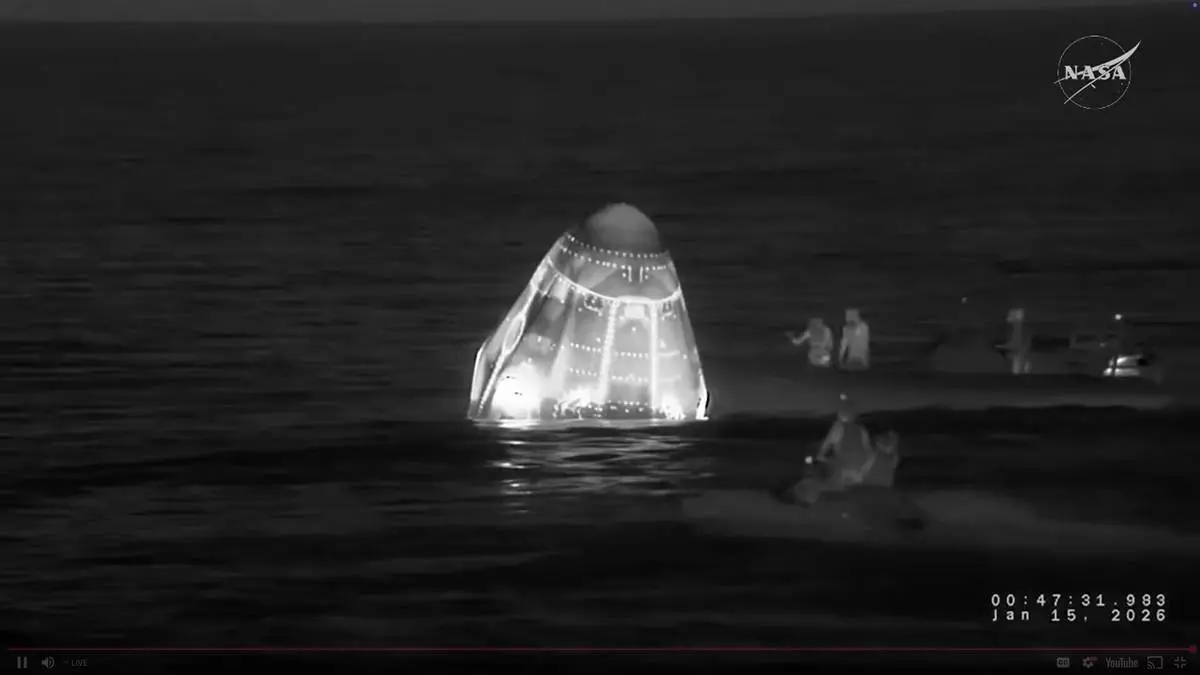
This screengrab from video provided by NASA shows recovery vessels approaching the NASA's SpaceX Crew-11 capsule to evacuate one of the crew members after they re-entered the earth in a middle-of-the-night splashdown near San Diego, Calif., Thursday, Jan. 15, 2026. (NASA via AP)
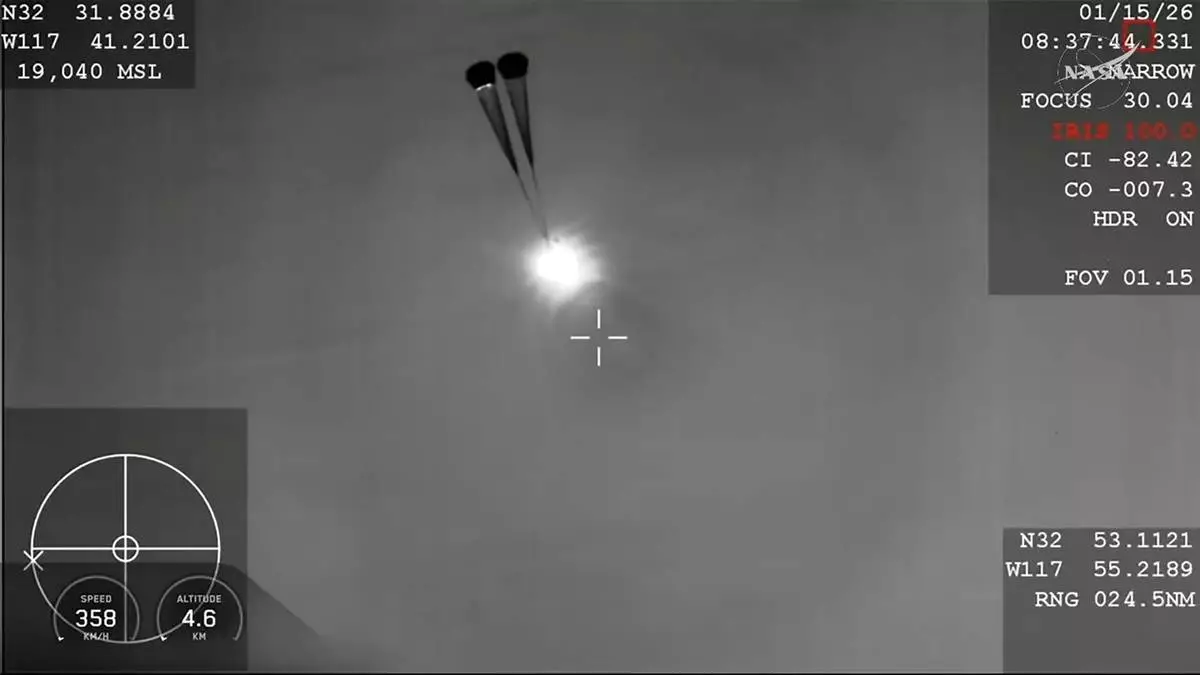
This screengrab from video provided by NASA shows the NASA's SpaceX Crew-11 members re entering the earth in a middle-of-the-night splashdown near San Diego, Calif., Thursday, Jan. 15, 2026. (NASA via AP)
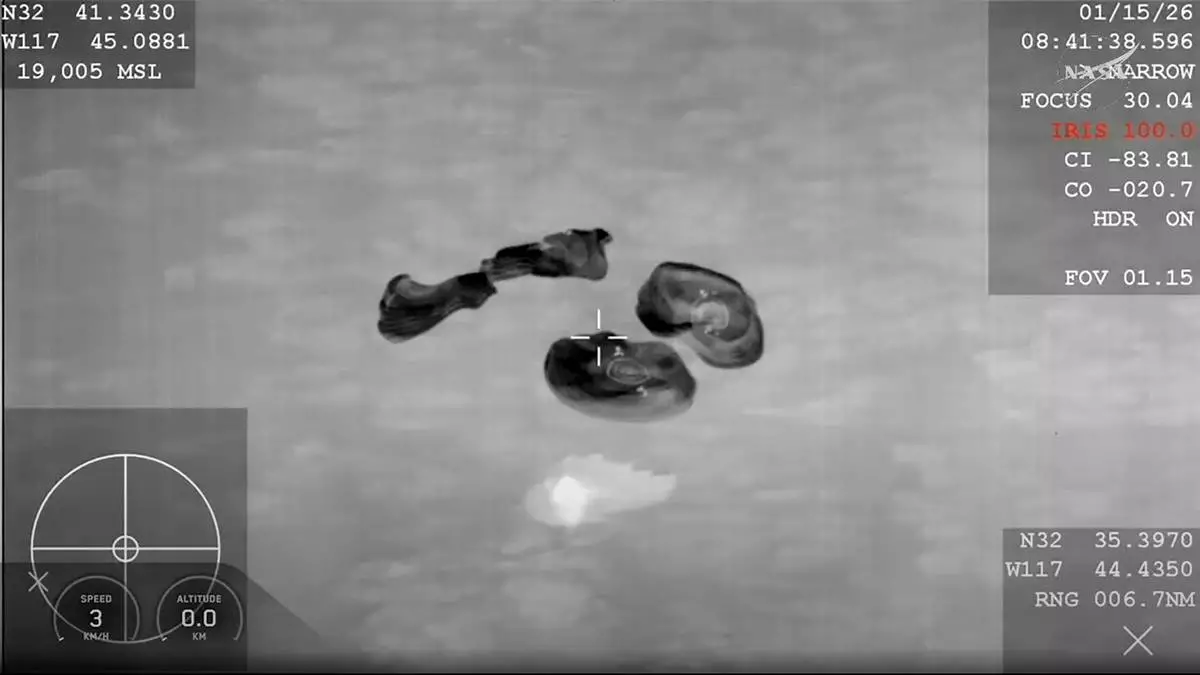
This screengrab from video provided by NASA shows the NASA's SpaceX Crew-11 members re entering the earth in a middle-of-the-night splashdown near San Diego, Calif., Thursday, Jan. 15, 2026. (NASA via AP)