Skip to Content Facebook Feature Image

NTSB focused on controllers after B-52 bomber and two planes nearly collided over North Dakota

News

NTSB focused on controllers after B-52 bomber and two planes nearly collided over North Dakota
News

News

NTSB focused on controllers after B-52 bomber and two planes nearly collided over North Dakota

2025-08-29 03:46 Last Updated At:03:50

Shortly after an airliner made an aggressive maneuver to avoid colliding with a B-52 last month over North Dakota, the bomber nearly collided with a small private plane as it flew past the Minot airport, according to the National Transportation Safety Board.

Investigators released their preliminary report Wednesday on the July 18 incident that happened after the bomber completed a flyover at the North Dakota State Fair in Minot. The close call with Delta Flight 3788 is well known because of a video a passenger shot of the pilot's announcement after making an abrupt turn to avoid the bomber. But the fact that the B-52 subsequently came within one-third of a mile of a small Piper airplane hadn't been previously reported.

The SkyWest pilot told his passengers that day that he was surprised to see the bomber looming to the right, and the U.S. Air Force also said that air traffic controllers never warned the B-52 crew about the nearby airliner. Officials said at the time that the flyover had been cleared with the FAA and the private controllers who oversee the Minot airport ahead of time.

The NTSB report on these close calls focuses on the actions of air traffic controllers that day. This incident was just the latest one to raise questions about aviation safety in the wake of January’s midair collision over Washington, D.C., that killed 67 people.

The NTSB report doesn't identify the cause of the incidents, but the transcript of the conversation between the three planes, the air traffic controller on duty in Minot and a regional FAA controller at a radar center in Rapid City, South Dakota, show several confusing commands were issued by the tower that day. Investigators won't release their final report on the cause until sometime next year.

With the B-52 and Delta planes converging on the airport from different directions, the controller told the Delta plane that was carrying 80 people to fly in a circle to the right until the pilot told the controller he didn't want to do that because the bomber was off to his right, so he broke off his approach.

“Sorry about the aggressive maneuver. It caught me by surprise,” the pilot can be heard saying on the video a passenger posted on social media. “This is not normal at all. I don’t know why they didn’t give us a heads up.”

At one point, the controller intended to give the Delta plane directions but mistakenly called out the bomber's call sign and had to cancel that order.

Less than a minute after the B-52 crossed the path of the airliner, it nearly struck the small plane that was also circling while the bomber flew past the airport on its way back to Minot Air Force Base where 26 of the bombers are based.

The Air Force said in a statement Thursday that the controller also didn't tell the bomber's crew about the presence of the Piper airplane, but the B-52 pilots maintained visual separation with the small plane even as they reached as close as one-third of a mile apart.

“Safety remains our top priority,” the Air Force said in its statement. “We continue to fully cooperate with the ongoing NTSB investigation. We are committed to upholding the highest standards of professionalism and safety in all our operations.”

Aviation safety consultant Jeff Guzzetti, who used to investigate plane crashes for both the NTSB and FAA, said the controller didn't give the commands for the Delta and Piper planes to circle soon enough for them to stay a safe distance away from the bomber.

The transcript shows the local controller calling the regional FAA controller to get permission every time before he issued a command to the planes. Guzzetti said it is not clear whether taking that extra step to consult with the other controller delayed the commands or whether the Minot controller simply didn't anticipate how close the planes would come.

“It all just kind of came together at the same time very quickly, and this controller was not on top of it,” Guzzetti said.

The Minot airport typically handles between 18 and 24 flights a day. But at this moment, three planes were all arriving at the same time.

After the close calls, all the planes landed safely.

These North Dakota close calls put the spotlight on small airports like Minot that operate without their own radar systems, but it is not clear whether that contract tower program that includes 265 airport towers nationwide had anything to do with the incident. There was one controller staffing the tower in Minot at the time of incident, and a controller at a regional radar center in Rapid City was helping direct planes in the area.

This story has been updated to clarify that the NTSB investigation is focused on the air traffic controllers.
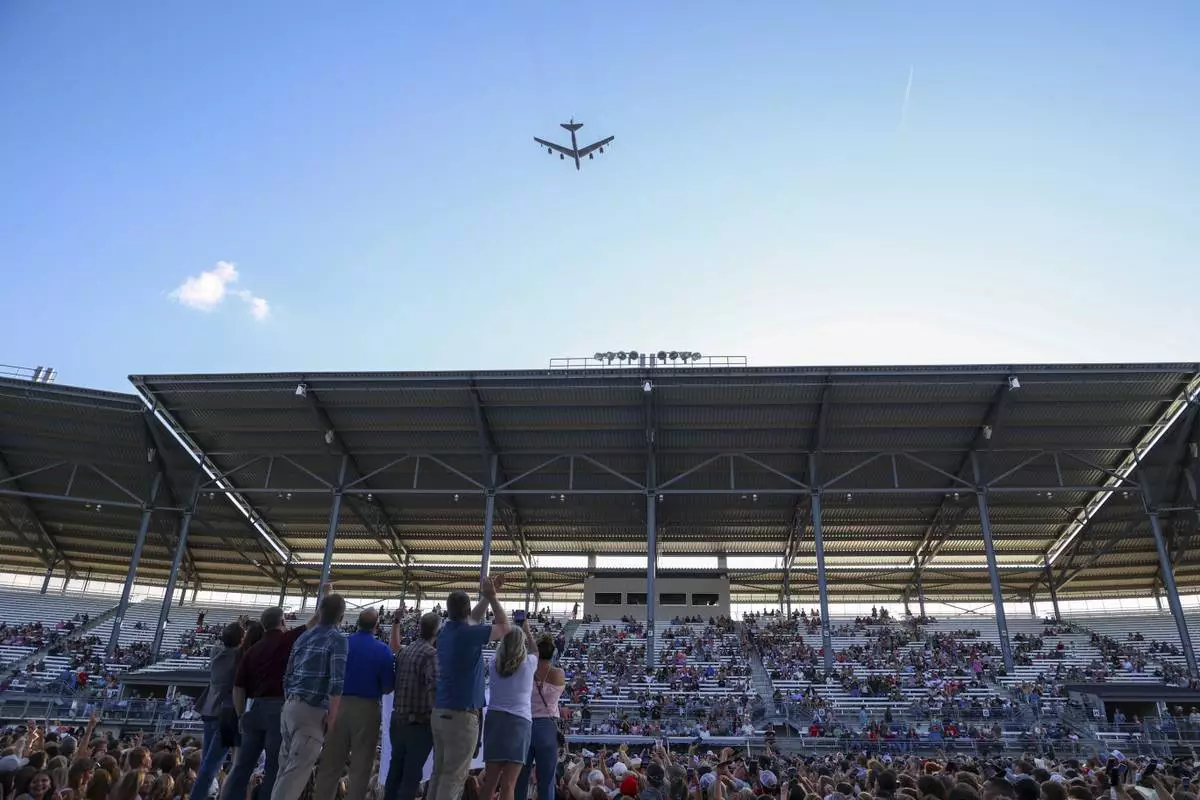
FILE - This photo provided by the North Dakota Governor's Office shows a B-52 bomber from Minot Air Force Base in a flyover at the North Dakota State Fair on July 18, 2025, in Minot, N.D. (North Dakota Governor's Office via AP, File)
FILE - This photo provided by the North Dakota Governor's Office shows a B-52 bomber from Minot Air Force Base in a flyover at the North Dakota State Fair on July 18, 2025, in Minot, N.D. (North Dakota Governor's Office via AP, File)
DUBAI, United Arab Emirates (AP) — Iranians could call abroad on mobile phones Tuesday for the first time since communications were halted during a crackdown on nationwide protests in which activists said at least 646 people have been killed.

Several people in Tehran were able to call The Associated Press and speak to a journalist there. The AP bureau in Dubai, United Arab Emirates, was unable to call those numbers back. The witnesses said SMS text messaging still was down and that internet users in Iran could connect to government-approved websites locally but nothing abroad.

The witnesses gave a brief glimpse into life on the streets of the Iranian capital over the four and a half days of being cut off from the world. They described seeing a heavy security presence in central Tehran.

Anti-riot police officers, wearing helmets and body armor, carried batons, shields, shotguns and tear gas launchers. They stood watch at major intersections. Nearby, the witnesses saw members of the Revolutionary Guard's all-volunteer Basij force, who similarly carried firearms and batons. Security officials in plainclothes were visible in public spaces as well.

Several banks and government offices were burned during the unrest, they said. ATMs had been smashed and banks struggled to complete transactions without the internet, the witnesses added.

However, shops were open, though there was little foot traffic in the capital. Tehran's Grand Bazaar, where the demonstrations began Dec. 28, was to open Tuesday. However, a witness described speaking to multiple shopkeepers who said the security forces ordered them to reopen no matter what. Iranian state media had not acknowledged that order.

The witnesses spoke on condition of anonymity for fear of reprisal.

U.S. President Donald Trump has said Iran wants to negotiate with Washington after his threat to strike the Islamic Republic over its crackdown.

Iranian Foreign Minister Abbas Araghchi, speaking to the Qatar-funded satellite news network Al Jazeera in an interview aired Monday night, said he continued to communicate with U.S. envoy Steve Witkoff.

The communication “continued before and after the protests and are still ongoing," Araghchi said. However, “Washington’s proposed ideas and threats against our country are incompatible.”

White House press secretary Karoline Leavitt said Iran’s public rhetoric diverges from the private messaging the administration has received from Tehran in recent days.

“I think the president has an interest in exploring those messages,” Leavitt said. “However, with that said, the president has shown he’s unafraid to use military options if and when he deems necessary, and nobody knows that better than Iran.”

Meanwhile, pro-government demonstrators flooded the streets Monday in support of the theocracy, a show of force after days of protests directly challenging the rule of 86-year-old Supreme Leader Ayatollah Ali Khamenei. Iranian state television aired chants from the crowd, which appeared to number in the tens of thousands, who shouted “Death to America!” and “Death to Israel!”

Others cried out, “Death to the enemies of God!” Iran’s attorney general has warned that anyone taking part in protests will be considered an “enemy of God,” a death-penalty charge.

Trump announced Monday that countries doing business with Iran will face 25% tariffs from the United States. Trump announced the tariffs in a social media posting, saying they would be “effective immediately.”

It was action against Iran for the protest crackdown from Trump, who believes exacting tariffs can be a useful tool in prodding friends and foes on the global stage to bend to his will.

Brazil, China, Russia, Turkey and the United Arab Emirates are among economies that do business with Tehran.

Trump said Sunday that his administration was in talks to set up a meeting with Tehran, but cautioned that he may have to act first as reports of the death toll in Iran mount and the government continues to arrest protesters.

“I think they’re tired of being beat up by the United States,” Trump said. “Iran wants to negotiate.”

Iran, through the country’s parliamentary speaker, warned Sunday that the U.S. military and Israel would be “legitimate targets” if Washington uses force to protect demonstrators.

More than 10,700 people also have been detained over the two weeks of protests, said the U.S.-based Human Rights Activists News Agency, which has been accurate in previous unrest in recent years and gave the latest death toll early Tuesday. It relies on supporters in Iran crosschecking information. It said 512 of the dead were protesters and 134 were security force members.

With the internet down in Iran, gauging the demonstrations from abroad has grown more difficult. The Associated Press has been unable to independently assess the toll. Iran’s government hasn’t offered overall casualty figures.

A picture of Ayatollah Ali Khamenei is set alight by protesters outside the Iranian Embassy in London, Monday, Jan. 12, 2026. (AP Photo/Alastair Grant)

A picture of Ayatollah Ali Khamenei is set alight by protesters outside the Iranian Embassy in London, Monday, Jan. 12, 2026. (AP Photo/Alastair Grant)

In this frame grab from footage circulating on social media shows protesters dancing and cheering around a bonfire as they take to the streets despite an intensifying crackdown as the Islamic Republic remains cut off from the rest of the world, in Tehran, Iran, Friday, Jan. 9, 2026.(UGC via AP)

In this frame grab from footage circulating on social media shows protesters dancing and cheering around a bonfire as they take to the streets despite an intensifying crackdown as the Islamic Republic remains cut off from the rest of the world, in Tehran, Iran, Friday, Jan. 9, 2026.(UGC via AP)

In this frame grab from footage circulating on social media from Iran showed protesters once again taking to the streets of Tehran despite an intensifying crackdown as the Islamic Republic remains cut off from the rest of the world in Tehran, Iran, Saturday Jan. 10, 2026. (UGC via AP)

In this frame grab from footage circulating on social media from Iran showed protesters once again taking to the streets of Tehran despite an intensifying crackdown as the Islamic Republic remains cut off from the rest of the world in Tehran, Iran, Saturday Jan. 10, 2026. (UGC via AP)

FILE - Protesters march on a bridge in Tehran, Iran, on Dec. 29, 2025. (Fars News Agency via AP, File)

FILE - Protesters march on a bridge in Tehran, Iran, on Dec. 29, 2025. (Fars News Agency via AP, File)

Recommended Articles