WASHINGTON (AP) — The United States is boosting its maritime force in the waters off Venezuela to combat threats from Latin American drug cartels with the expected arrival of more vessels next week, an action that will undoubtedly fuel more speculation in Venezuela.
The U.S. government has not signaled any planned land incursion from the thousands of personnel being deployed, and analysts and current and former government officials see no possibility of an invasion in Venezuela.
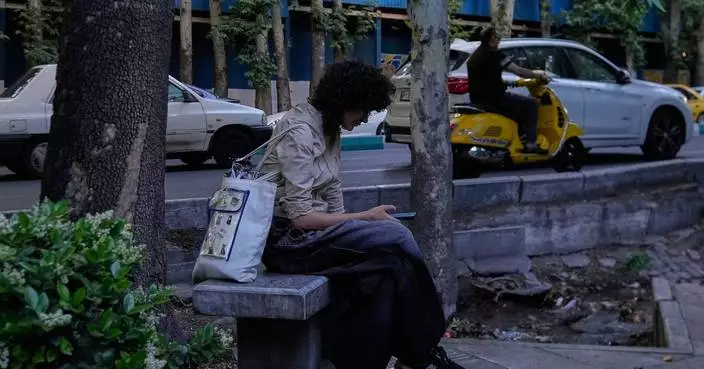
Still, the deployment has dominated conversations in the streets and at dinner tables in Venezuela, where an alleged threat of invasion is spilling over from social media and state television.
The government has capitalized on the speculation by appealing to people, primarily its diminishing base, to enlist in a beleaguered militia, while the opposition is again characterizing U.S. actions as a sign of President Nicolás Maduro’s rule nearing an end.
The U.S. Navy now has two Aegis guided-missile destroyers — the USS Gravely and the USS Jason Dunham — in the Caribbean, as well as the destroyer USS Sampson and the cruiser USS Lake Erie in the Pacific Ocean off Latin America, according to a defense official, who spoke on the condition of anonymity to describe ongoing operations.
That military presence is set to expand. Three amphibious assault ships — a force that encompasses more than 4,000 sailors and Marines — would be entering the waters off Latin America by next week, the official said.
Pentagon officials have refused to say exactly where the USS Iwo Jima, the USS San Antonio and the USS Fort Lauderdale are heading.
Here’s what to know about the situation:
Adm. Daryl Caudle, the new chief of naval operations, told reporters that U.S. ships are heading into waters off South America to support “Venezuelan operations and missions” that involve drug cartels.
Speaking Thursday at a Navy base in Norfolk, Virginia, Caudle cited the concern that some Venezuelans are taking part in large drug operations. But he declined to provide specifics about the military’s goals, saying much of the information is classified.
Caudle said his job is to provide naval forces for military commanders to deploy, which in turn gives “the president and secretary of defense options."
The deployment comes as President Donald Trump has pushed for using the military to thwart cartels he blames for the flow of fentanyl and other illicit drugs into American communities and for perpetuating violence in some U.S. cities.
White House press secretary Karoline Leavitt was asked by a reporter Thursday about the presence of the U.S. warships and whether the Republican president was considering military strikes on Venezuela.
She said she would not get ahead of Trump but many nations in the region cheered U.S. counterdrug efforts and “the president is prepared to use every element of American power to stop drugs from flooding into our country and to bring those responsible to justice.”
Trump has designated Venezuela’s Tren de Aragua, MS-13 in El Salvador and six groups based in Mexico as foreign terrorist organizations, pointing to the international connections and operations of the groups that include drug trafficking, migrant smuggling and violent pushes to extend their territory.
Christopher Sabatini, a research fellow at the Chatham House in London, said the deployment, the Tren de Aragua’s designation and the recent doubling of a bounty for Maduro are parts of the White House’s strategy of making “as much noise as possible” to satisfy Venezuela’s opposition, many of whom are Trump supporters, and to “scare maneuver” high-level government officials into defecting.
But, he added, “there’s no realism here in terms of the likelihood of an actual invasion.”
When a state television presenter on Monday asked Maduro for his take on “these siren songs about a fleet of marines coming to end” his government, the president said more than 90% of Venezuelans reject the “announcements and threats from the U.S. government.”
“We, Venezuelans, are within our own law, and no one touches this land,” Maduro added during his weekly television show.
Maduro also repudiated the drug trafficking accusations from the U.S. and insisted Venezuela, unlike neighboring Colombia, is “free of coca leaf crops and free of cocaine production.” He also suggested that drug crimes are the White House’s accusations du jour.
“They have changed the narrative and no longer accuse those they want to destroy of being communists. That was the accusation they made during the Soviet Union,” Maduro said. “They no longer accuse them of being terrorists … (like) when they accused Iraq, Afghanistan and Libya of being terrorists. Now, the crude — I’d say extravagant — outlandish accusation is drug trafficking.”
Venezuela’s U.N. Ambassador Samuel Moncada met with Secretary-General Antonio Guterres on Thursday and said he asked the U.N. chief to call on the U.S. government to stop “all its hostile actions and threats” and respect his country’s sovereignty and territorial integrity.
The announcement of the U.S. deployment prompted Maduro to call on Venezuelans to join a volunteer militia meant to assist the armed forces in case of attack. Members hosted sign-up drives over the past weekend, which Maduro characterized as successful without providing the number of new recruits.
The government has scheduled enlistment events for Friday and Saturday.
The ruling party has long claimed the militia's membership to be above 4.5 million, but that is certainly an overcount as support for the government has plummeted, and millions, including Maduro supporters, have migrated in search of better living conditions.
The figure contrasts sharply with the results of last year’s presidential election, which ruling party-loyal electoral authorities said Maduro won despite credible evidence to the contrary. Electoral authorities claimed Maduro received 6.4 million votes, while detailed tally sheets released from the opposition showed he lost with 3.4 million votes.
Opposition leader Maria Corina Machado, whose surrogate Edmundo González is recognized by the U.S. and several other governments as the legitimate winner of the 2024 election, appeared on Fox News following the announcement and thanked Trump administration officials for taking “the right approach, with courage and clarity, towards the criminal enterprise that has taken over” Venezuela.
"The time has come for change," Machado said.
She also posted on X that Venezuelans had “disobeyed” the government by not showing up to last weekend's militia recruitment effort.
“The empty squares of Venezuela today herald the future that is approaching,” she wrote.
But that promise is not new for Venezuelans.
Sabatini of Chatham House criticized opposition leaders for “cynically manipulating people’s hopes” again and “falling into this trap that an invasion is imminent.”
“They’ve just been sort of parked in neutral,” Sabatini said, referring to the faction’s inability to energize its base since the presidential election. “This is a new opportunity they’re trying to seize on.”
Garcia Cano reported from Mexico City. Associated Press writers Ben Finley in Norfolk, Va., and Edith M. Lederer at the United Nations contributed to this report.
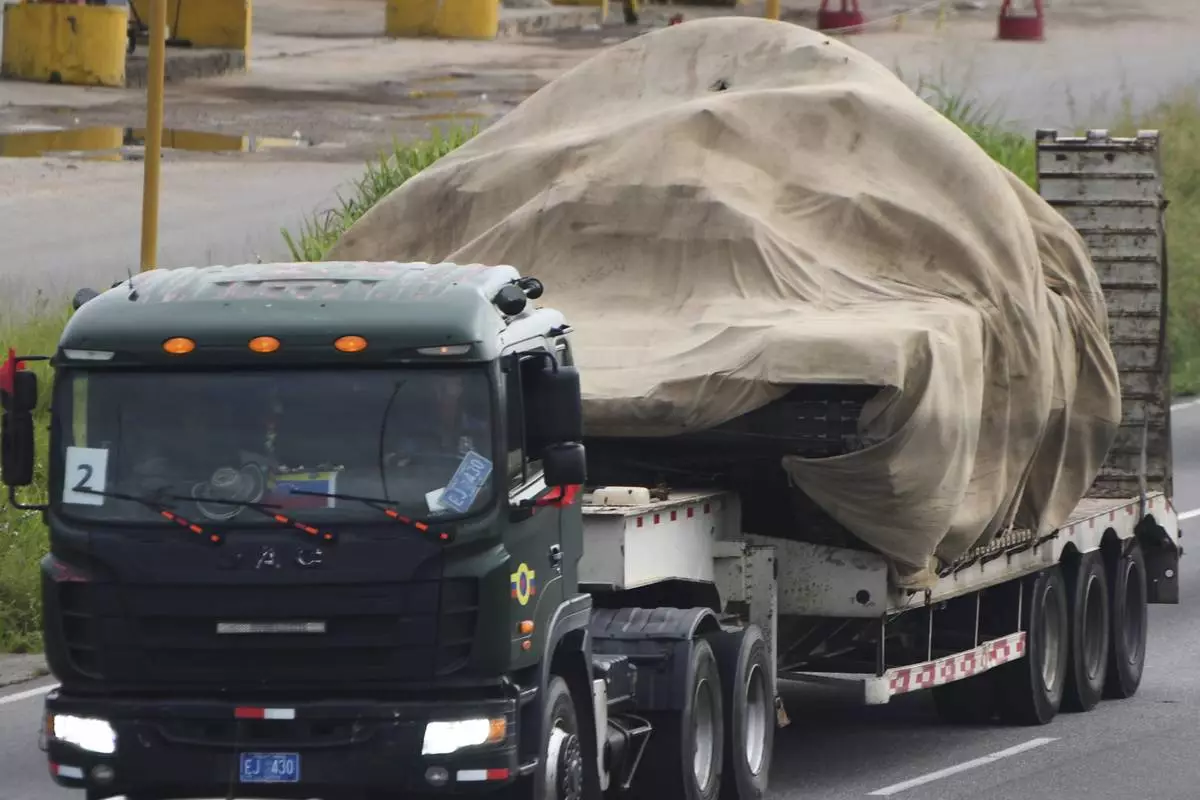
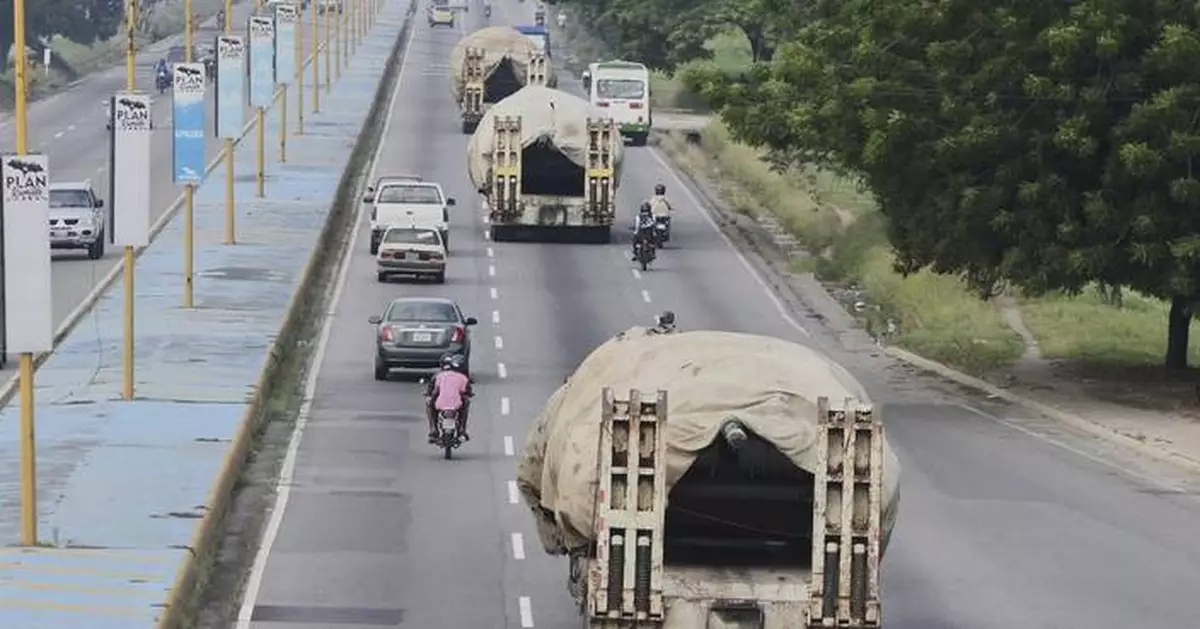
Trucks transport tanks east from Valencia, Venezuela, Wednesday, Aug. 27, 2025, after the government announced a military mobilization following the U.S. deployment of warships off Venezuela. (AP Photo/Jacinto Oliveros)
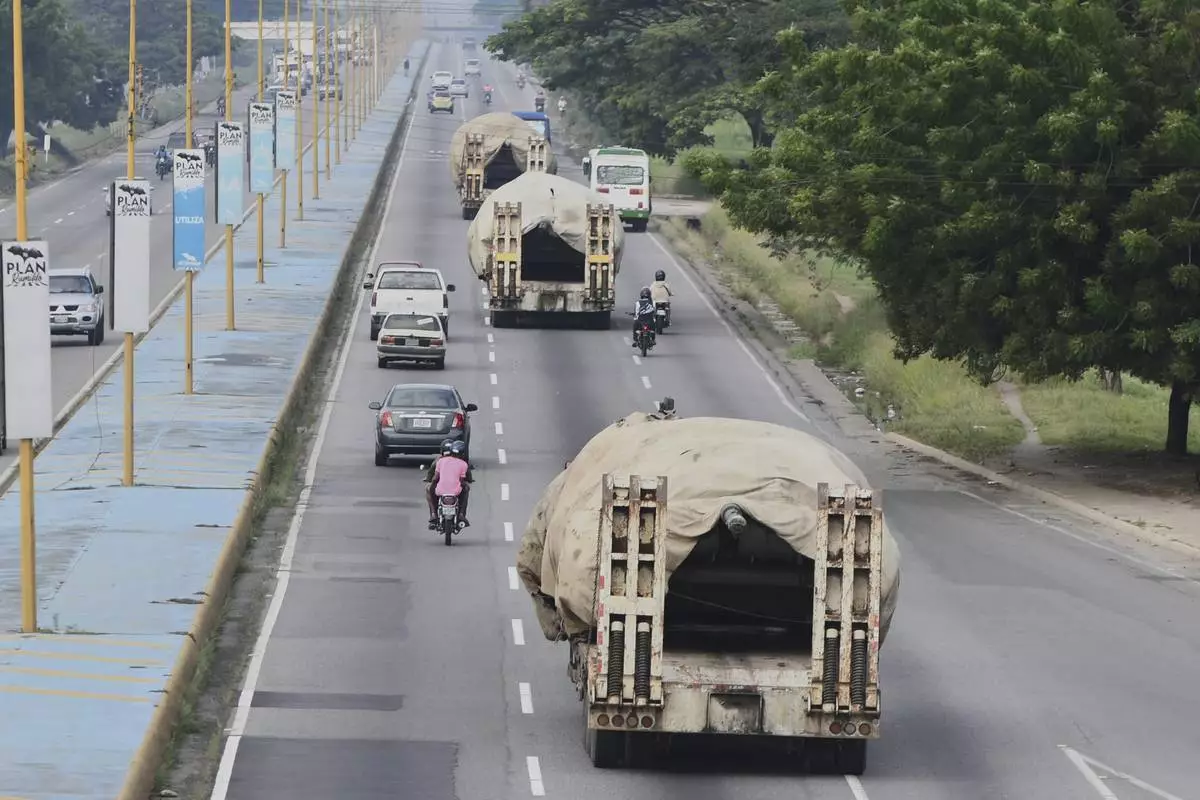
Trucks transport tanks east from Valencia, Venezuela, Wednesday, Aug. 27, 2025, after the government announced a military mobilization following the U.S. deployment of warships off Venezuela. (AP Photo/Jacinto Oliveros)