TOKYO (AP) — Japan plans to deploy its domestically developed long-range missiles a year earlier than planned, the Defense Ministry announced Friday, as the country steps up efforts to strengthen its strike-back capability in response to rising challenges in the region.
Under the new schedule, a first batch of the domestically developed Type-12 anti-ship missiles will be installed at its army's Camp Kengun in Japan's southwestern prefecture of Kmuamoto by March 2026, the ministry said. The Type-12 missile has a range of about 1,000 kilometers (620 miles).
Japan is seeking to create a more self-sufficient military as a deterrence against China’s increasingly assertive naval activity in regional seas. Japan in June spotted two Chinese aircraft carriers almost simultaneously operating near southern Japanese islands for the first time.
Japan also has concerns about the rising tensions caused by North Korea and Russia.
These efforts mark a historic shift. Japan, under its post-World War II pacifist constitution, used to limit the use of force for self-defense only. But it made a major break from that policy in 2022 when it adopted a five-year security strateg y that names China as its biggest strategic challenge and calls for a closer Japan-U.S. alliance and more offensive roles for Japan's Self-Defense Forces.
The country is boosting military spending to 2% of GDP by 2027 from an earlier level of about 1% under the buildup plan, while facing pressure from the United States, a treaty ally, to do more.
The announcement of the accelerated missile schedule coincides with a ministry request for a record 8.8 trillion yen ($59.9 billion) in the fiscal 2026 budget to focus on long-range missiles and drones to counter threats from China, North Korea, and Russia.
With domestically produced missiles still under development, Japan plan to deploy U.S.-developed Tomahawks later this year.
The ministry is also seeking to deploy unmanned air, sea-surface and underwater drones for surveillance to defend Japanese coastlines, as a country with an aging and declining population struggles with an understaffed military.
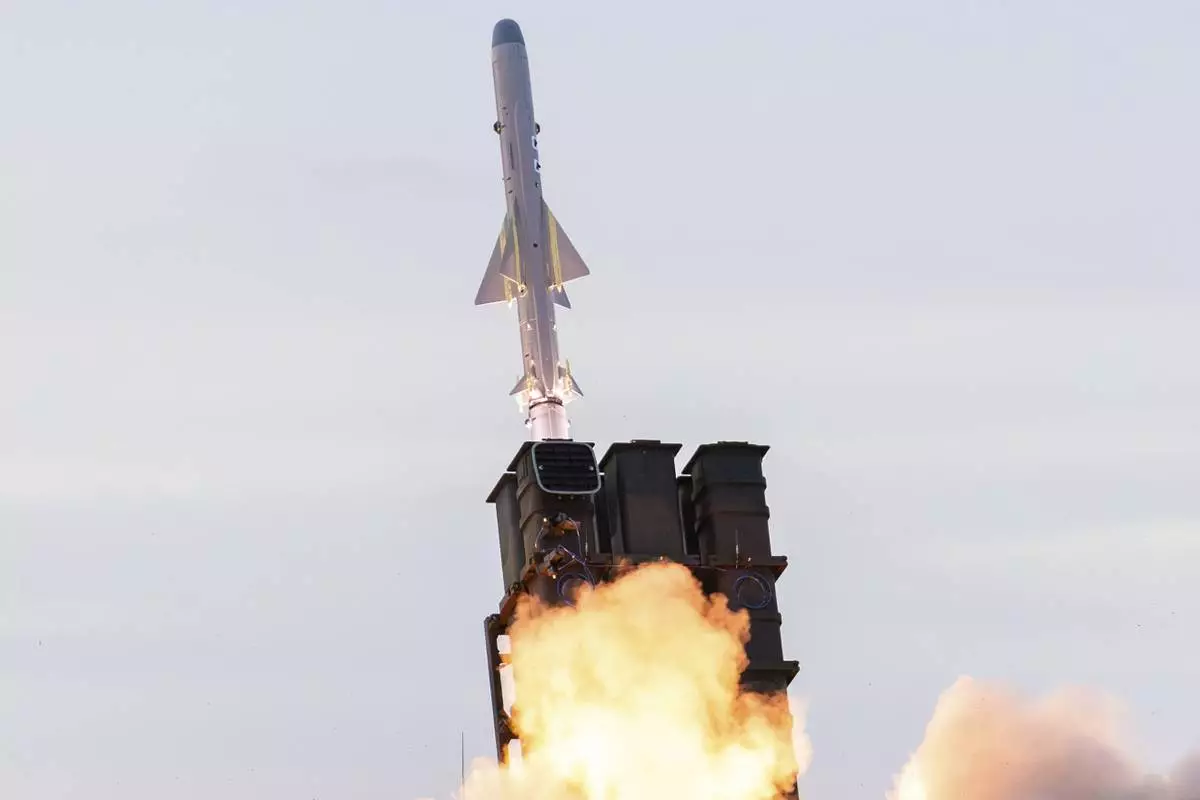
FILE - In this photo provided by the Australian Department of Defense, a Japanese Type 12 surface-to-ship missile is launched by the Second Artillery Brigade of the Japan Ground Self-Defense Force at Beecroft Weapons Range near Jervis Bay, Australia, on Tuesday, July 22, 2025, as part of Talisman Sabre, a biennial joint exercise involving 19 nations and 35,000 military personnel. (PTE Alex Brown/Australian Department of Defense via AP)
A federal appeals panel on Thursday reversed a lower court decision that released former Columbia University graduate student Mahmoud Khalil from an immigration jail, bringing the government one step closer to detaining and ultimately deporting the Palestinian activist.
The three-judge panel of the 3rd U.S. Circuit Court of Appeals didn’t decide the key issue in Khalil’s case: whether the Trump administration’s effort to throw Khalil out of the U.S. over his campus activism and criticism of Israel is unconstitutional.
But in its 2-1 decision, the panel ruled a federal judge in New Jersey didn’t have jurisdiction to decide the matter at this time. Federal law requires the case to fully move through the immigration courts first, before Khalil can challenge the decision, they wrote.
“That scheme ensures that petitioners get just one bite at the apple — not zero or two,” the panel wrote. “But it also means that some petitioners, like Khalil, will have to wait to seek relief for allegedly unlawful government conduct.”
The law bars Khalil “from attacking his detention and removal in a habeas petition,” the panel added.
It was not clear whether the government would seek to detain Khalil, a legal permanent resident, again while his legal challenges continue.
Thursday’s decision marked a major win for the Trump administration’s sweeping campaign to detain and deport noncitizens who joined protests against Israel.
In a statement distributed by the American Civil Liberties Union, Khalil said the appeals ruling was “deeply disappointing, but it does not break our resolve.”
He added: “The door may have been opened for potential re-detainment down the line, but it has not closed our commitment to Palestine and to justice and accountability. I will continue to fight, through every legal avenue and with every ounce of determination, until my rights, and the rights of others like me, are fully protected.”
Baher Azmy, one of Khalil's lawyers, said the ruling was “contrary to rulings of other federal courts.” He noted the panel’s finding concerned a “hypertechnical jurisdictional matter,” rather than the legality of the Trump administration’s policy.
“Our legal options are by no means concluded, and we will fight with every available avenue,” he added, saying Khalil would remain free pending the full resolution of all appeals, which could take months or longer.
The ACLU said the Trump administration cannot lawfully re-detain Khalil until the order takes formal effect, which won't happen while he can still immediately appeal.
Khalil's lawyers can request the active judges on the 3rd Circuit hear an appeal, or they can go to the U.S. Supreme Court.
An outspoken leader of the pro-Palestinian movement at Columbia, Khalil was arrested on March 8, 2025. He then spent three months detained in a Louisiana immigration jail, missing the birth of his firstborn.
Federal officials have accused Khalil of leading activities “aligned to Hamas,” though they have not presented evidence to support the claim and have not accused him of criminal conduct. They have also accused Khalil, 30, of failing to disclose information on his green card application.
The government has justified the arrest under a seldom-used statute that allows for the expulsion of noncitizens whose beliefs are deemed to pose a threat to U.S. foreign policy interests.
In June, a federal judge in New Jersey ruled that justification would likely be declared unconstitutional and ordered Khalil released.
President Donald Trump's administration appealed that ruling, arguing the deportation decision should fall to an immigration judge, rather than a federal court.
Khalil has dismissed the allegations as “baseless and ridiculous,” framing his arrest and detention as a “direct consequence of exercising my right to free speech as I advocated for a free Palestine and an end to the genocide in Gaza.”
Judge Arianna Freeman dissented Thursday, writing that her colleagues were holding Khalil to the wrong legal standard. Khalil, she wrote, is raising “now-or-never claims” that can be handled at the district court level. He does not have a final order of removal, which would permit a challenge in an appellate court, she wrote.
Both judges who ruled against Khalil, Thomas Hardiman and Stephanos Bibas, were Republican appointees. President George W. Bush appointed Hardiman to the 3rd Circuit, while Trump appointed Bibas. President Joe Biden, a Democrat, appointed Freeman.
The majority opinion noted Freeman worried the ruling would leave Khalil with no remedy for unconstitutional immigration detention, even if he later can appeal.
“But our legal system routinely forces petitioners — even those with meritorious claims — to wait to raise their arguments, the judges wrote. “To be sure, the immigration judge’s order of removal is not yet final; the Board has not affirmed her ruling and has held the parties’ briefing deadlines in abeyance pending this opinion. But if the Board ultimately affirms, Khalil can get meaningful review.”
The decision comes as an appeals board in the immigration court system weighs a previous order that found Khalil could be deported. His attorneys have argued that the federal order should take precedence.
That judge has suggested Khalil could be deported to Algeria, where he maintains citizenship through a distant relative, or Syria, where he was born in a refugee camp to a Palestinian family.
His attorneys have said he faces mortal danger if forced to return to either country.
Associated Press Writer Larry Neumeister contributed to this story.
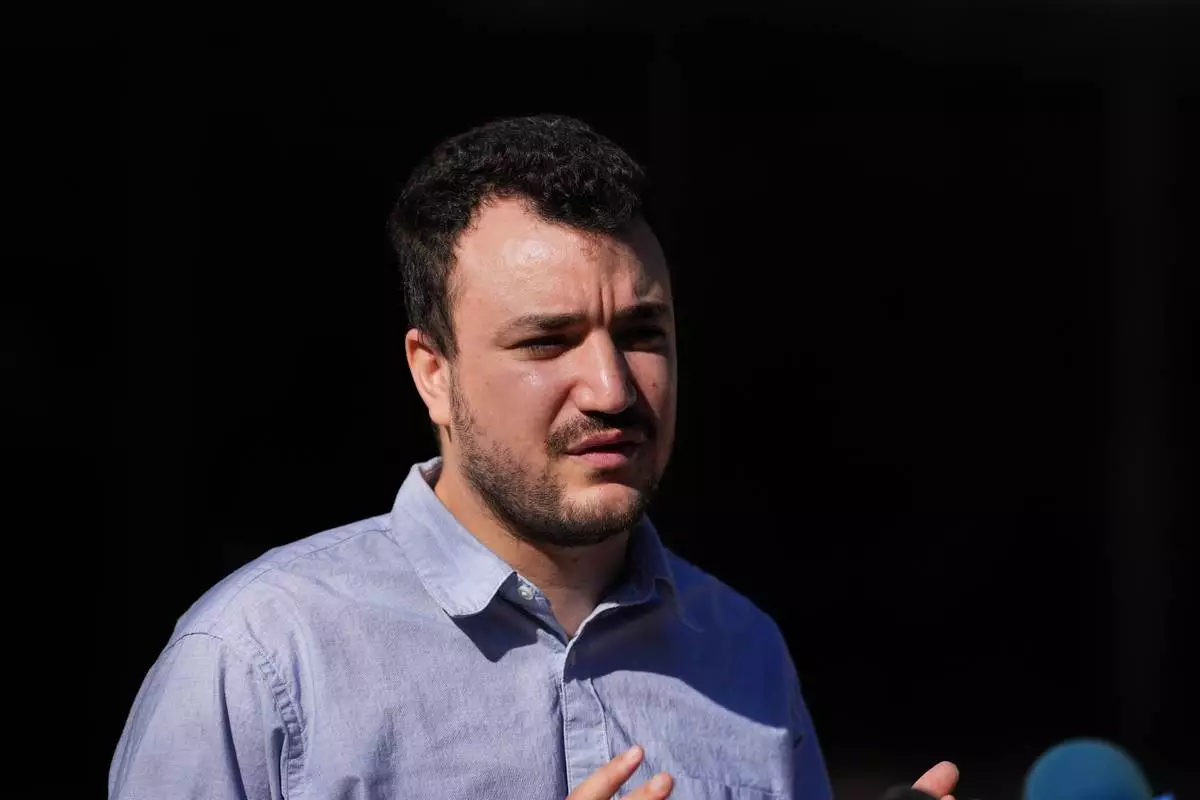
FILE - Palestinian activist Mahmoud Khalil holds a news conference outside Federal Court on Tuesday, Oct. 21, 2025 in Philadelphia (AP Photo/Matt Rourke, File)