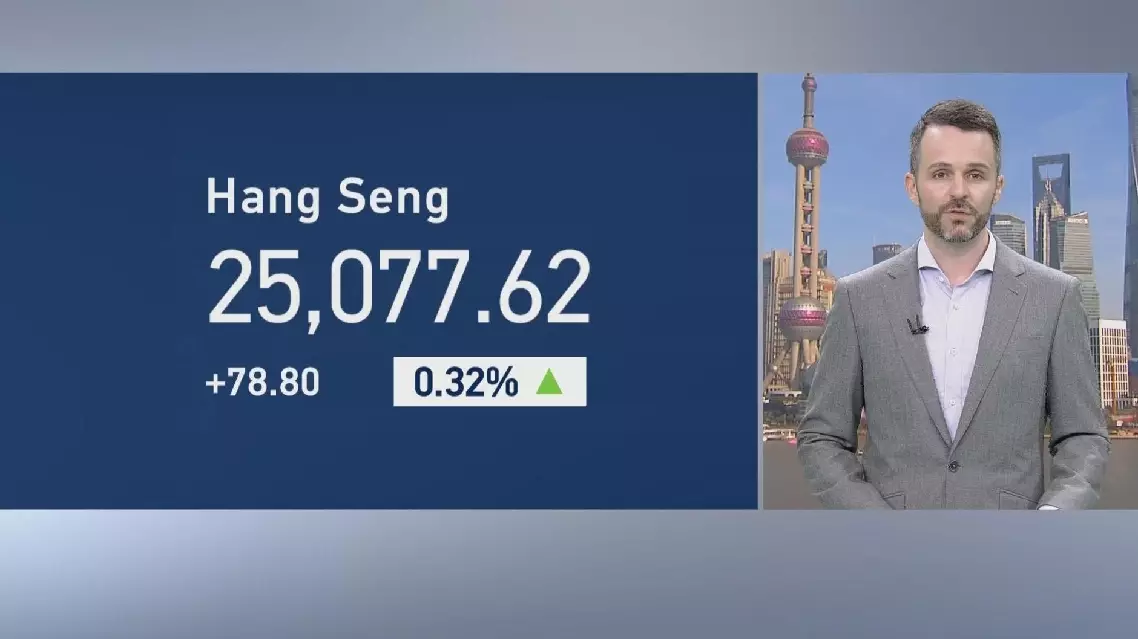
The Hong Kong stock market ended higher Friday with the benchmark Hang Seng Index up 0.32 percent to close at 25,077.62 points.
The Hang Seng China Enterprises Index gained 0.35 percent to end at 8947.79 points, and the Hang Seng Tech Index gained 0.54 percent to end at 5,674.31 points.
Japan's benchmark Nikkei stock index, the 225-issue Nikkei Stock Average, fell 110.32 points or 0.26 percent to 42,718.47 points.
Timothy Pope, a market analyst, recapped stock markets' performance of Hong Kong and Japan on Friday.
"Hong Kong's Hang Seng was up today about one third of one percent. Tech companies were gaining ground there as well, but we're also into first half results season for the markets in Hong Kong. So we are seeing those filings move stocks a bit. We saw telecoms equipment maker ZTE slumping 9.2 percent after posting an almost 12 percent year-on-year drop in first half net profits. On the other side of things, appliance maker Haier was up 4.6 percent after posting a 15.6 percent jump in first half profits compared to last year. Now there's been a really big push, especially this year, to get Chinese households to upgrade appliances. There have been trade in schemes and subsidies, so that could very well have played in Haier's favor," he said.
"The EV and battery makers were also doing very well today, those listed in Hong Kong anyway. The National Development and Reform Commission, which is the top economic planner in China, said that it's going to be speeding up efforts to investigate and punish below-cost dumping of battery products in the Chinese auto sector. So that helped a host of stocks including automakers like Xpeng and Neo, right the way down the production chain to the lithium producers like Tianchi and Ganfeng Lithium," he said.
"Now over in Japan, the markets paused today to take some profits, the Nikkei 225 was a quarter of one percent lower after also having a pretty strong month. It's up four and a half percent for August, and hit a record high on August 19. So, a bit of profit-taking as we head into September was probably to be expected. Plus today, investors were also facing a stronger yen and some less cheerful economic data, which added to a sense of caution. Japanese factory output was down a bit more than expected last month, while retail sales were up less than expected, managing only a pretty fractional gain. So, we saw some losses for most of the heavyweights on the Nikkei today, especially its chip majors and the currency sensitive auto sector was also trading lower," he said.
Analyst recaps Asian stock markets' performance