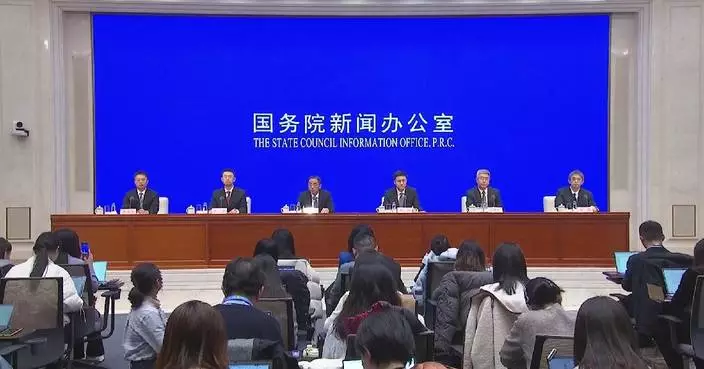
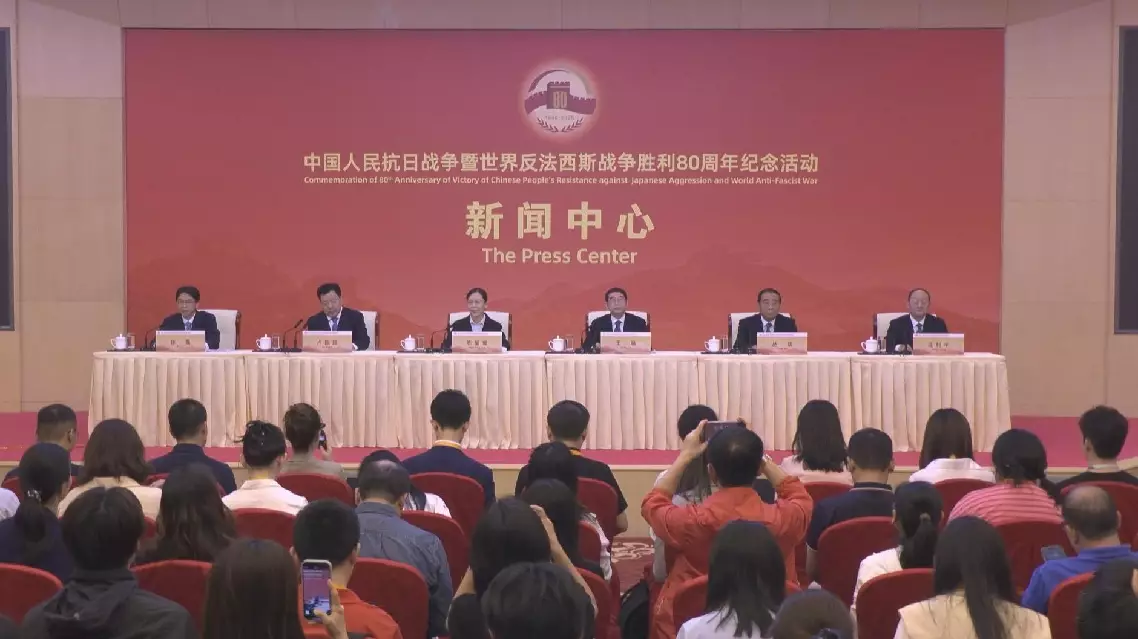
Leaders of China's non-communist political parties reflected on the historical significance of the victory of the Chinese People's War of Resistance against Japanese Aggression (1931-1945), at a press meet-and-greet event held in the Media Center in Beijing on Friday.
Attending the event to mark the 80th anniversary of the victory in the Chinese People's War of Resistance against Japanese Aggression and the World Anti-Fascist War were senior representatives from China's non-communist political parties, who jointly reviewed the spirit of the Communist Party of China (CPC) and other political parties in cooperation in the fight against Japanese aggression during the war, stressing inter-party solidarity under the leadership of the CPC.
Chen Xingying, vice chair of the central committee of the Revolutionary Committee of the Chinese Kuomintang (RCCK), said the history of the Chinese People's War of Resistance against Japanese Aggression is a history of establishing and developing the anti-Japanese National United Front under the leadership of the CPC and of achieving the victory of the entire nation in the war.
"Under the guidance and support of the CPC, our predecessors in the RCCK fought bravely with millions of fellow Chinese people. They not only demonstrated the spirit and resilience of the Chinese nation, but also painted a vivid picture of unity and cooperation among the CPC, political parties, the non-affiliates in resisting foreign aggression. It also showed the role of the CPC as a major force in the fight against Japanese aggression and its mission of seeking rejuvenation of the Chinese nation," Chen said.
Wang Lu, vice chair of the central committee of the Chinese Peasants and Workers Democratic Party (CPWDP), echoed the similar sentiment.
"The key to the victory of the Chinese people over Japanese militarism 80 years ago was the pivotal role of the Communist Party of China. The spirit of resistance that the Chinese people forged will continue to inspire us to overcome all challenges and strive for national rejuvenation," Wang said.
Lu Guoyi, vice chair of the central committee of the China Zhi Gong Party, pledged continued support for national development under the leadership of the CPC.
"Looking forward to the future, the China Zhi Gong Party will unite more closely around the CPC Central Committee with Comrade Xi Jinping at its core, pool the wisdom and strength of Chinese people at home and abroad to contribute to building China into a strong nation and to the national rejuvenation of China," Lu said.
Noting this year also marks the 80th anniversary of the founding of the Jiusan Society, Cong Bin, vice chair of the party's central committee, said that the party will forge ahead with the CPC.
"At this new historical starting point, as a participating party composed mainly of intellectuals from the sci-tech sector, we will remain firmly aligned with the CPC in ideology, position and action," Cong said.
The Taiwan Democratic Self-Government League vowed to carry forward cross-Strait unity.
"Taking the 80th Anniversary of the victory in the Chinese People's War of Resistance against Japanese Aggression and the World Anti-Fascist War and the restoration of Taiwan as an opportunity, we will carry forward the patriotic tradition of Taiwan compatriots, pool strength for the building of China into a strong country and the rejuvenation of the nation, carry forward fine traditional Chinese culture, and forge closer bonds across the Taiwan Strait to jointly advance national reunification and rejuvenation," said Jiang Liping, vice chair of the central committee of the Taiwan Democratic Self-Government League.
China's non-communist political parties reflect on V-day legacy