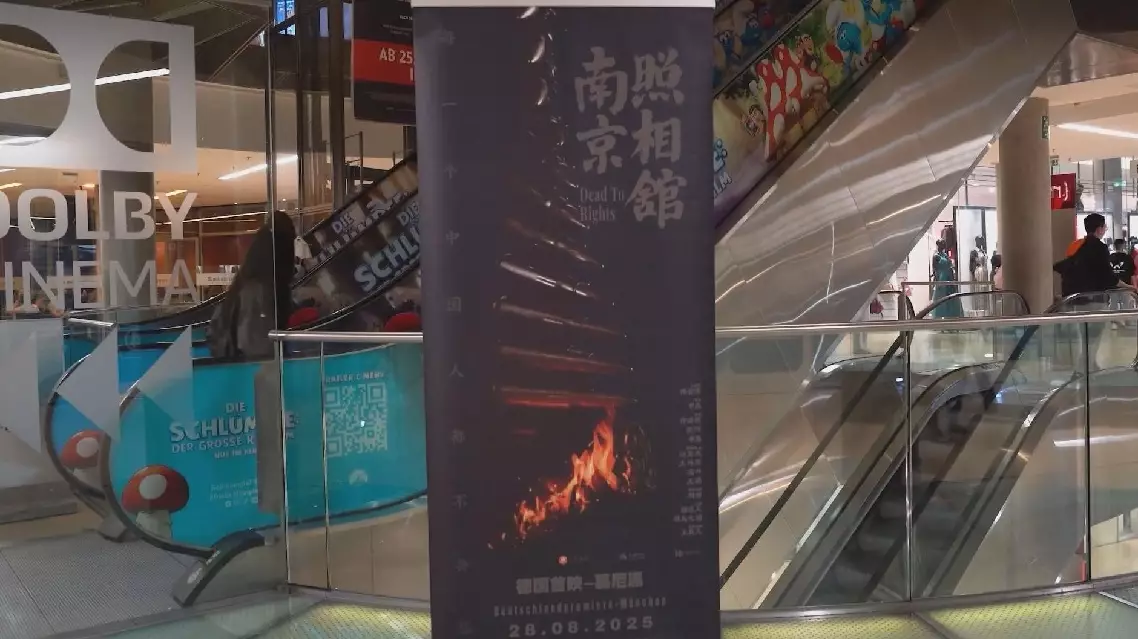
The German premiere of "Dead to Rights," a Chinese historical film about the 1937 Nanjing Massacre, was held in Munich on Thursday, resonating strongly with the audience.
Based on verified photographic evidence of Japanese wartime atrocities, the film tells the story of a group of Chinese civilians who seek refuge in a photography studio during the brutal occupation of the then Chinese capital city of Nanjing by Japanese aggressor troops.
The premiere, taking place in the theater of Mathaeser Filmpalast in central Munich, attracted nearly 400 moviegoers, including political, business and cultural figures, media representatives and movie fans from both China and Germany, as well as consulates general from various countries in Munich.
Many viewers remarked that the film provided a more intuitive understanding of Asia's tragic history during World War II, allowing them to grasp the immense suffering endured by countless civilians during that time.
"This is a great film, a great Chinese film. It's important to showcase such a film in Germany and Europe, as few Europeans are aware of the history of Nanjing. The horror of that massacre is beyond words. The director has captured these moments effectively and powerfully, and I believe everyone has been deeply moved by what happened there," said Bernd Einmeier, president of the German-Chinese Association for Economy, Education and Culture.
"This film has left a deep impression on me. Compared to what I have read in books, the film depicts the atrocities committed by the Japanese invaders in a more direct manner," said Werner Zuse, an expert at the Schiller Institute, a German think tank.
"I think it's great that this film is being shown in Europe, and it deserves to be seen worldwide. The reality is even more severe than what the film portrays. We should look to the future and truly strive for peace," said Erhard Rau, president of the German Cultural and Economic Promotion Association.
During Nanjing Massacre, tens of thousands of Chinese were inhumanely tortured and raped by Japanese aggressor troops over the course of just six weeks, most of them innocent civilians. The massacre left more than 300,000 people dead.
Chinese film on Nanjing Massacre premieres in Munich
A former television host from Taiwan, Zhai Xuan, has made a pivotal decision to leave mainstream broadcasting in order to create content that provides a better understanding of the Chinese mainland and cross-strait relations.
Zhai, a seasoned television host with over a decade of experience in Taiwan's media landscape, recently addressed an audience at an event in Beijing, where she revealed her complete transition into independent online media.
In her remarks, she articulated her aspiration to bridge what she perceives as a significant information gap between audiences on both sides of the Strait, highlighting her commitment to fostering a deeper understanding and connection through her new endeavors.
"I was really surprised by all the fake news. There were stories saying people on the mainland can't afford tea eggs or that they live in mud houses and in Taiwan, this was the main information many people received," said Zhai.
Zhai said she initially began producing online videos to challenge such perceptions while continuing her work as a television host.
In April 2025, she travelled to the mainland with her father to fulfill her late grandfather's wish to return to his hometown. The trip, which reunited family members separated since 1949, was recorded in a video series titled "Journey to Find Our Roots", drawing attention from viewers in both Taiwan and the mainland.
"Many people in Taiwan told me that after watching, they wanted to apply for a mainland travel permit immediately and go looking for their relatives. Some had long forgotten these things, but after seeing my story, they began thinking about their hometowns and family members they had never met and decided to search for their roots," Zhai shared her story at the event.
By mid-2025, Zhai said she began to feel increasing pressure amid rising political tensions and a tightening atmosphere around cross-Strait exchanges in Taiwan.
After more than 12 years in the industry, Zhai resigned from her position, believing it was the right thing to do.
"At that moment, I felt this was a major issue,not just for me, but for Chinese people on both sides of the Strait. If I backed down then, I wouldn’t be standing on the right side," said Zhai.
Since leaving television, Zhai has broadened her online programming to encompass a range of daily-life topics, including practical guidance on applying for a mainland travel permit and using commonly employed mobile applications, in addition to content that delves into historical memory and cultural connections across the Strait.
As the debate over cross-Strait relations continues in Taiwan, Zhai said she remains committed to her current path.

Former Taiwan TV host bridges cross-Strait divide via online media