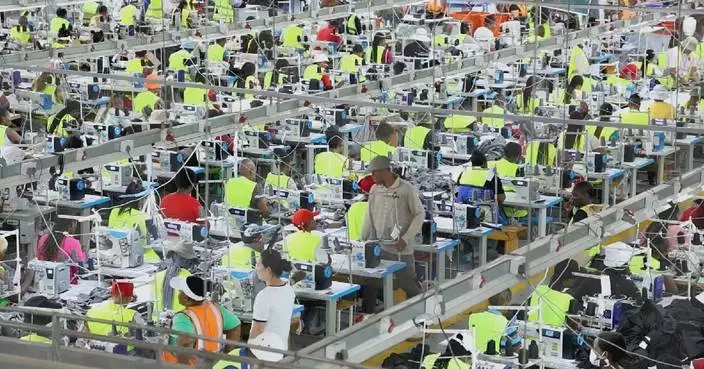
A young Chinese couple working on the Astana light rail transit (LRT) project, Central Asia's first urban light rail system, celebrated their significant life milestones -- marriage and parenthood -- in the very process of construction of the project in Astana, Kazakhstan, while witnessing the positive impact of China-Kazakhstan infrastructure cooperation on the country's transport network.
As a flagship project under the Belt and Road Initiative, the Chinese-built rail, spanning 22.4 kilometers to connect landmarks and key areas in Astana, is nearing completion.
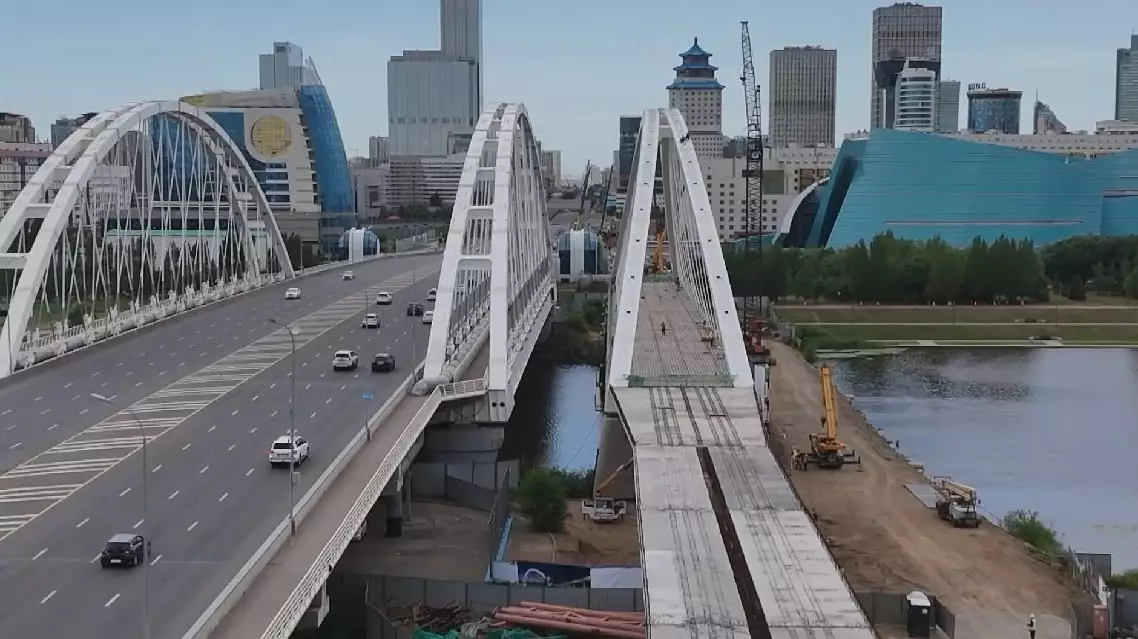
The China Construction Third Engineering Bureau under the China State Construction Engineering Corporation, a Chinese state-owned construction giant, built an 18.34-kilometer section of the rail, which includes the Ishim River steel arch bridge -- the most critical structure on the entire railway line.
"Construction of the 154-meter-long steel bridge has been completed. The Ishim River is known as the mother river of Astana, much like the significance of the Haihe River to the people in Tianjin. We often take our kid for a walk along its banks. I feel immensely proud to have participated in this light rail construction project," said Hasiyet Mahbal, engineer with the China Construction Third Engineering Bureau.
Many families, such as Mahbal's, have participated in the construction of the project.
Astana is the world's second-coldest capital city. In winter, temperatures can drop to between minus 35 degrees Celsius and minus 40 degrees Celsius, while summers bring intense heat. These extreme weather conditions significantly prolong the construction period for the light rail project. Consequently, many young Chinese builders have married and started families here.
In June, a batch of light rail trains arrived in Astana from China. Test runs on some sections are expected to begin by the end of this year. Once fully operational, the line is projected to serve an estimated 25,000 passengers daily, with ridership potentially peaking at 92,000 per day during busy periods.
"We have keenly felt the advantages brought about by China-Kazakhstan cooperation. For example, Chinese standards are very high in construction. Both sides are closely collaborating," said Orynbasar Agbaev, managing director of the City Transportation Systems of Kazakhstan.
Chinese couple builds life during process of light rail construction in Kazakhstan
A former television host from Taiwan, Zhai Xuan, has made a pivotal decision to leave mainstream broadcasting in order to create content that provides a better understanding of the Chinese mainland and cross-strait relations.
Zhai, a seasoned television host with over a decade of experience in Taiwan's media landscape, recently addressed an audience at an event in Beijing, where she revealed her complete transition into independent online media.
In her remarks, she articulated her aspiration to bridge what she perceives as a significant information gap between audiences on both sides of the Strait, highlighting her commitment to fostering a deeper understanding and connection through her new endeavors.
"I was really surprised by all the fake news. There were stories saying people on the mainland can't afford tea eggs or that they live in mud houses and in Taiwan, this was the main information many people received," said Zhai.
Zhai said she initially began producing online videos to challenge such perceptions while continuing her work as a television host.
In April 2025, she travelled to the mainland with her father to fulfill her late grandfather's wish to return to his hometown. The trip, which reunited family members separated since 1949, was recorded in a video series titled "Journey to Find Our Roots", drawing attention from viewers in both Taiwan and the mainland.
"Many people in Taiwan told me that after watching, they wanted to apply for a mainland travel permit immediately and go looking for their relatives. Some had long forgotten these things, but after seeing my story, they began thinking about their hometowns and family members they had never met and decided to search for their roots," Zhai shared her story at the event.
By mid-2025, Zhai said she began to feel increasing pressure amid rising political tensions and a tightening atmosphere around cross-Strait exchanges in Taiwan.
After more than 12 years in the industry, Zhai resigned from her position, believing it was the right thing to do.
"At that moment, I felt this was a major issue,not just for me, but for Chinese people on both sides of the Strait. If I backed down then, I wouldn’t be standing on the right side," said Zhai.
Since leaving television, Zhai has broadened her online programming to encompass a range of daily-life topics, including practical guidance on applying for a mainland travel permit and using commonly employed mobile applications, in addition to content that delves into historical memory and cultural connections across the Strait.
As the debate over cross-Strait relations continues in Taiwan, Zhai said she remains committed to her current path.

Former Taiwan TV host bridges cross-Strait divide via online media