WASHINGTON (AP) — Democrat Eric McWilliams doesn't approve of Donald Trump sending National Guard troops to cities like Washington, D.C. And he's certainly not supportive of most of the president's policies.
But the 63-year old retired handyman and U.S. Navy veteran does praise Trump for one thing. “When it comes to crime," he said, “He’s alright. He's doing pretty good. How he’s doing it is another matter.”
“Crime is a big problem,” he went on. “At least he is doing something.”
McWilliams' views reflect the thinking of a lot of Democrats, according to a recent poll from The Associated Press-NORC Center for Public Affairs Research. It finds that while most disapprove of how Trump is handling the issue, a large majority, 68%, see crime as a “major problem” in large cities. That's despite the fact that statistics show crime, overall, is down across the nation, with some cities reporting 30-year lows.
The findings underscore the challenge facing Democratic leaders. They must thread the needle between criticizing Trump's policies, which are deeply unpopular among their base, while at the same time not dismissing widespread concerns about safety, which are amplified in many news sources and in online forums like Facebook and the popular Nextdoor app.
That could create a vulnerability for the party heading into next year’s midterm elections.
While Trump remains unpopular overall, the new poll finds his approach to crime has earned him high marks compared to other issues like the economy and immigration. About half of U.S. adults, 53%, say they approve of his handling of crime.
The vast majority of Americans, 81%, also see crime as a “major problem” in large cities. That includes nearly all Republicans, roughly three-quarters of independents and nearly 7 in 10 Democrats.
The issue is complex, though, even for those who are concerned. In interviews, participants who oppose Trump’s unprecedented takeover of Washington, D.C.’s police department and threats to expand his efforts to other cities expressed alarm, calling his actions anti-American and part of what they see as an effort to distract the public from issues the White House would prefer they ignore.
They believe resources would be better spent investing in community policing, mental health services and passing meaningful laws to get guns off city streets.
But many also bemoaned the state of public safety in the country, even if they said they felt safe in their own neighborhoods and acknowledged that violent crime is down after a pandemic-era spike. Several noted that they or their neighbors had been the victims of serious crimes and complained about what they felt was a lackluster police response.
Brian Cornelia, 62, a retired foreman and lifelong Democrat who lives in Michigan, near Marquette, is displeased with the performance of both parties.
“Defund the police was nuts," he said. “Now with Trump what he’s doing, that’s nuts too."
He said that crime is “not at all” an issue where he lives and “down all over," but nonetheless appreciates that Trump is doing something.
"Something is happening. We’ll see if it helps or not, but it's better than not doing anything," he said. Either way, he said Trump had backed Democrats into a corner.
“It's bad. How are you going to say you don't want crime to be dealt with?" he said. “If you argue with him, what, you’re soft on crime? It’s a Catch-22."
Even those who give Trump credit question his tactics.
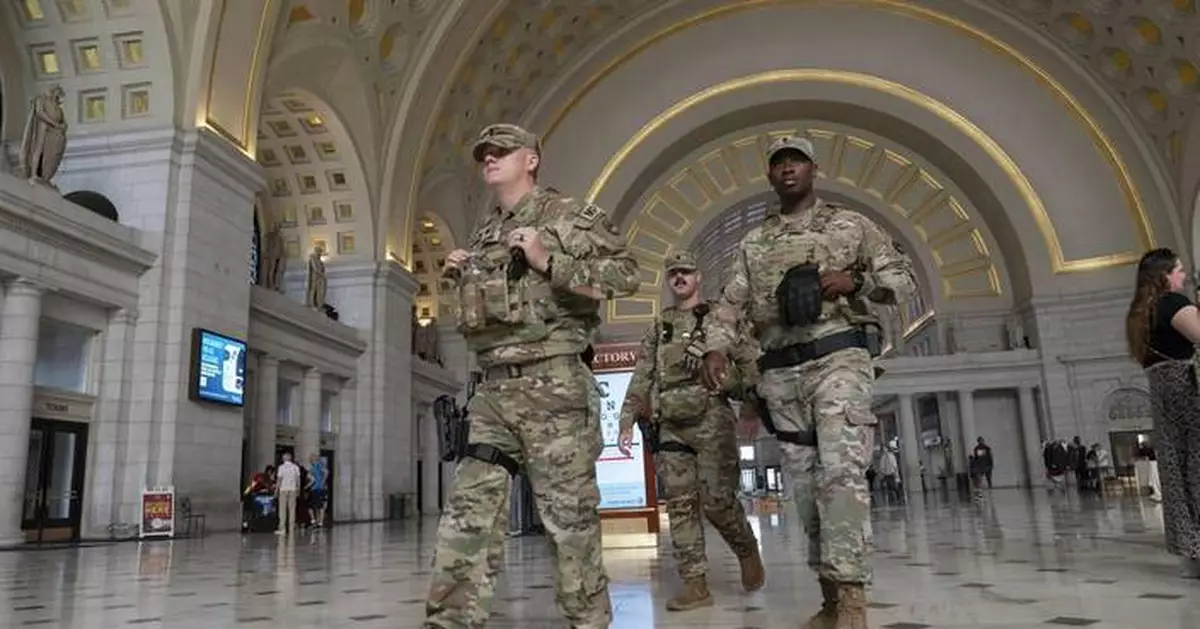
About 8 in 10 Democrats say it’s “completely” or “somewhat” unacceptable for the president to seize control of local police departments, as he’s done in Washington. And about 6 in 10 say it’s unacceptable for the federal government to use the U.S. military and National Guard to assist local police.
“I don’t approve of national troops having authority over fellow Americans,” said McWilliams, the Navy veteran. “You shouldn’t use our armed forces to patrol our own people. That turns it into an authoritarian state.”
McWilliams, who lives in White Hall, Pennsylvania, said crime “is practically non-existent” in his neighborhood, where he doesn't even lock his door. But he worries about the situation in nearby Allentown and across the nation, noting the deadly mass shooting this week at a Minneapolis church.
“I’m glad he does want to fight crime because – well, nobody else is doing it, certainly not our mayors and governors and police department,” he said, accusing them of being “too politically correct” to pursue controversial tactics like “stop and frisk,” which he believes works.
Others are far more skeptical.
“I think he's just terrible," said Carolyn Perry, 79, a lifelong Democrat and retired nurse who lives in Philadelphia and sees Trump’s actions as an excuse to target Democratic cities that voted against him.
“I think this National Guard thing he’s doing is ridiculous," she said. “It's almost like martial law. And now they’re walking around with guns.”
Democrat Star Kaye, 59, who lives in Downey, California, near Los Angeles, agreed, slamming Trump for using the military against residents — something she said the Revolutionary War was fought, in part, against.
“Of course living in a big city, I understand concerns about crime,” she said. “But I don’t think an authoritarian playbook is the right way to fix them.”′
If the president really wanted to tackle the issue, she argued, he would be investing in local police departments instead of diverting resources to immigration enforcement. She sees the crackdown as part of a broader effort to bolster Republicans' chances in next year’s midterm elections.
“I think he’s going to want to have troops in the street to intimidate people not to vote,” she said.
Part of the challenge for Democrats is that, historically, crime has not been a top issue for their base.
Gallup polling from April found that only about one-third of Democrats said they worried “a great deal” about crime and violence and were more likely to be concerned about the economy, Social Security, the environment, hunger and homelessness.
Crime has also traditionally been a stronger issue for Republicans, including in the 2024 election.
Democrats acknowledged the gap last week at a national party gathering in Minneapolis. In a presentation to Democratic National Committee members, party strategists noted Republicans spent about three times as much on crime-related ads as Democrats in recent presidential election years.
They urged Democrats not to mimic the “tough-on-crime” rhetoric Republicans have embraced for decades, but instead position themselves as being “serious about safety, not empty scare tactics.”
“DON’T TAKE TRUMP’S CRIME BAIT—INSTEAD, LEAN INTO SOLUTIONS TO PREVENT CRIME, RESPOND TO CRISIS, AND STOP VIOLENCE," they urged in a slide presentation.
Some Democratic politicians have been trying to do just that.
They include Illinois Gov. JB Pritzker, who has been pushing back against Trump's threats to expand his efforts to Chicago. He defended Democrats' approach and said local efforts to tackle crime have been working.
“We also are tough on crime,” Pritzker told The Associated Press in an interview on Wednesday. Trump, he said, “talks a good game."
“What the President has done, however, is to make it harder to crack down on crime," he said.
The AP-NORC poll of 1,182 adults was conducted Aug. 21-25, using a sample drawn from NORC’s probability-based AmeriSpeak Panel, which is designed to be representative of the U.S. population. The margin of sampling error for adults overall is plus or minus 3.8 percentage points.
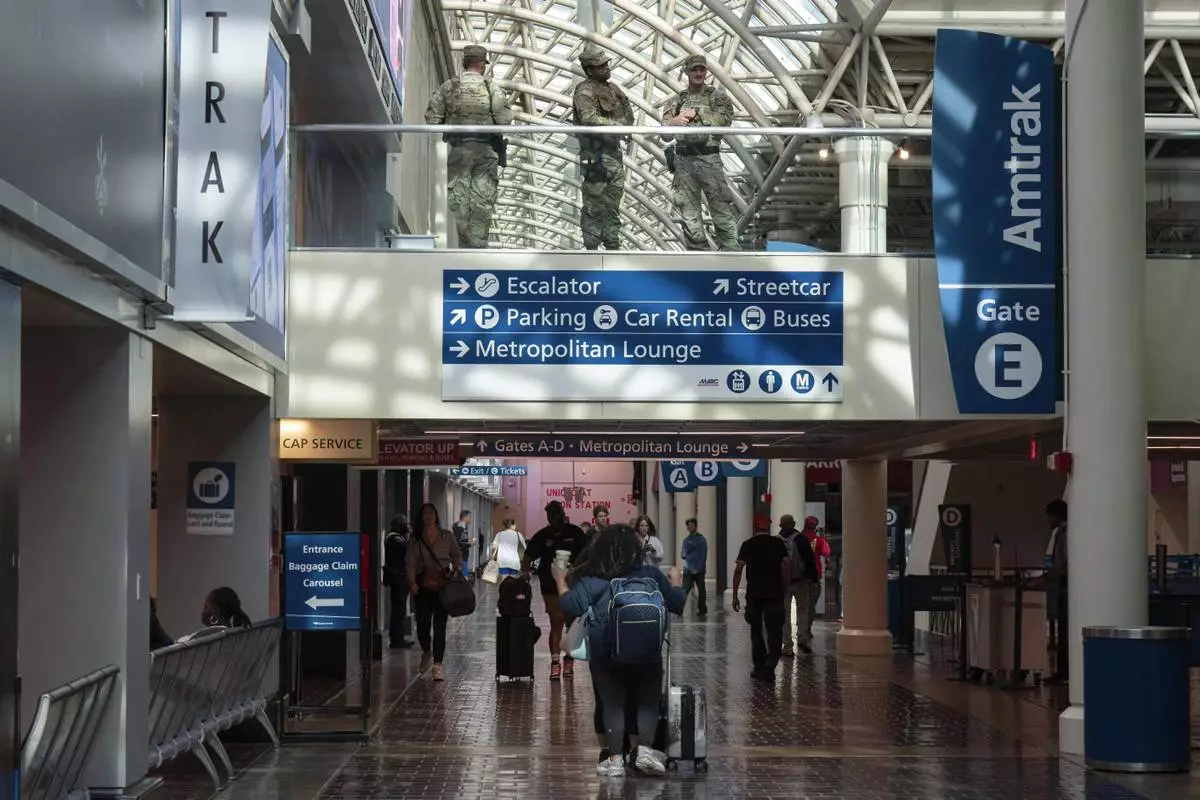
Members of the Louisiana National Guard, top, patrol the passengers area in Union Station, Saturday, Aug. 30, 2025, in Washington. (AP Photo/Jose Luis Magana)
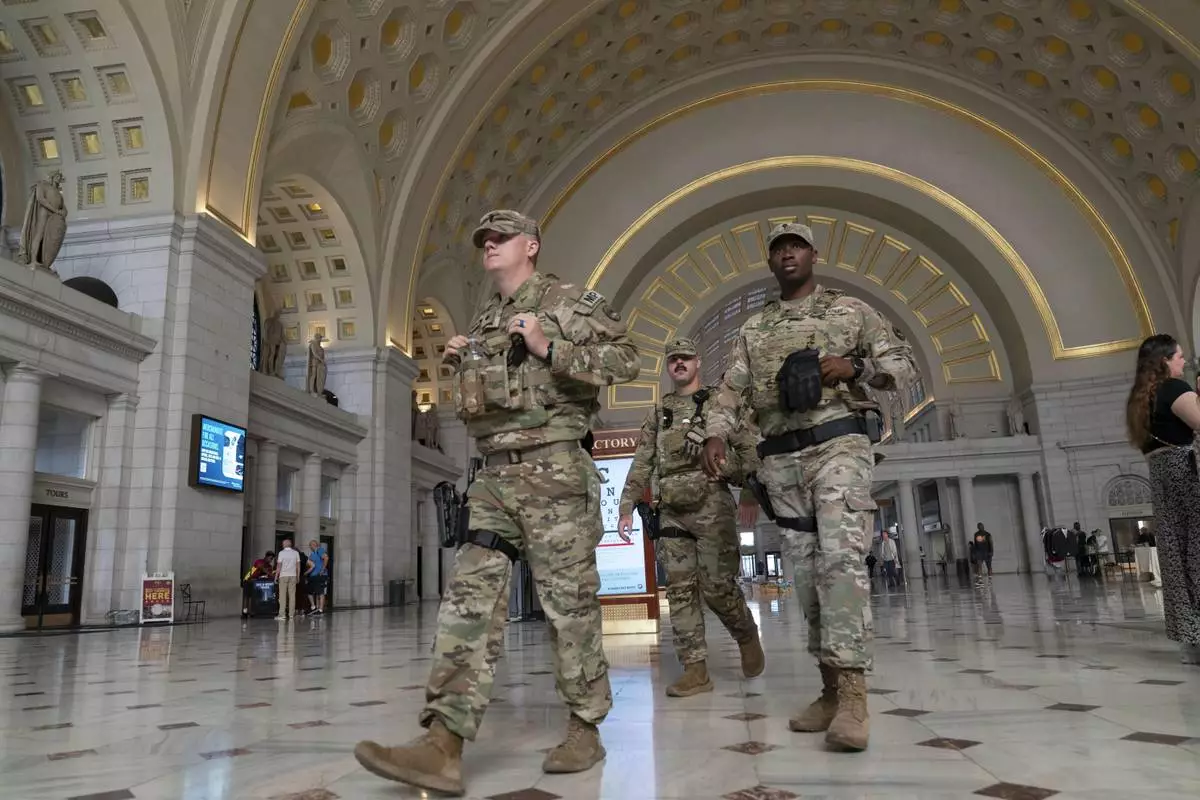
Members of the Louisiana National Guard patrol Union Station, Saturday, Aug. 30, 2025, in Washington. (AP Photo/Jose Luis Magana)