WASHINGTON (AP) — President Donald Trump's administration has made good on its pledge to label three Middle Eastern branches of the Muslim Brotherhood as terrorist organizations, imposing sanctions on them and their members in a decision that could have implications for U.S. relationships with allies in the region.
The Treasury and State departments announced the actions Tuesday against the Lebanese, Jordanian and Egyptian chapters of the Muslim Brotherhood, which they said pose a risk to the United States and American interests.
The State Department designated the Lebanese branch a foreign terrorist organization, the most severe of the labels, which makes it a criminal offense to provide material support to the group. The Jordanian and Egyptian branches were listed by Treasury as specially designated global terrorists for providing support to Hamas.
“These designations reflect the opening actions of an ongoing, sustained effort to thwart Muslim Brotherhood chapters’ violence and destabilization wherever it occurs,” Secretary of State Marco Rubio said in a statement. “The United States will use all available tools to deprive these Muslim Brotherhood chapters of the resources to engage in or support terrorism.”
Rubio and Treasury Secretary Scott Bessent were mandated last year under an executive order signed by Trump to determine the most appropriate way to impose sanctions on the groups, which U.S. officials say engage in or support violence and destabilization campaigns that harm the United States and other regions.
Bessent said in a post on X that the Muslim Brotherhood "has a longstanding record of perpetrating acts of terror, and we are working aggressively to cut them off from the financial system." He added that the Trump administration will “deploy the full scope of its authorities to disrupt, dismantle, and defeat terrorist networks wherever they operate in order to keep Americans safe.”
Muslim Brotherhood leaders have said they renounce violence, and the Muslim Brotherhood branches in Egypt and Lebanon denounced their inclusion.
“The Egyptian Muslim Brotherhood categorically rejects this designation and will pursue all legal avenues to challenge this decision which harms millions of Muslims worldwide," it said in a statement, denying any involvement in or support for terrorism.
The Lebanese branch of the Muslim Brotherhood, known as al-Jamaa al-Islamiya (the Islamic Group), said in a statement that it is “a licensed Lebanese political and social entity that operates openly and within the bounds of the law” and that the U.S. decision “has no legal effect within Lebanon.”
In singling out the chapters in Lebanon, Jordan and Egypt, Trump's executive order noted that a wing of the Lebanese chapter had launched rockets on Israel after Hamas' Oct. 7, 2023, attack in Israel that set off the war in Gaza. Leaders of the group in Jordan have provided support to Hamas, the order said.
The Muslim Brotherhood was founded in Egypt in 1928 but was banned in that country in 2013. Jordan announced a sweeping ban on the Muslim Brotherhood in April.
Egypt on Tuesday welcomed the designation and praised Trump’s efforts to combat global terrorism.
“This is a significant step that reflects the extremist ideology of this group and the direct threat it represents for regional and international security and stability,” the Egyptian Foreign Ministry said in a statement.
Nathan Brown, a professor of political science and international affairs at George Washington University, said other allies of the U.S., including the United Arab Emirates, would likely be pleased with the designation.
"For other governments where the brotherhood is tolerated, it would be a thorn in bilateral relations,” including in Qatar and Turkey, he said. While the Turkish ruling party has been associated with members of the Muslim Brotherhood in the past, the government of Qatar has denied any relationship with it.
Brown also said a designation on the chapters may have effects on visa and asylum claims for people entering not just the U.S. but also Western European countries and Canada.
“I think this would give immigration officials a stronger basis for suspicion, and it might make courts less likely to question any kind of official action against Brotherhood members who are seeking to stay in this country, seeking political asylum,” he said.
Trump, a Republican, weighed whether to designate the Muslim Brotherhood a terrorist organization in 2019 during his first term in office. Some prominent Trump supporters, including right-wing influencer Laura Loomer, have pushed his administration to take aggressive action against the group.
Two Republican-led state governments — Florida and Texas — designated the group as a terrorist organization this year.
Fatma Khaled in Cairo contributed to this report.

President Donald Trump speaks to reporters while in flight on Air Force One to Joint Base Andrews, Md., Sunday, Jan. 11, 2026. (AP Photo/Julia Demaree Nikhinson)
CAPE CANAVERAL, Fla. (AP) — NASA’s Artemis II astronauts fired their engines and blazed toward the moon Thursday night, breaking free of the chains that have trapped humanity in shallow laps around Earth in the decades since Apollo.
The so-called translunar ignition came 25 hours after liftoff, putting the three Americans and a Canadian on course for a lunar fly-around early next week. Their Orion capsule bolted out of orbit around Earth right on cue and chased after the moon nearly 250,000 miles (400,000 kilometers) away.
“Ladies and gentlemen, I am so, so excited to be able to tell you that for the first time since 1972 during Apollo 17, human beings have left Earth orbit,” NASA’s Lori Glaze announced at a news conference.
The engine firing was flawless, she noted.
Canadian astronaut Jeremy Hansen said he and his crewmates were glued to the capsule's windows as they left Earth in the rearview mirror, taking in the “phenomenal” views. Their faces were pressed so tightly against the windows that they had to wipe them clean.
“Humanity has once again shown what we are capable of, and it’s your hopes for the future that carry us now on this journey around the moon,” Hansen said.
NASA had the Artemis II crew stick close to home for a day to test their capsule’s life-support systems before clearing them for lunar departure.
Now committed to the moon, the Artemis II test flight is the opening act for NASA’s grand plans for a moon base and sustained lunar living.
Commander Reid Wiseman, pilot Victor Glover, Christina Koch and Hansen will dash past the moon then hang a U-turn and zip straight home without stopping on land. In the process, they will go the farthest humans have ever traveled from Earth, breaking the Apollo 13 distance record set in 1970. They also may become the fastest during their reentry at flight’s end on April 10.
Glover, Koch and Hansen already have made history as the first Black person, the first woman and the first non-U.S. citizen to launch to the moon. Apollo’s 24 lunar travelers were all white men.
“Trust us, you look amazing. You look beautiful," Glover said in a TV interview after beholding the globe from pole to pole. "And from up here you also look like one thing: homo sapiens as all of us no matter where you’re from or what you look like, we’re all one people.”
To set the mood for the day’s main event, Mission Control woke up the crew with John Legend’s “Green Light” featuring Andre 3000 and a medley of NASA teams cheering them.
“We are ready to go,” Glover said.
Mission Control gave the final go-ahead minutes before the critical engine firing, telling the astronauts that they were embarking on “humanity’s lunar homecoming arc” to bring them back to Earth. The capsule is relying on the gravity of Earth and the moon — termed a free-return lunar trajectory — to complete the round-trip figure-eight loop. The engine accelerated their capsule to more than 24,000 mph (38,000 kph) to shove them out of Earth's orbit.
“I’ve got to tell you, there is nothing normal about this," Wiseman said. "Sending four humans 250,000 miles away is a herculean effort, and we are now just realizing the gravity of that.”
Flight director Judd Frieling said he and his team were all business while on duty but will likely reflect on the momentousness of it all once they go home.
“I suspect everybody understands that this is a once-in-a-lifetime moment," he told reporters.
The next major milestone will be Monday’s lunar flyby.
Orion will zoom 4,000 miles (6,400 kilometers) beyond the moon before turning back, providing unprecedented and illuminated views of the lunar far side, at least for human eyes. The cosmos will even treat the Artemis II astronauts to a total solar eclipse as the moon temporarily blocks the sun from their perspective.
While awaiting their orbital departure earlier Thursday, the astronauts savored the views of Earth from tens of thousands of miles high. Koch told Mission Control that they can make out the entire coastlines of continents and even the South Pole, her old stomping ground.
NASA is counting on the test flight to kickstart the entire Artemis program and lead to a moon landing by two astronauts in 2028.
The so-called lunar loo may need some design tweaks, however.
Orion's toilet malfunctioned as soon as the Artemis crew reached orbit Wednesday evening. Mission Control guided astronaut Koch through some plumbing tricks and she finally got it going, but not before having to resort to using contingency urine storage bags.
The urine pouches are serving double duty. Mission Control ordered the crew to fill a bunch of the empty bags with water from the capsule’s dispenser on Thursday. A valve issue arose with the dispenser following liftoff, and NASA wanted plenty of drinking water on hand for the crew in case the problem recurred. The astronauts used straws and syringes to fill the pouches with more than 2 gallons (7 liters) worth before pivoting to the moon.
The Associated Press Health and Science Department receives support from the Howard Hughes Medical Institute’s Department of Science Education and the Robert Wood Johnson Foundation. The AP is solely responsible for all content.
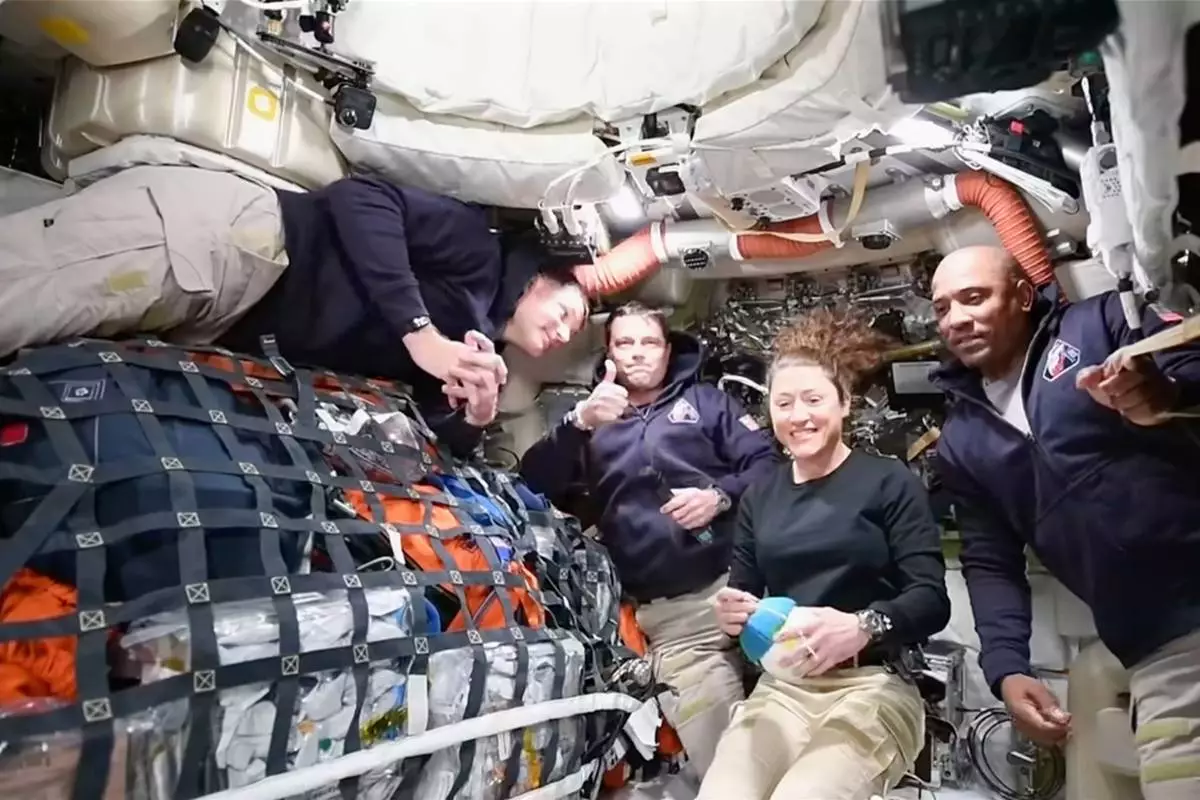
This image taken from video provided by NASA shows the Artemis II crew, from left, Canadien astronaut and mission specialist Jeremy Hansen, Commander Reid Wiseman, mission specialist Christina Koch and pilot Victor Glover as they speak with NASA Mission Control via video conference from the moon's orbit Thursday, April 2, 2026. (NASA via AP)
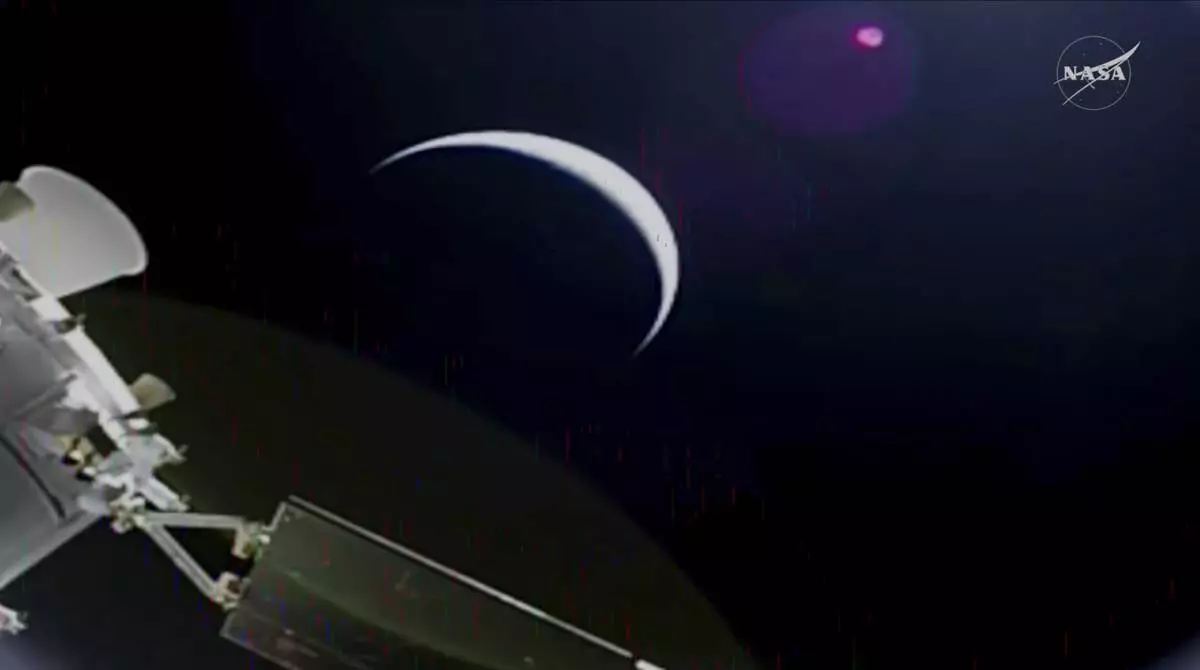
This image released by NASA on Thursday, April 2, 2026, shows NASA’s Orion spacecraft with Earth in the background. (NASA via AP)
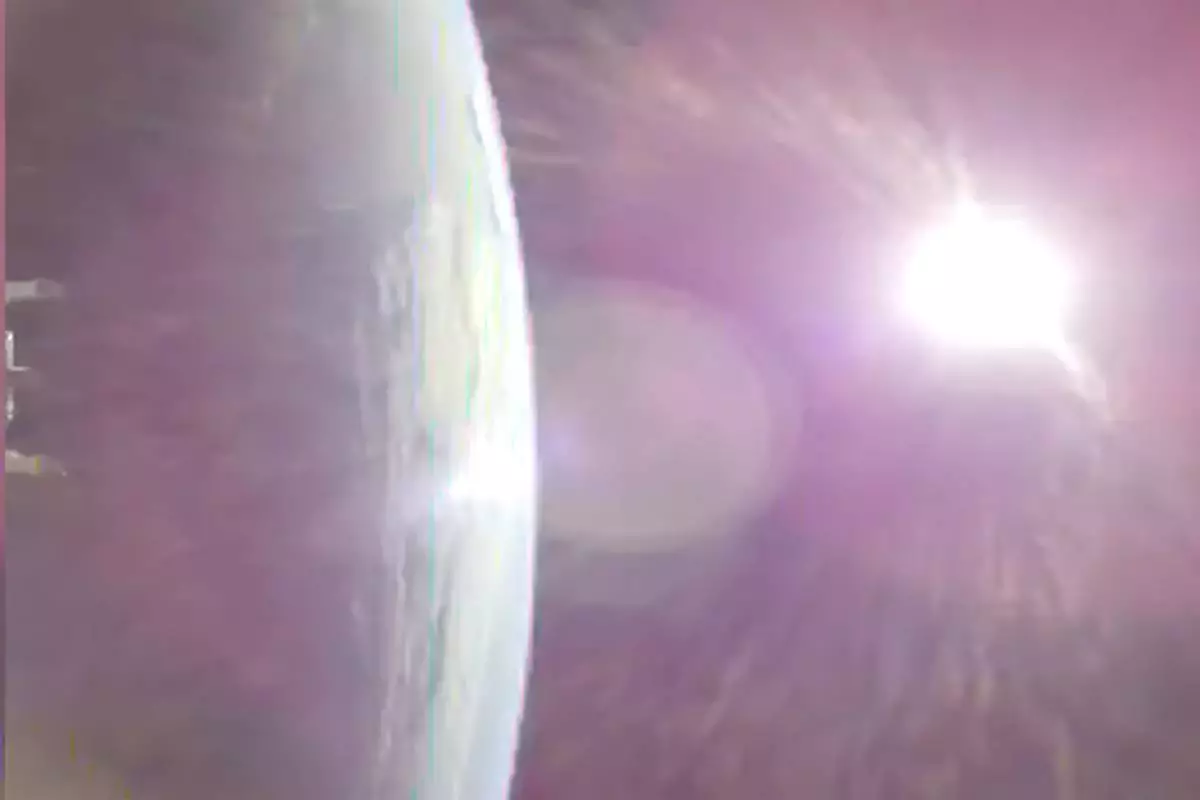
This image taken from video provided by NASA shows the Earth, left, from NASA's Orion spacecraft as it fired its engines heading toward the moon Thursday, April 2, 2026. (NASA via AP)
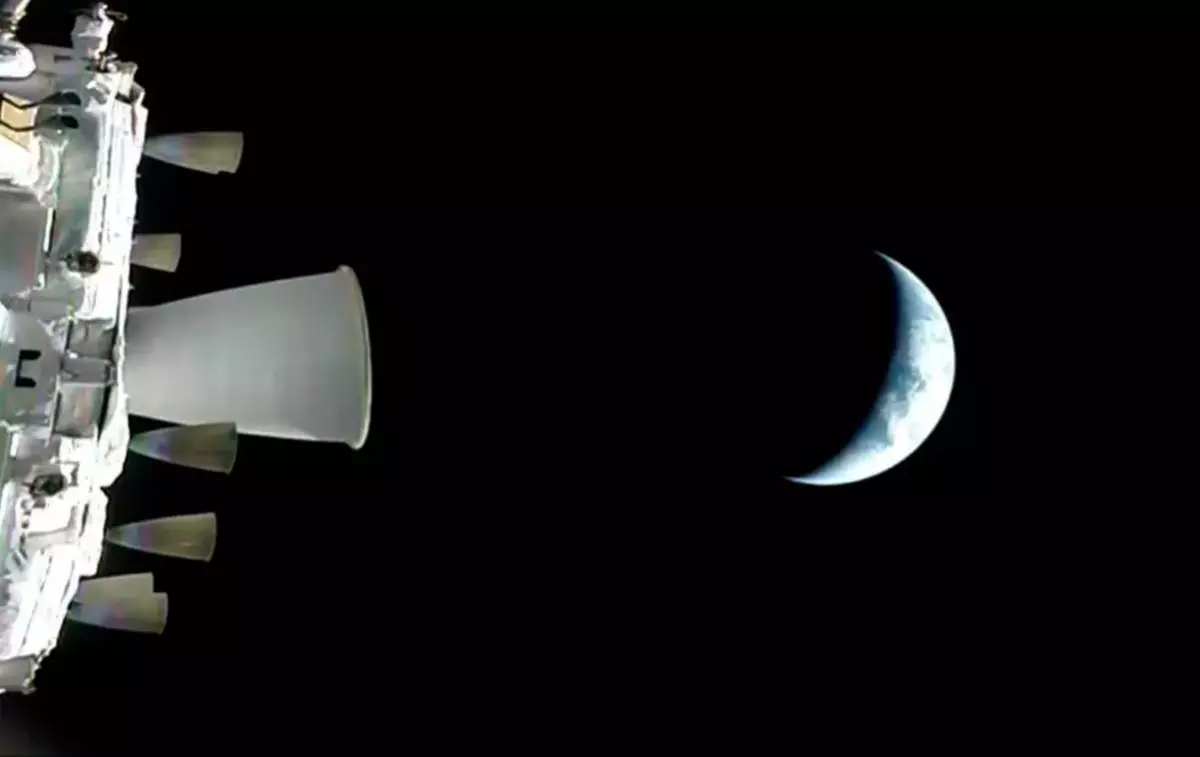
In this photo provided by NASA, a view of the Earth from NASA's Orion spacecraft as it orbits above the planet during the Artemis II test flight, on Thursday, April 2, 2026. (NASA via AP)
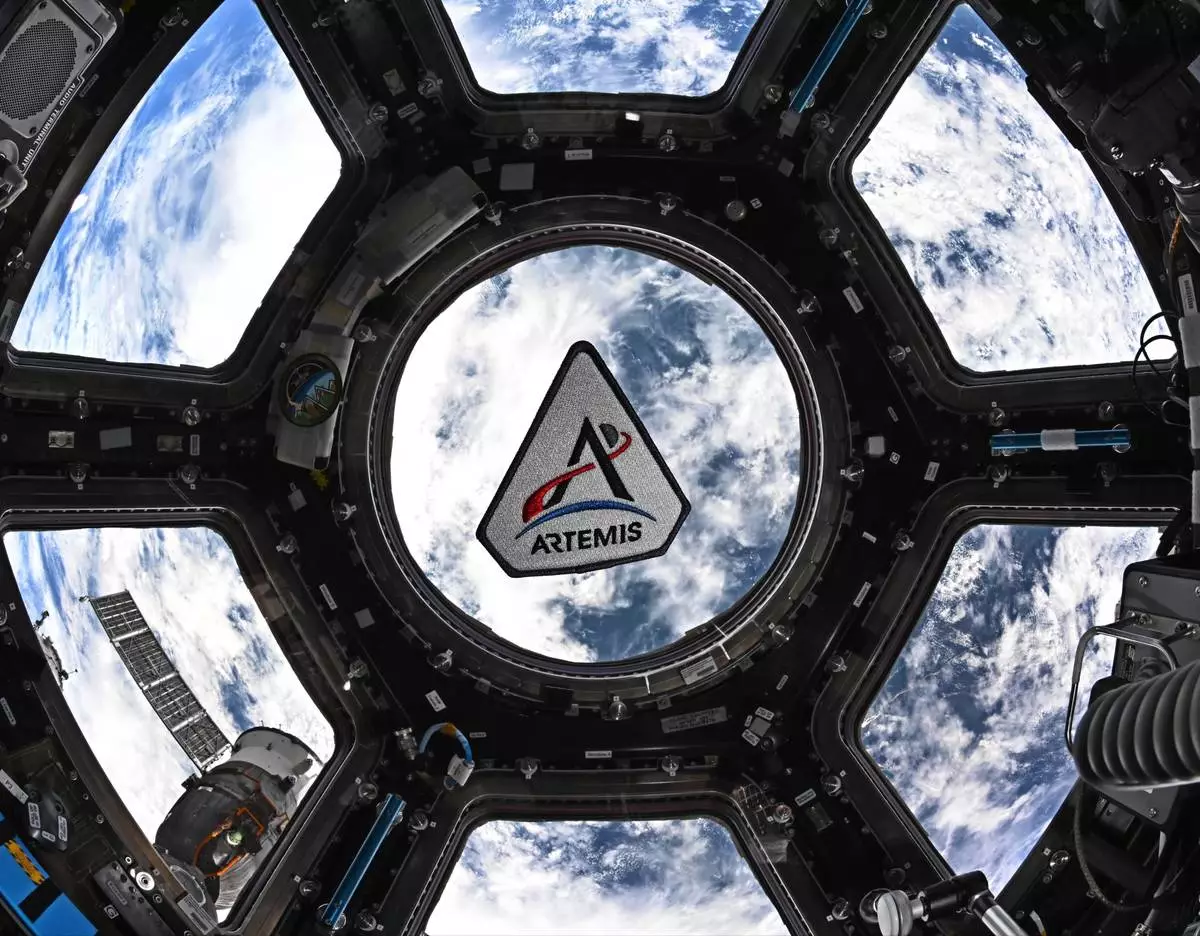
In this photo provided by NASA, an Artemis program patch floating in the International Space Station's cupola, on March 30, 2026. (Jessica Meir/NASA via AP)

Spectators view NASA's Artemis II moon rocket launch from the A. Max Brewer Bridge, Wednesday, April 1, 2026, in Titusville, Fla. (AP Photo/Phelan M. Ebenhack)
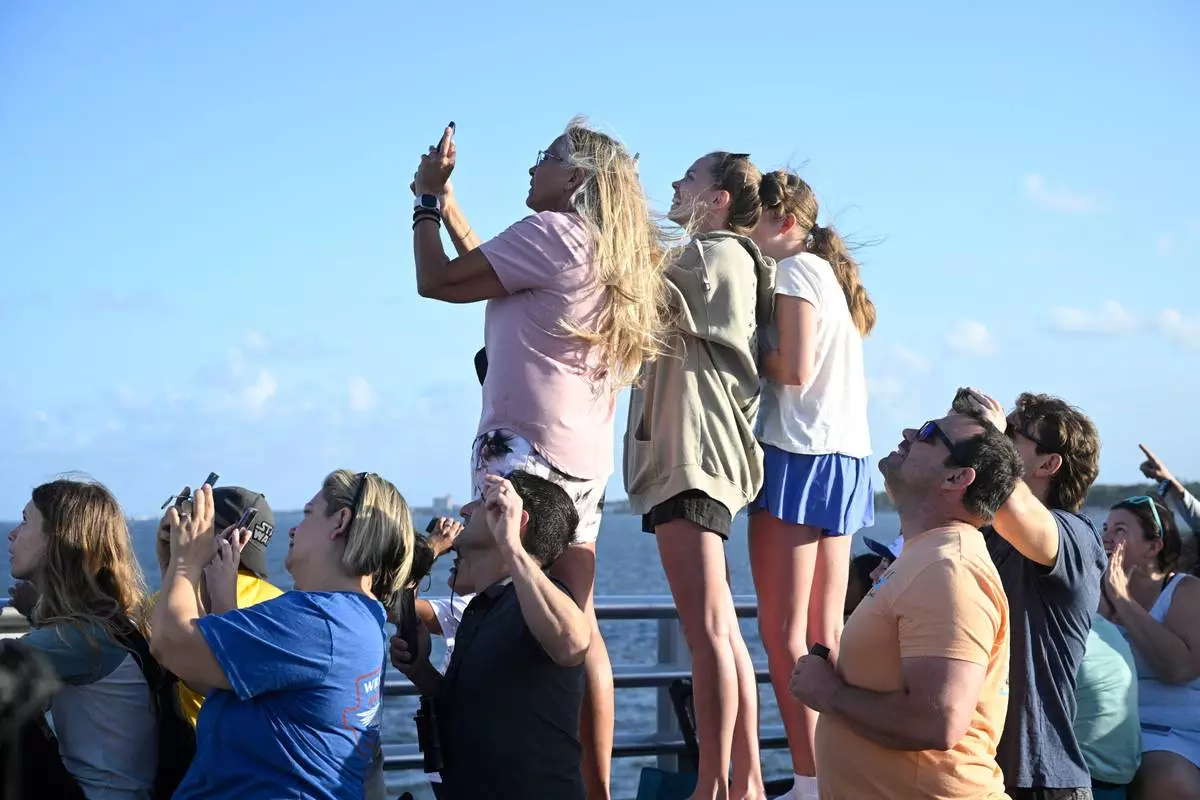
Spectators view NASA's Artemis II moon rocket launch from the A. Max Brewer Bridge, Wednesday, April 1, 2026, in Titusville, Fla. (AP Photo/Phelan M. Ebenhack)
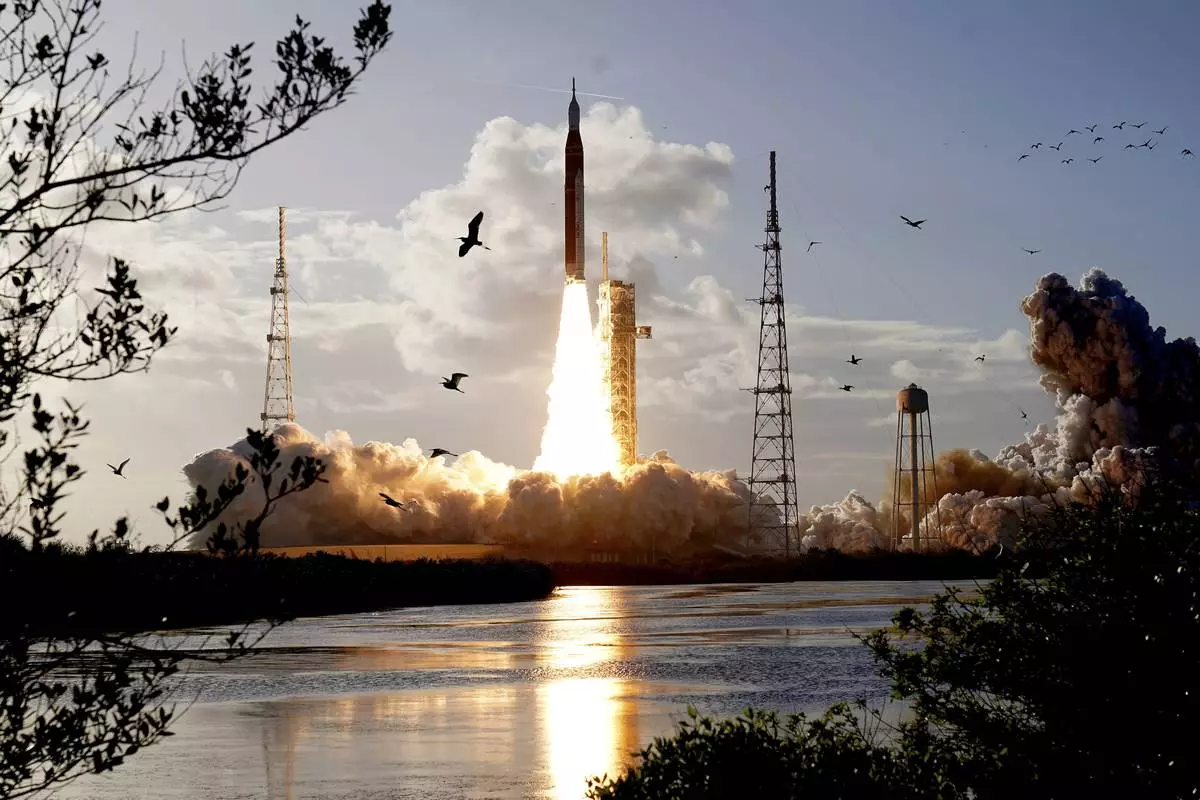
NASA's Artemis II moon rocket lifts off from the Kennedy Space Center's Launch Pad 39-B Wednesday, April 1, 2026, in Cape Canaveral, Fla. (AP Photo/Chris O'Meara)
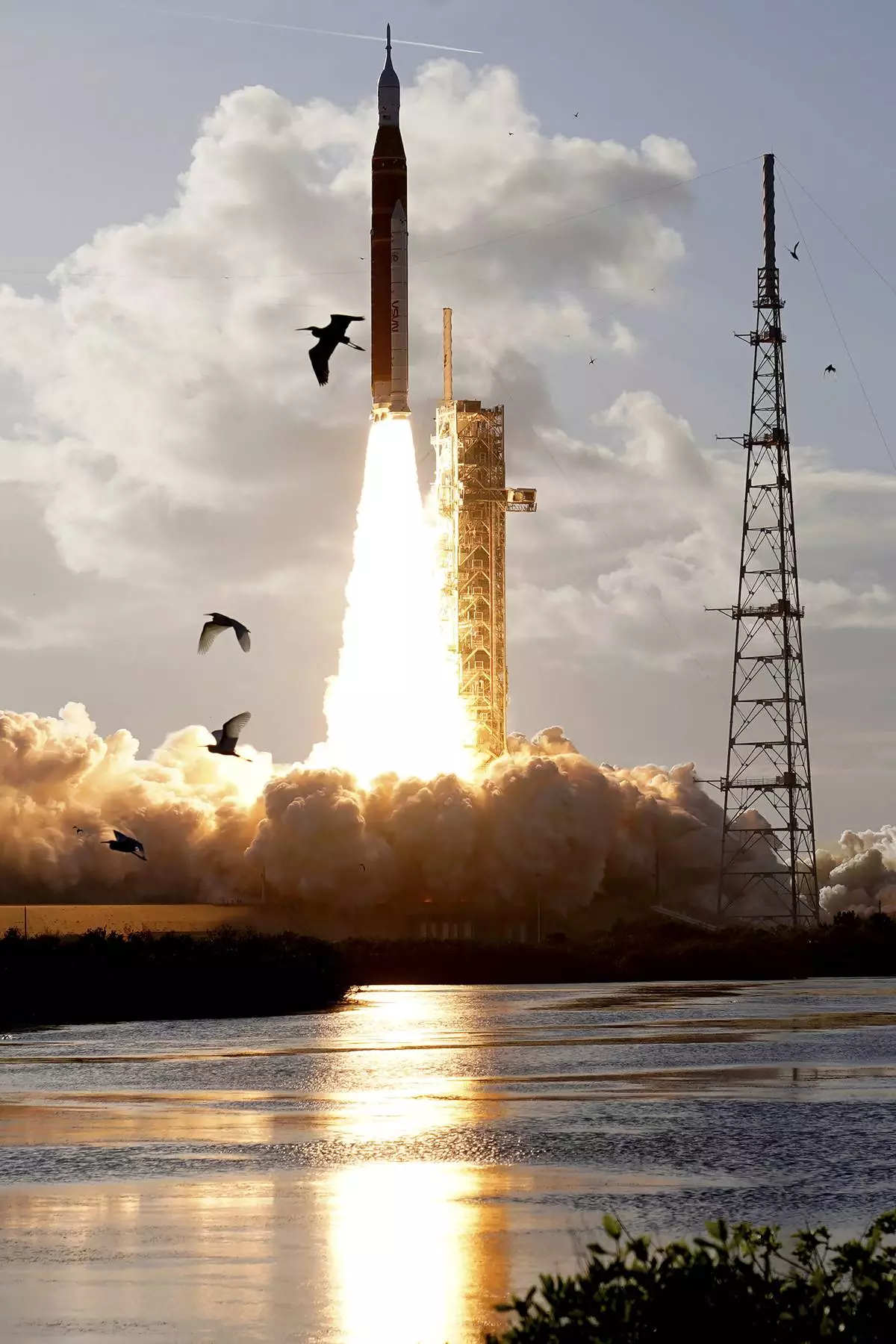
NASA's Artemis II moon rocket lifts off from the Kennedy Space Center's Launch Pad 39-B Wednesday, April 1, 2026, in Cape Canaveral, Fla. (AP Photo/Chris O'Meara)
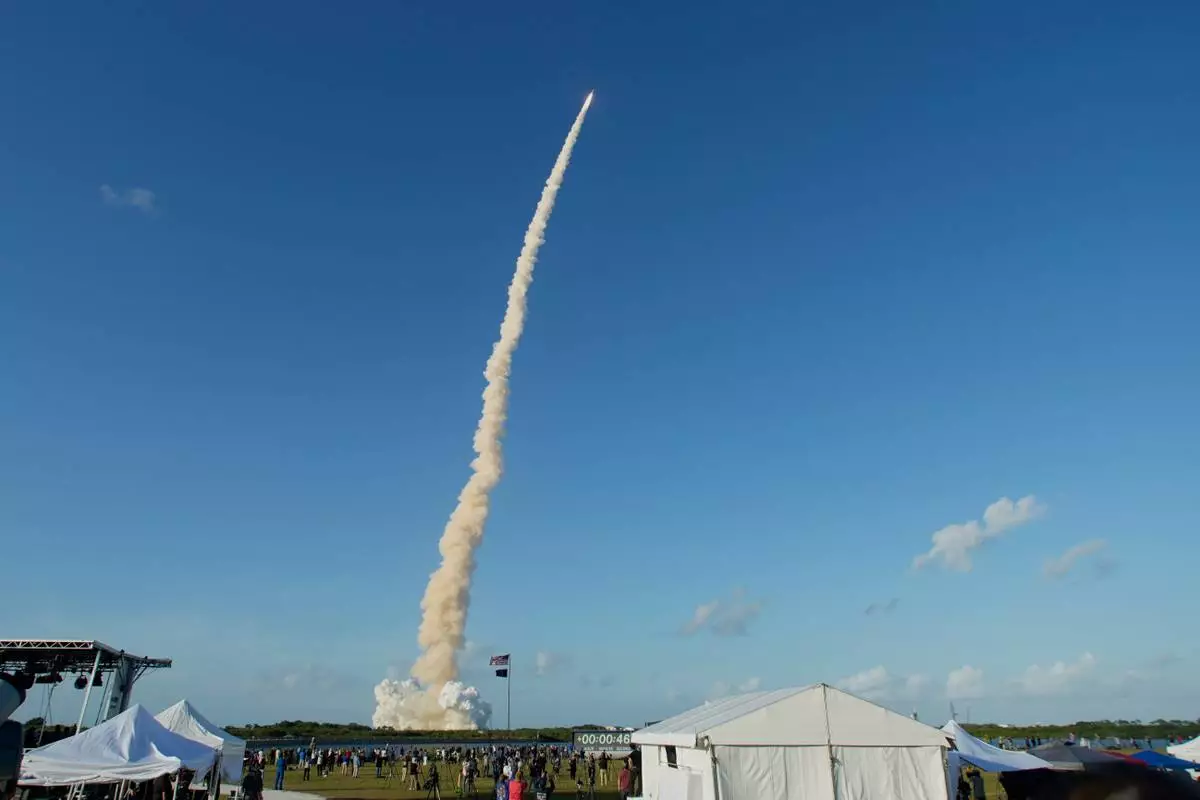
NASA's Artemis II moon rocket lifts off from the Kennedy Space Center's Launch Pad 39-B Wednesday, April 1, 2026, in Cape Canaveral, Fla. (AP Photo/John Raoux)