China's total box office for 2025, including overseas receipts, has crossed the 40 billion yuan (about 5.59 billion U.S. dollars) mark as of 13:53 Sunday, according to data released by the country's ticketing platform.
Domestic screenings alone account for 39.23 billion yuan (about 5.48 billion U.S. dollars), drawing more than 909 million cinema admissions, both comfortably ahead of last year's totals.
Films released this year boast a diverse range of genres, encompassing history, animation, comedy, and action, meeting the needs of different audiences.
As one of the most important film seasons of the year, the Spring Festival box office started off with a bang, with animated blockbuster "Ne Zha 2" ultimately earning approximately 15.45 billion yuan (about 2.16 billion U.S. dollars).
According to data from the China Film Administration, China's box office soared to 29.231 billion yuan (around 4.08 billion U.S. dollars) in the first half of 2025, up 22.91 percent year on year. Domestic films led the charge, contributing a whopping 91.2 percent of the box office earnings.
In the first six months of the year, 641 million moviegoers flocked to theaters, marking a year-on-year growth of 16.89 percent.
A total of 25 films crossed the 100 million yuan mark in H1, with domestic productions accounting for 16 of them, while 9 were international releases.
More than 160 movies were released during the year's summer season, the longest movie schedule of the year.
The war-themed film "Dead To Rights" led the pack in earnings since its release on July 25, setting a new record for China's summer film season. It tells the story of a group of Chinese civilians who took refuge in a photography studio during the Japanese aggressors' brutal occupation of Nanjing in 1937.
"Nobody," a spinoff from the acclaimed Yao-Chinese Folktales animation series, set a new box office record for 2D animated features in Chinese film history.
Other war-themed films, like "Dongji Rescue", telling the story of Chinese fishermen who defied gunfire to rescue over 300 British captives from the Japanese ship Lisbon Maru in 1942, and "Mountains and Rivers Bearing Witness", a documentary that chronicles China's resistance against Japanese aggression from 1931 to 1945, also resonated deeply with audiences with the stories based on real historical events.
The seamless blend of film and retail has sparked a fresh, cross-border model that has been re-energizing the entire industry.
On the first day of the release of "Nobody", sales of its peripheral products exceeded seven million yuan (around about 978,623.80 U.S. dollars), and more than three million blind-box products were sold.
According to data from online platform, revenue from summer film derivatives in 2025 increased by 120 percent year on year.

China's 2025 box office exceeds 40 bln yuan
The three astronauts of China's recently-returned Shenzhou-20 mission on Friday shared the experiences of their dramatic 204-day space mission, including detailing the emergency procedures which were implemented to bring them safely home after their return capsule was struck by space debris.
The trio -- Chen Dong, Chen Zhongrui, and Wang Jie -- met with the press in Beijing on Friday afternoon, marking their first public appearance since returning to Earth in November.
When detailing the emergency response mechanisms which were enacted prior to their scheduled return, the astronauts explained that upon discovering a triangular crack on the spacecraft's viewport window, they immediately took photos for documentation and transmitted them to the ground team, who swiftly activated an emergency plan to get the trio home safely.
Experienced mission commander Chen Dong explained how the crew had complete faith in their colleagues on the ground to find a solution to these unforeseen circumstances which led to their return being delayed.
"First, we must trust the ground team, who would anticipate everything and develop the safest return plan for us. Second, we must believe in ourselves; as well-trained astronauts, we have the ability to manage various unexpected failures. I believe that with the collaboration of astronauts and researchers on the ground, our space home will surely go farther, more steadily, and for a longer time," he said.
Following their extended stay in space as a result of the debris incident, the Shenzhou-20 crew spent a total 204 days in orbit, setting a new record for the longest duration by a single group of Chinese astronauts.
During their mission, they completed multiple payload operations, conducted extensive scientific experiments, and carried out four extravehicular activities.
"Our crew worked together with the ground team in unity and coordination, completing four extravehicular activities, several payload entry and exit tasks, and a large number of scientific experiments. It was a fulfilling yet challenging mission. The path to exploring the heavens is long and arduous, but I firmly believe that China's space missions will succeed," said Chen Zhongrui, a former air force pilot who was making his first spaceflight during the mission.
"From the ground to space, from learning to application, I have deeply felt the solid progress of Chinese space endeavors and the quiet dedication of countless personnel behind the scenes. In the future, I will accomplish each mission with full commitment, living up to the trust of the motherland and the people," said fellow astronaut Wang Jie, who was also making his debut spaceflight.
After returning to Earth on Nov 14, the trio successfully completed their isolation recovery and rehabilitation and will now resume normal training following health assessments.
The crew's return, originally scheduled for Nov 5, was postponed due to safety concerns, with the astronauts later using the return capsule belonging to their successor crew of the Shenzhou-21 mission to get back to Earth. China later launched the unmanned Shenzhou-22 spacecraft which will serve the future return of the crew now aboard the Tiangong Space Station.
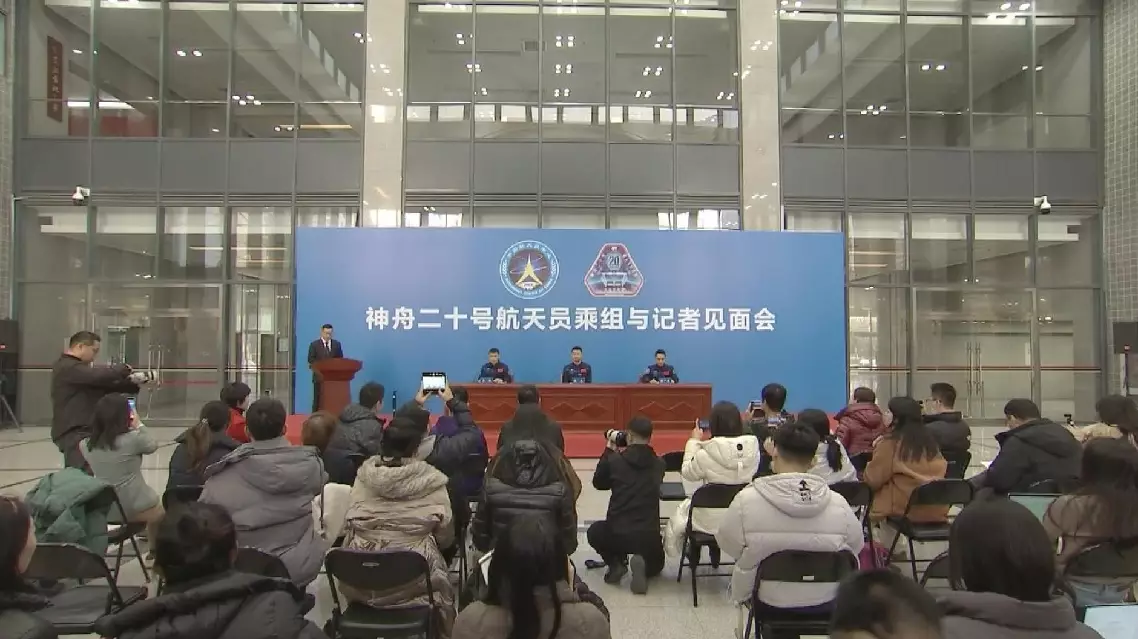
Shenzhou-20 astronauts share experiences after safely returning from debris incident