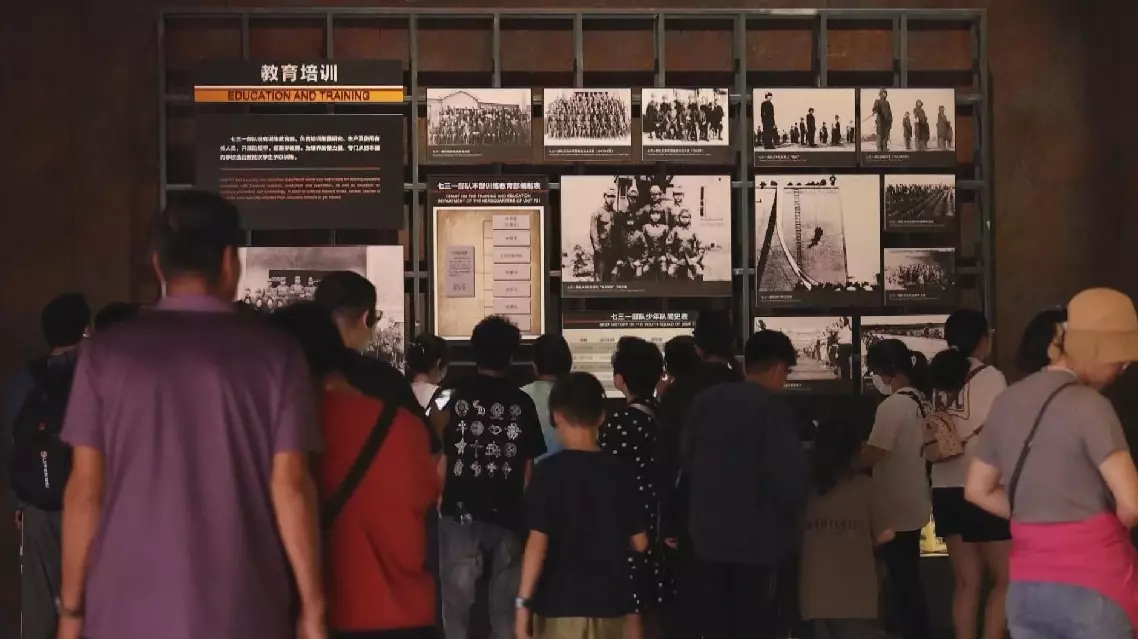
New evidence of Unit 731, a Japanese germ-warfare unit that operated during World War II, was officially put on display in Harbin, the capital of northeast China's Heilongjiang Province on Monday.
The release coincides with the 80th anniversary of victory in the Chinese People's War of Resistance Against Japanese Aggression and the World Anti-Fascist War.
The evidence, including 3,010 pages of documents, 194 minutes of video, 312 photos, 12 postcards, and 8 letters, was released by the Exhibition Hall of Evidence of Crime Committed by Unit 731 of Japanese Imperial Army in Harbin on Aug 15.
Most of those materials are exhibited for the first time and hold great historical value, further exposing the Japanese army's biological warfare crimes against China.
Among the collected documents, the oral testimonies of former Unit 731 youth corps members Kikuta Sunaga and Hisao Naganuma have drawn significant attention.
The Unit 731 youth corps was established to train teenagers as reserve forces for germ warfare. Its members, aged 14 to 18, were recruited from Japan. The group was formed around the same time as Unit 731 itself and grew to a considerable size.
"From 1937 to 1945, there were six sessions of the youth corps with over 230 members in total. Unit 731 sent key personnel to the Japanese Army Military Medical School to recruit students under the pretext of providing education. In Harbin, they were told they would be working at the Unit 731. In April 1939, Shiro Ishii personally returned to Japan to interview and assess candidates at the Japanese Army Military Medical School," said Jin Shicheng, deputy secretary-general of the Harbin Research Institute on the History of Bacterial and Gas Warfare by Japanese Invaders.
In April 1943, Kikuta Sunaga was recruited into the youth corps, and participated in the production of ceramic germ bombs.
"There was something like this, about 1.8 to 2 meters tall. It was sealed with a chemical substance and filled with vectors like fleas and sawdust. That way, the bacteria wouldn't die in the explosion. Simply put, that's what it was. If it was an iron bomb, the heat from the explosion would burn the fleas. Ceramic bombs didn't have that problem, so our superiors ordered us to produce them," said Sunaga.
Hisao Naganuma also joined the youth corps in April 1943. He saw the victims and was taken to visit the dissection room.
"It looked like they were cutting skulls of victims. After seeing that, I left," said Naganuma.
Unit 731 recruited teenagers aged 14 to 18 because their worldviews were still developing, making them susceptible to militarism and transformation into loyal executors of biological warfare, according to researchers.
"Teenagers selected from schools tended to be more disciplined, obedient, and compliant. They were easily influenced by their environment. If they were instilled with military spirit at that stage, they could become instruments for carrying out Japan's germ warfare crimes more quickly," said Gong Wenjing, director of the International Research Center on Unit 731 Issues at the Harbin Academy of Social Sciences.
New evidence of Japanese germ-warfare unit's youth corps put on display