President Xi Jinping on Monday proposed the Global Governance Initiative (GGI), calling on countries to work in concert for a more just and equitable global governance system.
Xi put forward the proposal when chairing the "Shanghai Cooperation Organization (SCO) Plus" Meeting in the northern Chinese port city of Tianjin, where the largest SCO summit in its 24-year history is undergoing, attended by leaders from more than 20 countries and heads of 10 international organizations.
Xi delivered a keynote speech at the meeting.
He said that this year marks the 80th anniversary of the victory of the World Anti-Fascist War and the founding of the United Nations. It is a milestone to remember the past and create a better future together.
Eighty years ago, the international community learned profound lessons from the scourge of two world wars and founded the United Nations, thus opening a new page in global governance. Eighty years later, while the historical trends of peace, development, cooperation and mutual benefit remain unchanged, the Cold War mentality, hegemonism and protectionism continue to haunt the world, Xi said.
New threats and challenges have been on the rise. The world has found itself in a new period of turbulence and transformation. Global governance has come to a new crossroads, he said. China is willing to work with all countries for a more just and equitable global governance system and advance toward a community with a shared future for humanity, Xi said.
Xi proposed the Global Governance Initiative (GGI) at the meeting, and highlighted five principles for the initiative:
First, adhering to sovereign equality.
All countries, regardless of size, strength and wealth, are equal participants, decision-makers and beneficiaries in global governance. Efforts should be made to promote greater democracy in international relations and increase the representation and voice of developing countries, Xi said.
Second, abiding by international rule of law.
The purposes and principles of the UN Charter and other universally recognized basic norms of international relations must be observed comprehensively, fully and holistically. International law and rules should be applied equally and uniformly. There should be no double standards, and the house rules of a few countries must not be imposed upon others, Xi said.
Third, practicing multilateralism.
It's necessary to uphold the vision of global governance featuring extensive consultation and joint contribution for shared benefit, strengthen solidarity and coordination, and oppose unilateralism. All parties should firmly safeguard the status and authority of the United Nations, and ensure its irreplaceable, key role in global governance, Xi said.
Fourth, advocating the people-centered approach.
Efforts should be made to reform and improve the global governance system to ensure that the people of every nation are the actors in and beneficiaries of global governance, so as to better tackle the common challenges for human society, better narrow the North-South gap, and better safeguard the common interests of all countries, the Chinese president said.
Fifth, focusing on taking real actions.
It's necessary to adopt a systematic and holistic approach, coordinate global actions, fully mobilize various resources, and strive for more visible outcomes. Efforts should be made to enhance practical cooperation to prevent the governance system from lagging behind or being fragmented, Xi said.
The GGI marks the fourth landmark global initiative proposed by Xi over the past several years, following the Global Development Initiative (GDI), the Global Security Initiative (GSI) and the Global Civilization Initiative (GCI). The founding declaration and the Charter of the SCO made it clear at the outset that a more democratic, just and equitable international political and economic order should be promoted, Xi said, adding that over the past 24 years, the SCO has adhered faithfully to the Shanghai Spirit of mutual trust, mutual benefit, equality, consultation, respect for diversity of civilizations, and pursuit of common development.
Noting that the SCO has increasingly become a catalyst for the development and reform of the global governance system, Xi called on the SCO to step up to play a leading role and set an example in carrying out the GGI.
Xi urged the SCO member states to contribute the SCO strength to safeguarding world peace and stability, continue to uphold the principles of non-alliance, non-confrontation and not targeting any third party, and join their efforts in addressing various threats and challenges.
The SCO should remain a force for stability in this volatile world, Xi said.
Xi called on the SCO member states to step up to take the responsibility for open cooperation across the globe.
Xi said that China will establish three major platforms for China-SCO cooperation in energy, green industry, and digital economy, and will set up three major cooperation centers for scientific and technological innovation, higher education, and vocational and technical education.
China will work with fellow SCO countries to increase the installed capacity of photovoltaic and wind power each by 10 million kilowatts in the next five years, said Xi.
China is ready to build with all sides the artificial intelligence (AI) application cooperation center, and share the dividends of progress in AI, he said.
China welcomes all parties to use the Beidou Satellite Navigation System and invites countries with relevant capacities to take part in the International Lunar Research Station project, he said.
Xi called for setting an example in championing the common values of humanity.
Xi announced that in the next five years, China will treat 500 patients with congenital heart disease, perform 5,000 cataract operations, and carry out 10,000 cancer screenings for other SCO countries.
Xi called for actions to defend international fairness and justice.
The SCO member states should continue to unequivocally oppose hegemonism and power politics, practice true multilateralism, and stand as a pillar in promoting a multipolar world and greater democracy in international relations, he said. Xi said China is ready to work with all parties to promote a correct historical perspective on World War II.
Xi called for joint efforts to resolutely safeguard the fruits of WWII victory and deliver more benefits to the entire humanity through the reform of the global governance system and the building of a community with a shared future for humanity.
Leaders of the SCO member states, observer states, dialog partners, the Presidency's guests, as well as heads of the UN and other international organizations and institutions, attended the meeting.
All parties spoke highly of the GGI, saying that the global governance deficit is expanding, sustainable development is facing challenges, unilateralism is on the rise, the authority of the United Nations and international rules are being undermined, and the world urgently needs a brand-new governance concept.
The GGI rejects the logic of power politics, supports the core role of the United Nations, advocates common development, adheres to fairness and justice, and contributes Chinese wisdom and solutions to achieving more effective, just and equitable global governance and addressing the world's pressing issues today, they said.
All parties agreed to enhance communication and coordination, strengthen cooperation in trade, investment, innovation, industry, agriculture and other fields, combat terrorism, drug trafficking and cybercrime, enhance mutual understanding by strengthening people-to-people and cultural exchanges, give full play to the influence of the SCO, practice multilateralism, safeguard the authority of the United Nations, and jointly promote the cause of world peace, development and progress.
Xi and leaders of all parties attending the meeting expressed their concern over the earthquake that struck Afghanistan in the early hours on Monday, extended their condolences to the Afghan side, and wished the Afghan people to overcome difficulties and rebuild their homeland as soon as possible.
Founded in Shanghai on June 15, 2001, the SCO is the first regional international organization that was co-founded by China and is named after a Chinese city.
The SCO has grown from its six founding members into a 26-nation family spanning Asia, Europe and Africa, comprising 10 member states, two observer states and 14 dialog partners. It is now the world's largest regional international organization in terms of both geographical area and population.
China assumed the SCO rotating presidency of 2024-2025 after the Astana Summit in Kazakhstan in July last year.
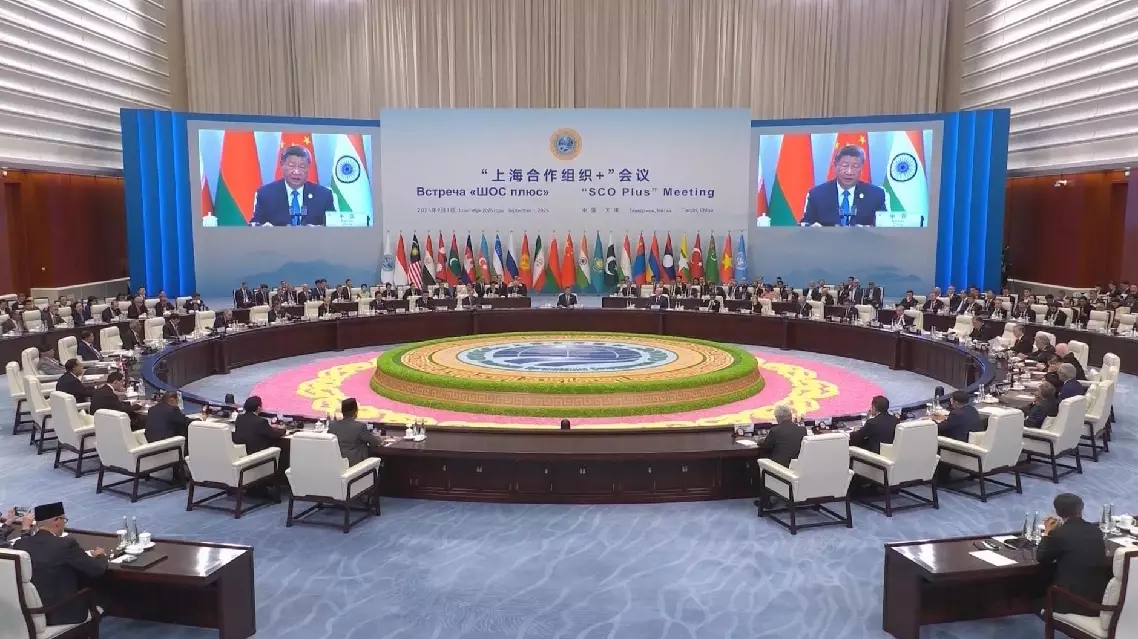
Xi proposes Global Governance Initiative at SCO summit
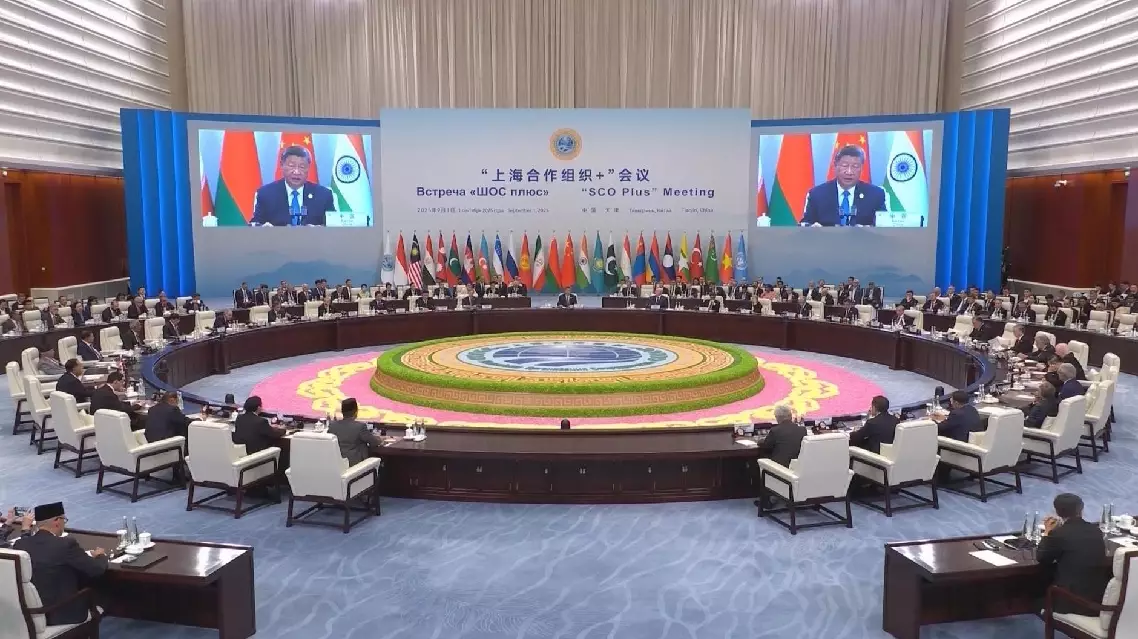
Xi proposes Global Governance Initiative at SCO summit