MELBOURNE, Australia (AP) — U.N. chief Antonio Guterres congratulated Papua New Guinea on Wednesday for its global leadership role on climate change during the first visit by a serving United Nations secretary-general to the South Pacific island nation.
Guterres’ visit comes ahead of the developing nation commemorating the 50th anniversary of its independence from near-neighbor Australia on Sept. 16.
He said the first lesson Papua New Guinea had taught the world was the “art of forging consensus through dialogue” since becoming an independent nation.
“The second lesson you offer to the world is bold climate action,” Guterres said in an address to the National Parliament in the capital Port Moresby.
“Time and again we have seen climate leadership flow not from countries with the most wealth and power but from those who know the stakes firsthand,” he added.
Guterres credited Papua New Guinea with playing a leading role in initiating the International Court of Justice’s advisory opinion in July that countries could be violating international law if they failed to take measures to protect the planet from climate change, and nations harmed by its effects could be entitled to reparations.
The ICJ's non-binding opinion, backed unanimously by the court’s 15 judges, has been hailed as a turning point in international climate law.
The case was led by the South Pacific island nation of Vanuatu and backed by more than 130 countries.
“It’s a testament to the leadership of Papua New Guinea, Melanesia and the wider Pacific region,” Guterres said.
“Papua New Guinea does not contribute to climate change. You are even a carbon sink country,” he added, referring to the nation's forests and surrounding sea grass absorbing more carbon dioxide than the population emits.
Guterres did not mention that Papua New Guinea has been exporting liquid natural gas since 2014 and plans to expand that fossil fuel industry.
Papua New Guinea Prime Minister James Marape told Parliament in response to Guterres’ speech that his nation’s “development pathway will be green, resilient and inclusive.”
Marape has long argued that the biggest carbon-emitting countries had a “moral obligation and the bigger responsibility” to manage climate change.
He was critical of President Donald Trump withdrawing the United States from the landmark Paris climate agreement in January.
Paul Barker, executive director of the Port Moresby-based think tank Institute of National Affairs, said Papua New Guinea’s effectiveness as a carbon sink had likely been reduced by decades of rain forest logging.
“It’s a mixed story and the data is a little uncertain,” Barker said on changing land uses under what the government calls forest conversion agreements.
Papua New Guinea is the South Pacific’s most populous country after Australia. Australia has 27 million people while Papua New Guinea’s statistical office estimates its population is approaching 12 million. A widely accepted census has not been completed since 2000.
Papua New Guinea is also an extraordinarily diverse population, with more than 800 Indigenous languages.
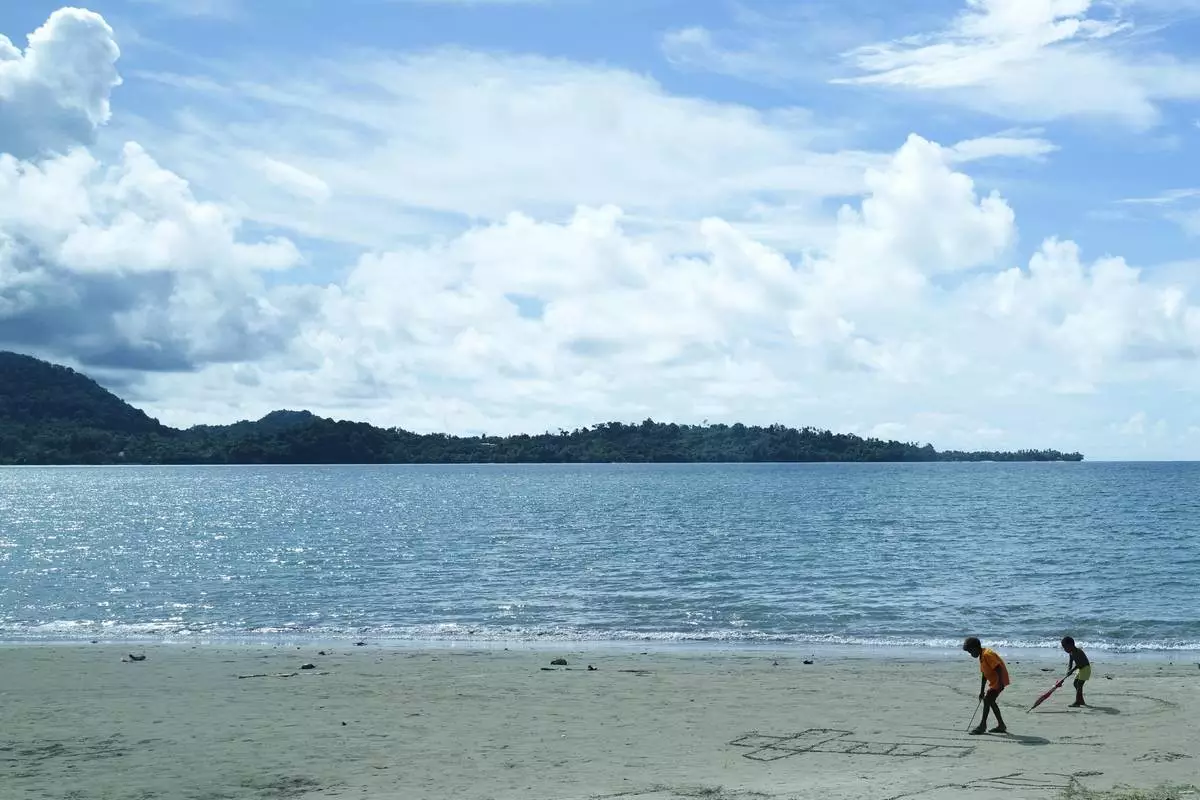
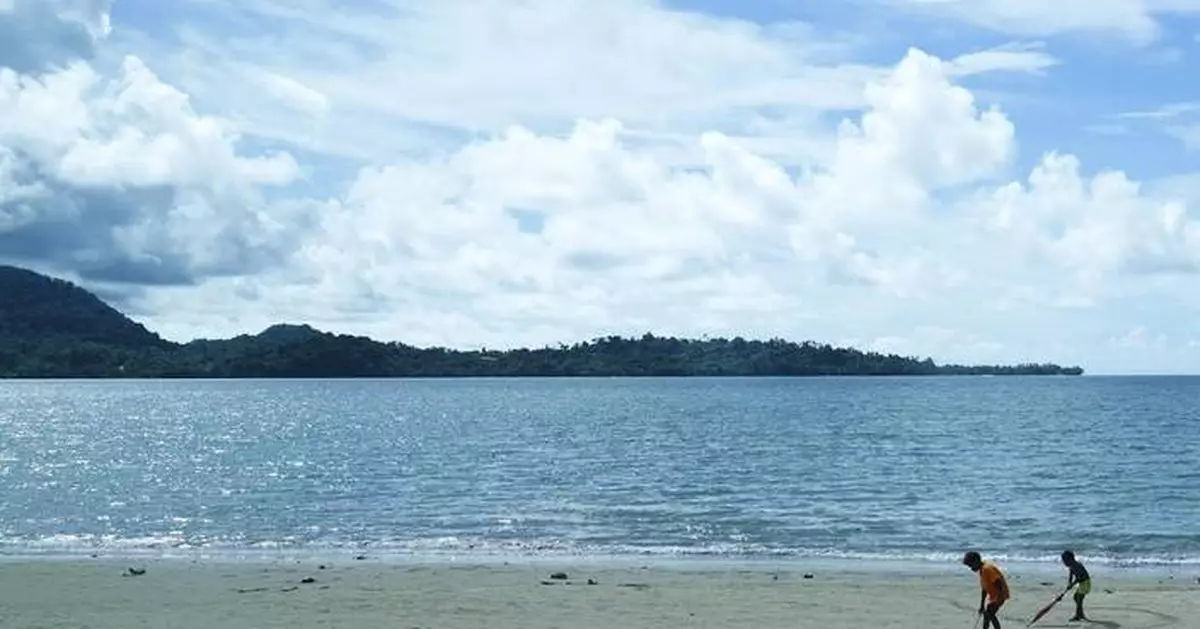
FILE - Children draw crosses on a sandy beach in Vanimo, Papua New Guinea, Sunday, Sept. 8, 2024. (AP Photo/Gregorio Borgia, File)
U.S., Danish and Greenlandic officials have met face to face to discuss President Donald Trump's ambitions to take control of Greenland, a semiautonomous territory of Denmark. At the same time, Denmark and several European allies are sending troops to Greenland in a pointed signal of intent to boost the vast Arctic island's security.
Danish Foreign Minister Lars Løkke Rasmussen said after a meeting in Washington on Wednesday with his Greenlandic counterpart, U.S. Vice President JD Vance and Secretary of State Marco Rubio that a “fundamental disagreement” remained. He acknowledged that “we didn't manage to change the American position” but said he hadn't expected to.
However, Wednesday's events did point to ways ahead.
Denmark, Greenland and the U.S. agreed to form a high-level working group “to explore if we can find a common way forward,” Løkke Rasmussen said. He added that he expects the group to hold its first meeting “within a matter of weeks.”
Danish and Greenlandic officials didn't specify who would be part of the group or give other details. Løkke Rasmussen said the group should focus on how to address U.S. security concerns while respecting Denmark's “red lines.” The two countries are NATO allies.
“Whether that is doable, I don't know,” he added, holding out hope that the exercise could “take down the temperature.”
He wouldn't elaborate on what a compromise might look like, and expectations are low. As Danish Defense Minister Troels Lund Poulsen put it Thursday, having the group is better than having no working group and “it's a step in the right direction.” It will at least allow the two sides to talk with each other rather than about each other.
Trump has argued repeatedly that the U.S. needs control of Greenland for its national security. He has sought to justify his calls for a U.S. takeover by repeatedly claiming that China and Russia have their own designs on Greenland, which holds vast untapped reserves of critical minerals.
Just as the talks were taking place in Washington on Wednesday, the Danish Defense Ministry announced that it was increasing its military presence in Greenland, along with NATO allies. France, Germany, Norway and Sweden announced that they were each sending very small numbers of troops in a symbolic but pointed move signaling solidarity with Copenhagen.
The U.K. said one British officer was part of what it called a reconnaissance group for an Arctic endurance exercise. The German Defense Ministry, which dispatched 13 troops, said the aim is to sound out “possibilities to ensure security with a view to Russian and Chinese threats in the Arctic.” It said it was sending them on a joint flight from Denmark as “a strong signal of our unity.”
Poulsen said that "the Danish Armed Forces, together with a number of Arctic and European allies, will explore in the coming weeks how an increased presence and exercise activity in the Arctic can be implemented in practice,” he said.
On Thursday, he said the intention was “to establish a more permanent military presence with a larger Danish contribution,” and to invite allies to take part in exercises and training on a rotating basis, according to Danish broadcaster DR.
While the European troops are largely symbolic at this point, the timing was no accident.
The deployment “serves both to send a political signal and military signal to America, but also indeed to recognize that Arctic security should be reinforced more," said Maria Martisiute, an analyst at the European Policy Center in Brussels. "And first and foremost, this should be done through allied effort, not by the U.S. coming and wanting to take it over. So it complicates the situation for the U.S.”
The European efforts are Danish-led and not coordinated through NATO, which is dominated by the United States. But the European allies are keen to keep NATO in play, and Germany said that “the aim is to obtain a well-founded picture on the ground for further talks and planning within NATO."
Poulsen has said he and Greenland's foreign minister plan to meet NATO Secretary General Mark Rutte in Brussels on Monday to discuss security in and around the Arctic. NATO has been studying ways to bolster security in the Arctic region.
“I’m really looking forward for an announcement of some kind of military activity or deployment under NATO’s framework,” Martisiute said. “Otherwise there is indeed a risk that ... NATO is paralyzed and that would not be good.”
Sylvain Plazy in Brussels contributed to this report.
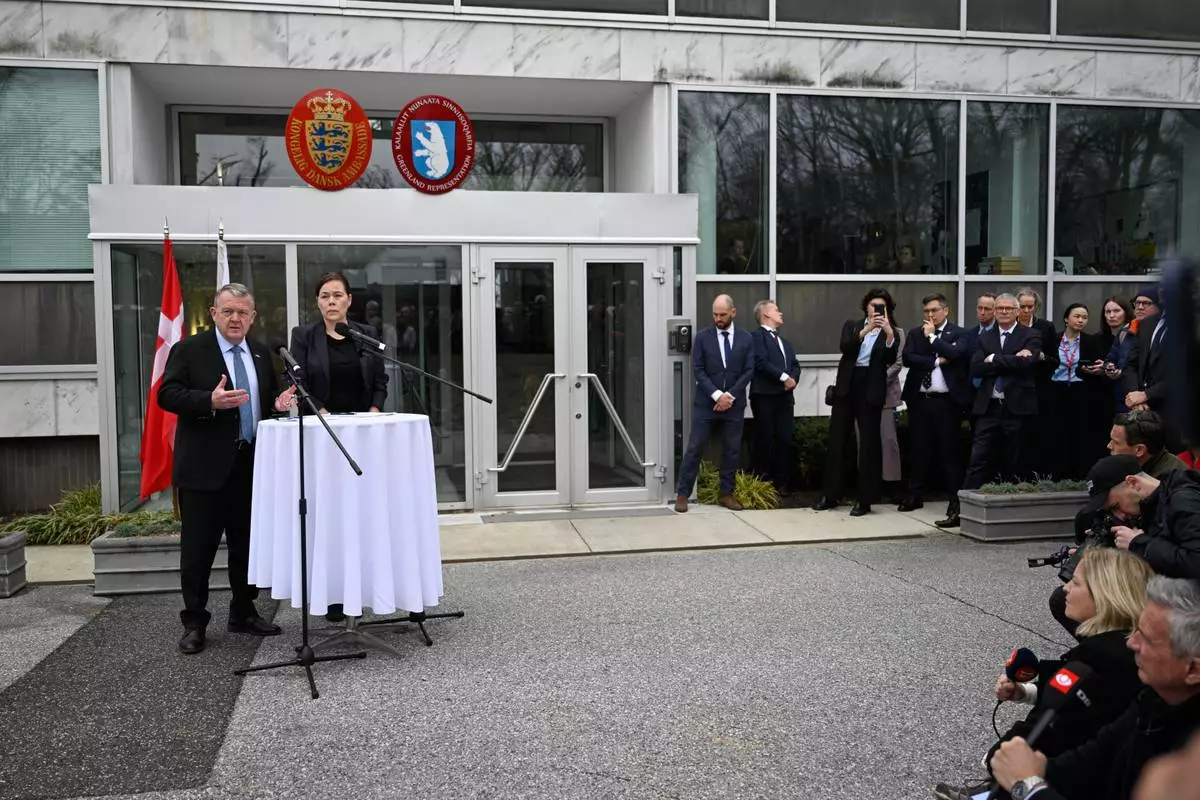
Denmark's Foreign Minister Lars Løkke Rasmussen and Greenland's Foreign Minister Vivian Motzfeldt speak at a news conference at the Embassy of Denmark, Wednesday, Jan. 14, 2026, in Washington. (AP Photo/John McDonnell)
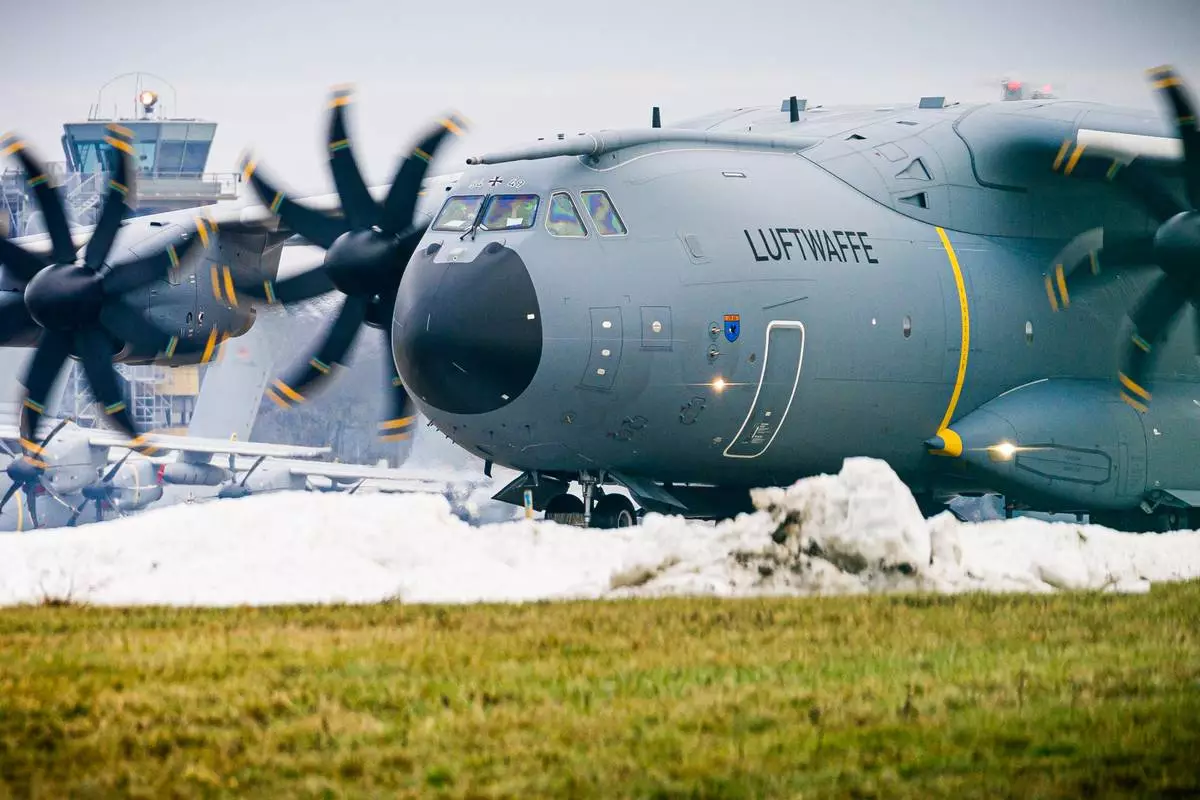
An Airbus A400M transport aircraft of the German Air Force taxis over the grounds at Wunstorf Air Base in the Hanover region, Germany, Thursday, Jan. 15, 2026 as troops from NATO countries, including France and Germany, are arriving in Greenland to boost security. (Moritz Frankenberg/dpa via AP)
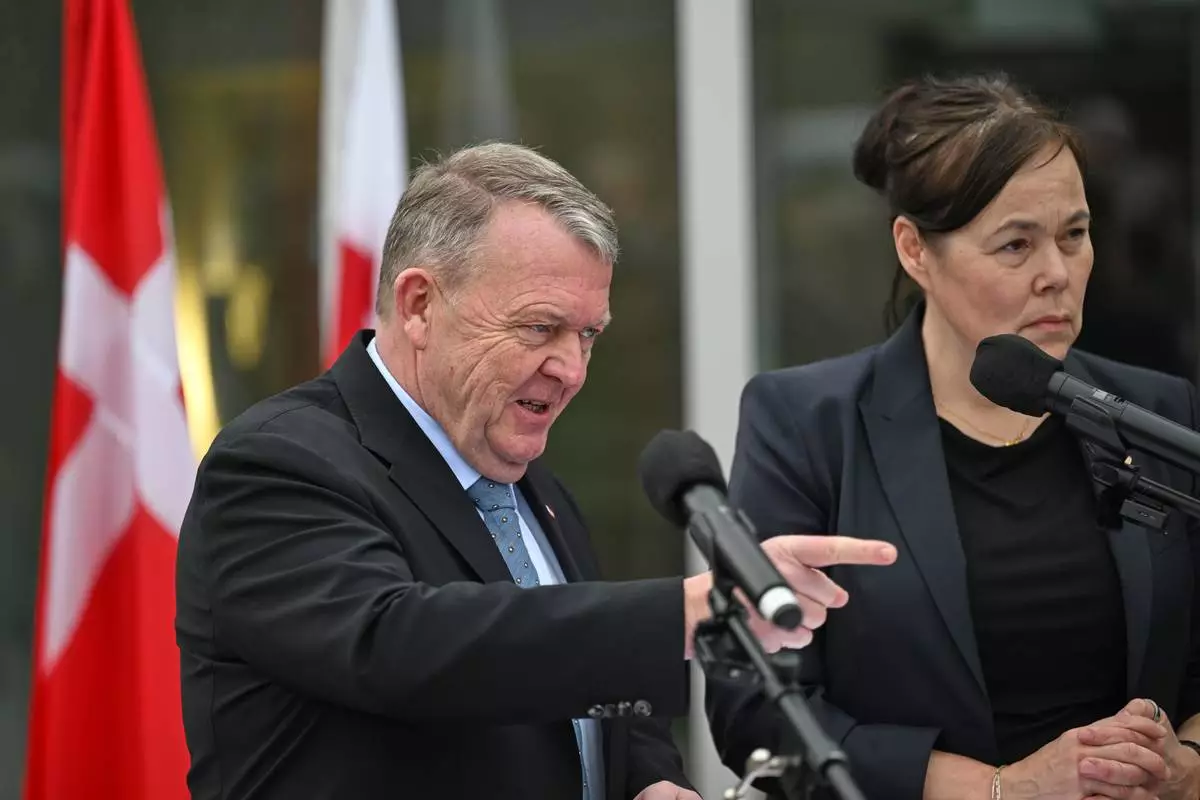
Denmark's Foreign Minister Lars Løkke Rasmussen and Greenland's Foreign Minister Vivian Motzfeldt speak at a news conference at the Embassy of Denmark, Wednesday, Jan. 14, 2026, in Washington. (AP Photo/John McDonnell)
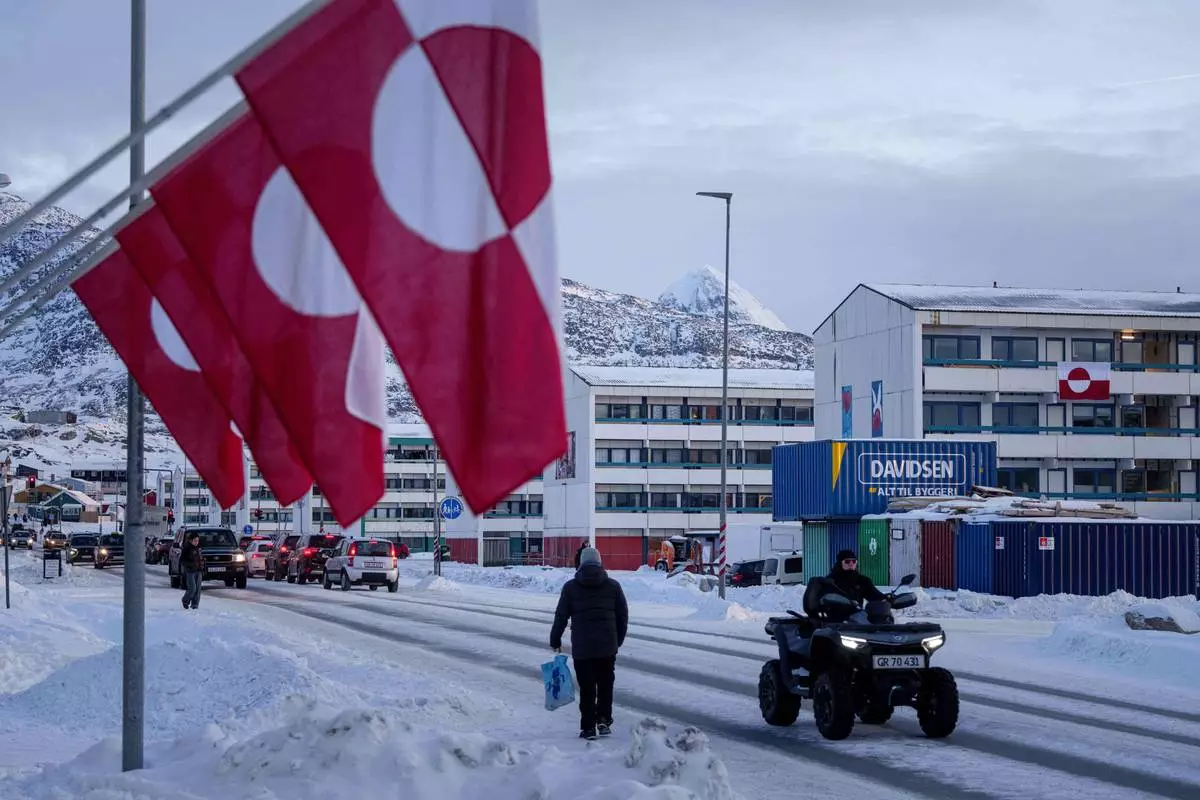
A man rides by on a quad bike past a row of Greenlandic national flags in Nuuk, Greenland, Wednesday, Jan. 14, 2026. (AP Photo/Evgeniy Maloletka)