TOKYO (AP) — A three-hour film about the esoteric world of Kabuki is defying the odds at the Japanese box office, with tickets selling out at some cinemas.
“Kokuho,” which means “national treasure,” has already grossed more than 10 billion yen ($68 million), making it the second-highest grossing Japanese live-action film of all time, and the first to achieve that in more than two decades.
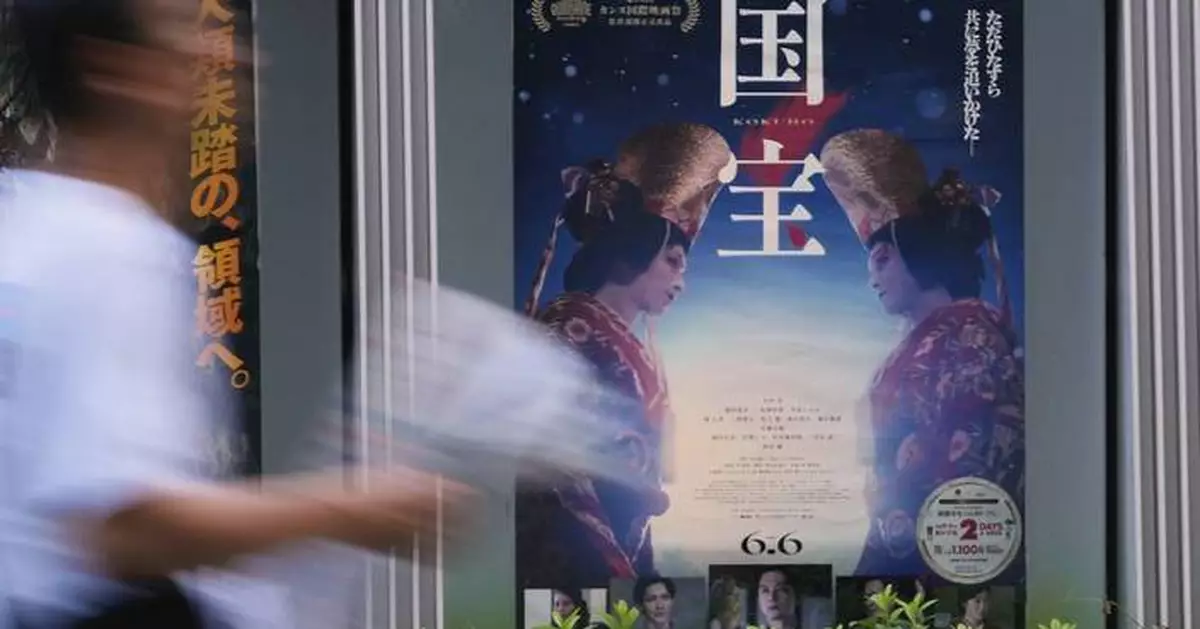
It stars heartthrobs Ryo Yoshizawa and Ryusei Yokohama who portray longtime rivals and soulmates. They are both Kabuki “onnagata” actors, meaning they specialize in women roles, from gorgeous princesses to damsels in distress.
They look stunning, and convincing, having gone through months of training with a real Kabuki actor.
Japan has submitted the film for the international feature category at the Academy Awards. The short list of the 15 films from which the final nominations come will be announced Dec. 16.
“Kohuko” got a favorable reception at the Cannes Film Festival. And it's been seen 7.4 million times in the first 73 days in Japanese theaters, many of them repeat viewers.
The plot of “Kokuho” — pronounced Koh-koo-hoe — explores perennial themes of family and the grueling hardships of being an artist, set to the backdrop of the intense but dreamlike life of the Kabuki actor.
It also pays homage to old-style yakuza movies, as well as obliquely to Western gangster films, like “The Godfather,” because one of the heroes is the son of a gangster.
In short, it’s not the kind of material that usually makes a hit movie in Japan, where action-packed blockbusters or animation based on popular manga comics or spectacular special effects have drawn audiences in the past.
But the movie’s theme explores something intrinsically Japanese and hit a raw nerve in a country where soul-searching about national pride is on the rise amid a widespread perception that economic and political clout is on the decline.
Being an outsider was the theme that jumped out for tourism science scholar Yosuke Kon.
“The Kabuki world seems very special, but a Kabuki kind of mentality exists in many places in Japan,” he told The Associated Press, noting a closed mentality is prevalent in the village, as well as local governments he has worked with.
“Many people can relate to the film,” he added.
The film is dominated by stage scenes from Kabuki, an art form dating to the 17th century, which combines stylized dance and acting to live music. It’s been stereotyped as catering to old people, as younger generations turn to Western and modern forms of entertainment like boys’ bands, baseball games and streaming services.
In Kabuki, all the roles are played by men, wearing thick makeup and elaborate kimono, delivering sing-song lines in tales of intrigue and violence set in the samurai era.
The film shows the dazzling esoteric elements of Kabuki, such as the backstage where actors apply makeup with their fingertips, or the flutter of paper snowflakes or flower petals on the stage.
It also reenacts the biggest hits of Kabuki — “Musume Dojoji,” in which a vengeful love turns a woman into a serpent, and “Sagi Musume,” whereby a heron dances taking the form of woman, a sort of Kabukiesque “Swan Lake.”
As with many younger Japanese, Sara Akino, a singer, hardly ever goes to the movies, but she was glad she went.
“It’s about living so true to yourself you are putting your life on the line,” she said.
People’s reactions varied, with everyone seeming to get something slightly different out of it.
“The beauty of the cinematography was utterly amazing,” said Miho Anzai, a nutritionist, who saw the film after hearing so much about it. She was especially impressed with the younger actors who portrayed the characters as children.
“The work was superb in how realistically Kabuki actors and their fiercely strict yet delicate aesthetic were portrayed,” she said.
Hiroyuki Okada, a teacher in the traditional “ikebana” flower arrangement, said the film gave him a sense of satisfaction as though he had seen high quality theater, and that the characters seemed to represent light and darkness, or the Asian duality of “yin and yang.”
“I felt the work depicted a tasteful pursuit of madness,” he said.
The success of the film has sparked interest in the two-volume best-selling book by Shuichi Yoshida it is based on. Yoshida worked as a stagehand for several years to learn the workings of Kabuki.
The film has been brought to the screen by acclaimed director Sang-il Lee, whose credits include the 2007 award-winning film “Hula Girls” and the 2022 Apple TV series “Pachinko,” as well as the Japanese-language version of Clint Eastwood’s “Unforgiven.”
Cinematographer Sofian El Fani, a Tunisian who worked on the Palme d’Or-winning “Blue is the Warmest Color,” presents mesmerizing closeups that highlight the inner turmoil of the characters. His camera angles give a delightfully new and pensive perspective on Kabuki, whose official footage tends to make a point of showing full-body shots.
Lee was deeply moved to see people watching his film, glued to the screen. The scene was straight out of the movies, he recalled
“There the barriers of generations were gone, living proof that everyone is searching for the moment that truly touches our emotions, knowing how beautiful those tears that flow for no reason can be,” he said in a statement. “Films are so wonderful. They are worth the fight.”
Yuri Kageyama is on Threads: https://www.threads.com/@yurikageyama
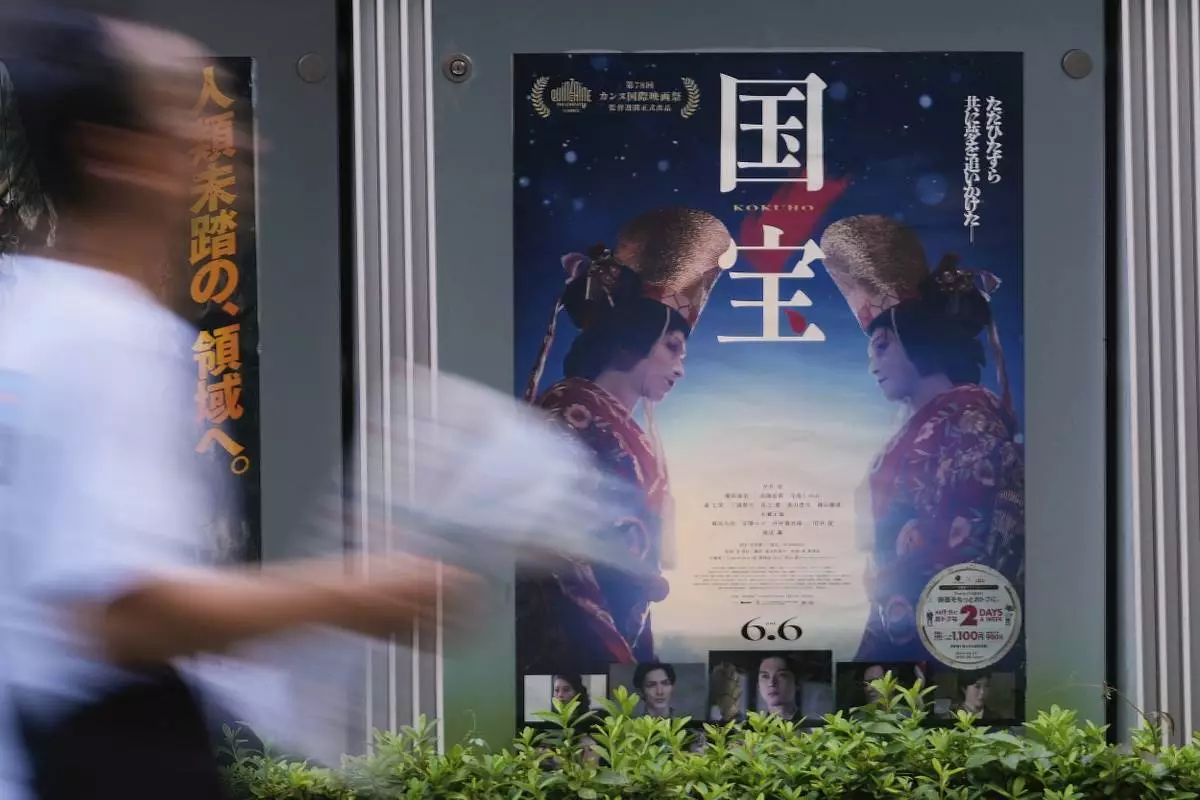
A person walks by a poster of film "Kokuho," in Tokyo, on Aug. 29, 2025. (AP Photo/Shuji Kajiyama)
BOSTON (AP) — When Zdeno Chara signed with the Boston Bruins in 2006, the No. 3 he wore early in his career had already been retired by the Original Six franchise.
So he picked No. 33 without giving it much thought.
“Little did I know how meaningful 33 was,” Chara said on Thursday night before his number was raised to the TD Garden rafters not far from where Larry Bird's No. 33 already hangs in Celtics green.
It is the 13th number retired by the Bruins, and the latest in a collection of Hall of Fame defenseman that runs from Eddie Shore to Bobby Orr to Raymond Bourque.
“It's a huge honor,” Chara told reporters. "I can’t explain to you how honored I feel. I’m humbled about being selected to be one of the numbers being retired. Being with that history, forever."
The 2009 Norris Trophy winner and a 2025 Hockey Hall of Fame inductee, Chara spent 14 of his 24 NHL seasons in Boston, leading the Bruins to the 2011 Stanley Cup championship. His 1,680 games is the most of any NHL defenseman; at 6 feet, 9 inches (2.06m), he is the tallest player in league history, and his 108.8 mph (175.1 kmh) slap shot in the 2012 skills competition remains the NHL record.
But his teammates and other Bruins attending Thursday's ceremony said Chara's biggest contribution was signing with a team that hadn't won a playoff series in six years — “the best decision I ever made” — and turning them into champions.
“Things really changed when Zee came here as a free agent,” Bourque said. "From that point on, the culture and everything that comes with that, and the success and the run that they had, he was such a big part of that.
“He’s a legend,” Bourque said. “He really deserves to be up there.”
Bourque was among the former Bruins greats in attendance, along with Orr — both of them, like Chara, Boston defensemen who finished their careers elsewhere on their way to the Hall of Fame. They arrived via gold carpet that led them past adoring fans and the statue of Orr flying through the air following his Cup-winning goal in the 1970 finals.
Other fellow retired number honorees in attendance included Cam Neely, Willie O’Ree, Rick Middleton, Terry O'Reilly and John Bucyk. The current Bruins sat on the bench, all wearing Chara jerseys.
Five members of the 2011 roster — Patrice Bergeron, Mark Recchi, Dennis Seidenberg, David Krejci and Tuukka Rask — carried the retired number onto the ice, and teammate Andrew Ference served as emcee.
In his speech, Chara read the names of every player on the Bruins last Cup winners. Asked why, he said after: “Without championships, you are not going to be successful, you’re not going to be recognized.
"The championships, that’s what they do. They raise everyone, they extend careers for everyone,” he explained. "They create dynasties. They create stories. They create memories. They created what we’re experiencing tonight.
"It’s very simple: Once you win the championship, everything gets so much better for everyone. And the most beautiful thing about it: You create extended families with each other. It’s true. You have bonds, you have friendships that are now still forever. It’s amazing; it’s like you’re seeing your brother. You trust the person; you know everything about them. And anytime anybody needs something, you’re there for them.
“That’s what winning championships do,” he said. “Not just for a career, but for the rest of your lives, it means something very special.”
The ceremony at center ice featured a “Big Zee” ice sculpture flanking the podium and a large No. 33 behind it. Fans were asked to get in their seats two hours early, and the full TD Garden erupted in a giant shout of “Zee!” followed by an extended cheer of “Thank you, Chara!”
A highlight video featured former Bruins Brad Marchand and current coach Marco Sturm, Chara's teammate from 2006-10. Many of them spoke of the way Chara led by example.
“He wasn’t really a ‘Rah, rah!’ guy,” former Bruins forward and current team president Neely said, “but when he spoke, it was with a purpose.”
And so, when it was time to raise his No. 33 to the rafters, Chara stood by with his wife, Tatiana, while their children — Zack, Ben and Elliz — pulled the ropes.
“That’s the biggest reward for me: To see my children and my family doing it instead of me. I think I get better joy watching them doing it than the joy of me doing it because it's so much more meaningful,” he explained. "They deserve that more than me."
AP NHL: https://apnews.com/hub/nhl
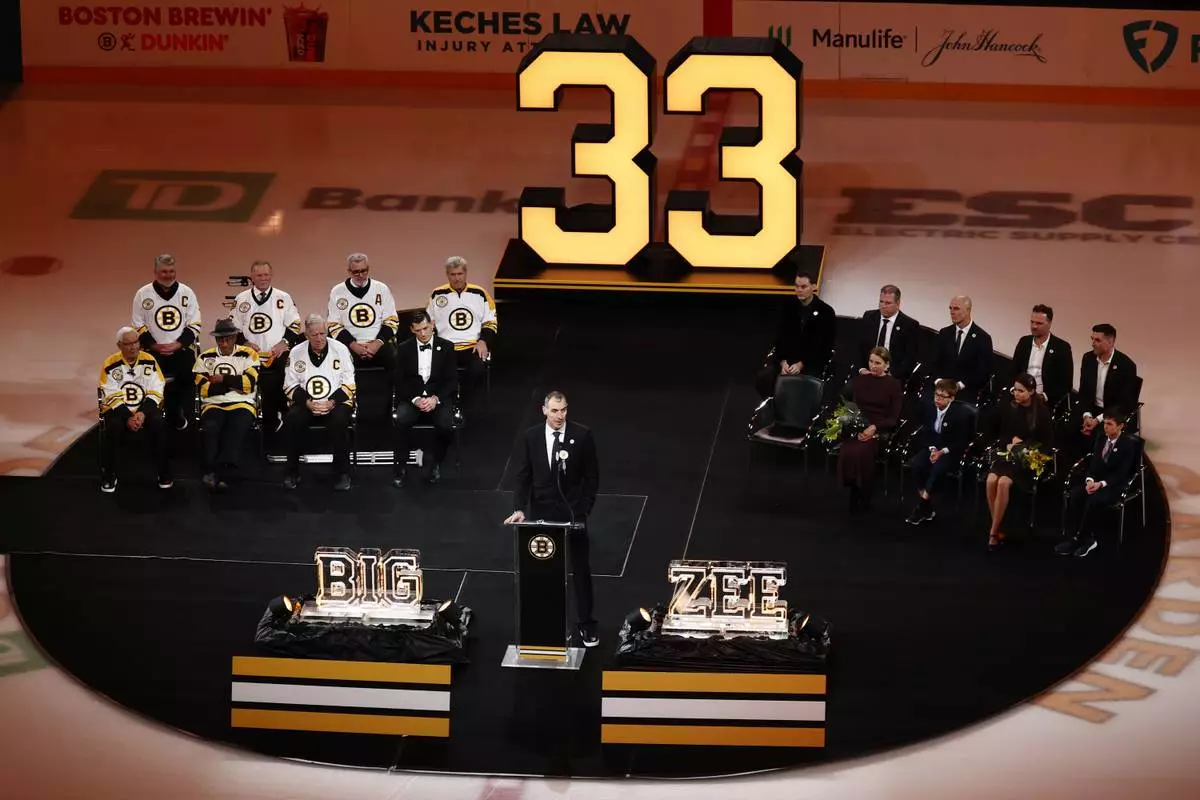
Former Boston Bruins captain Zdeno Chara speaks during his number retirement ceremony before an NHL hockey game between the Boston Bruins and the Seattle Kraken Thursday, Jan. 15, 2026, in Boston. (AP Photo/Winslow Townson)
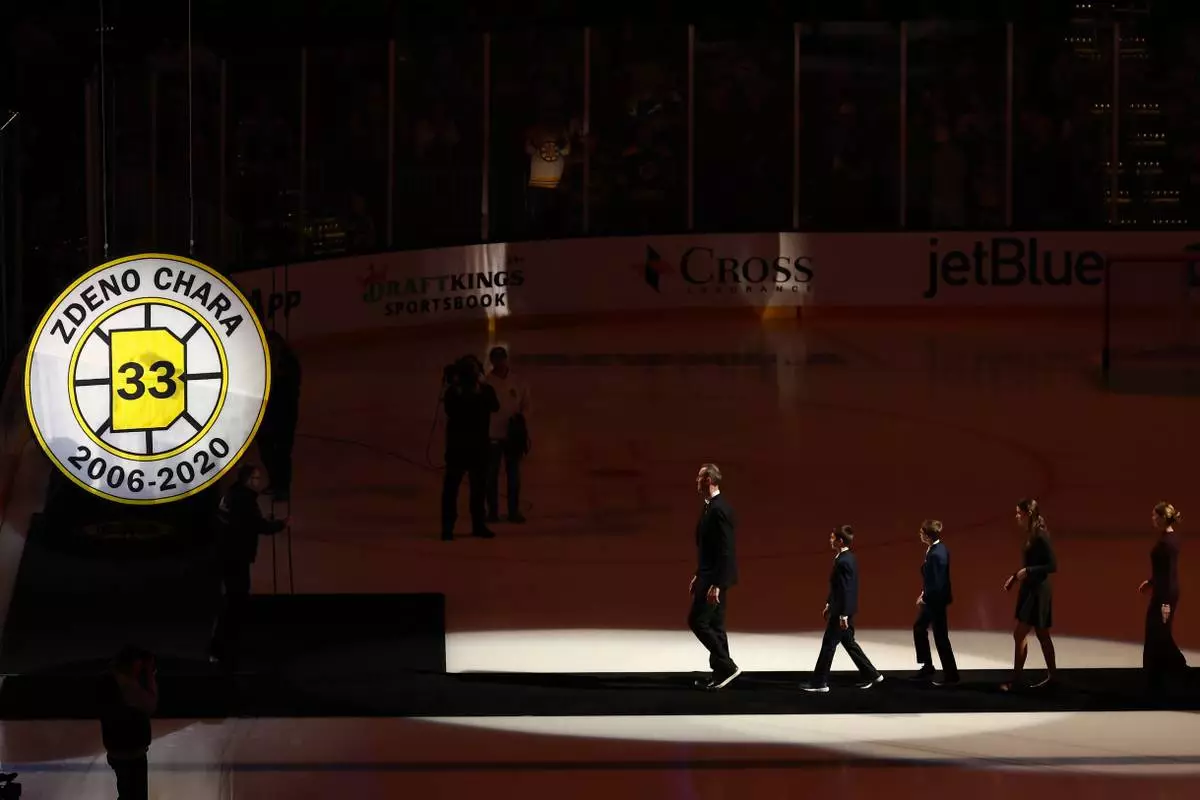
Former Boston Bruins captain Zdeno Chara leads his family over to his number "33" to raise it to the rafters before an NHL hockey game between the Boston Bruins and the Seattle Kraken, Thursday, Jan. 15, 2026, in Boston. (AP Photo/Winslow Townson)
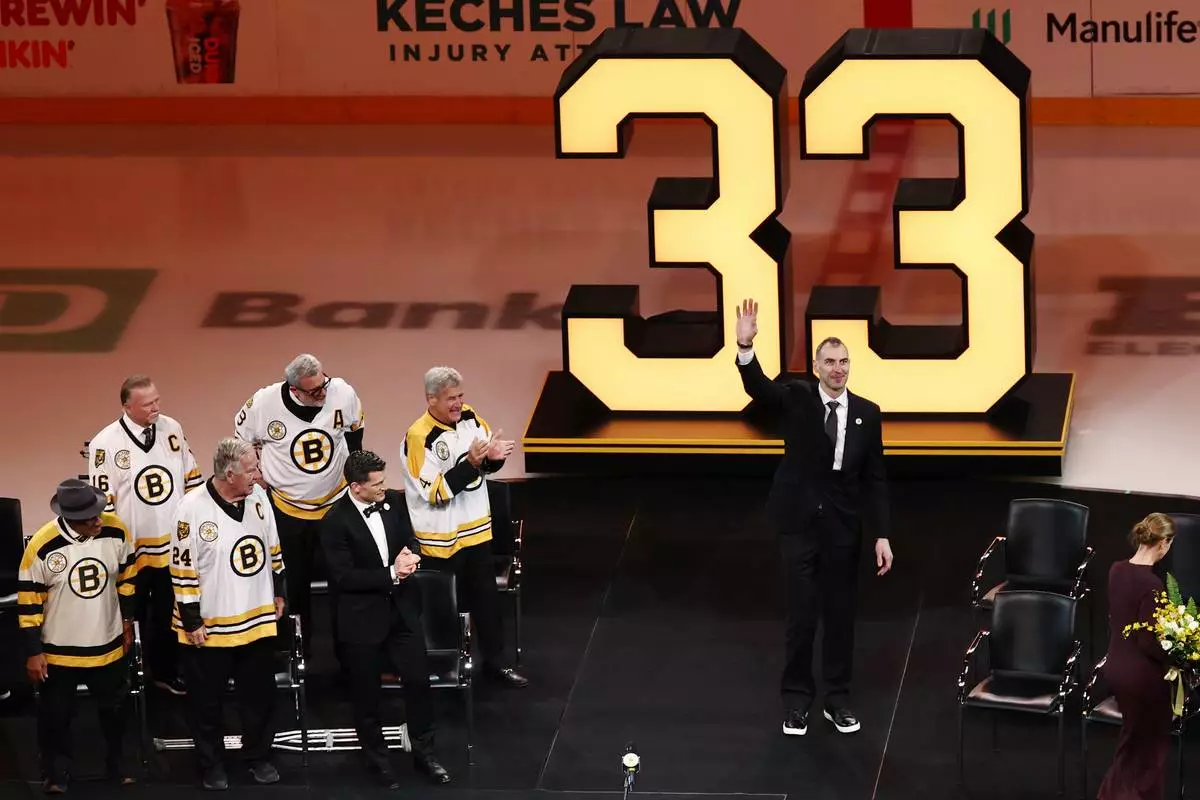
Former Boston Bruins captain Zdeno Chara, center, waves to the crowd during his number retirement ceremony, as Bruins' players with their number already retired, from left, Willie O'Ree, Rick Middleton, Terrry O'Reilly, Cam Neely, emcee Andrew Ferrance and Bobby Orr look on before an NHL hockey game between the Boston Bruins and the Seattle Kraken, Thursday, Jan. 15, 2026, in Boston. (AP Photo/Winslow Townson)
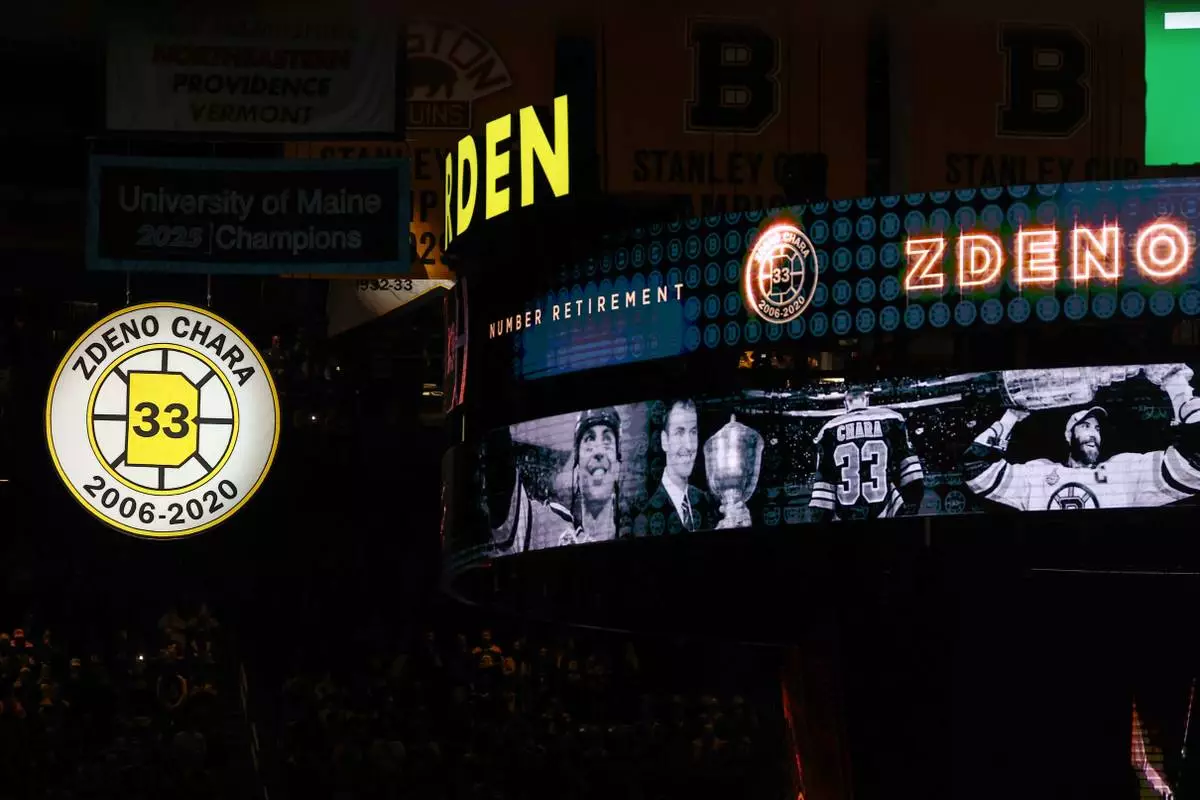
Former Boston Bruins captain Zdeno Chara's number "33" is raised to the rafters at TD Garden before an NHL hockey game between the Boston Bruins and the Seattle Kraken Thursday, Jan. 15, 2026, in Boston. (AP Photo/Winslow Townson)
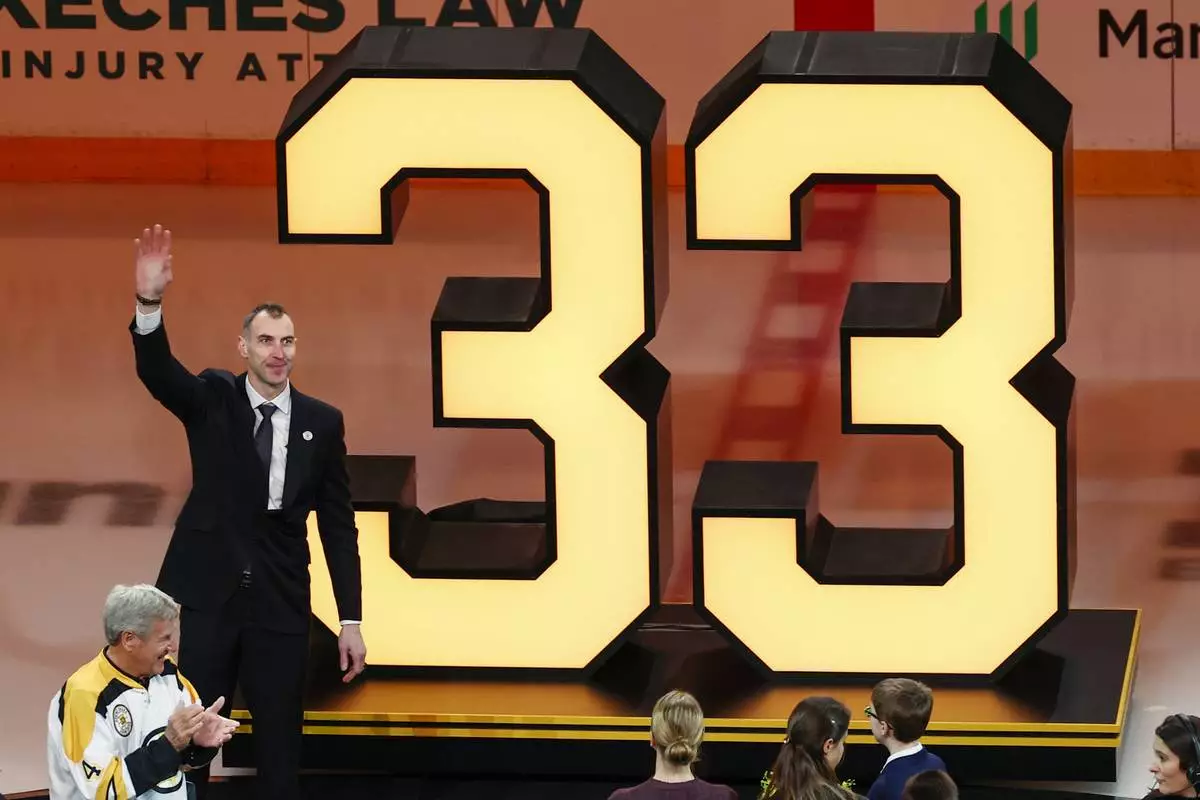
Bobby Orr applauds, left bottom, as former Boston Bruins captain Zdeno Chara waves to the crowd during his number retirement ceremony before an NHL hockey game between the Boston Bruins and the Seattle Kraken, Thursday, Jan. 15, 2026, in Boston. (AP Photo/Winslow Townson)