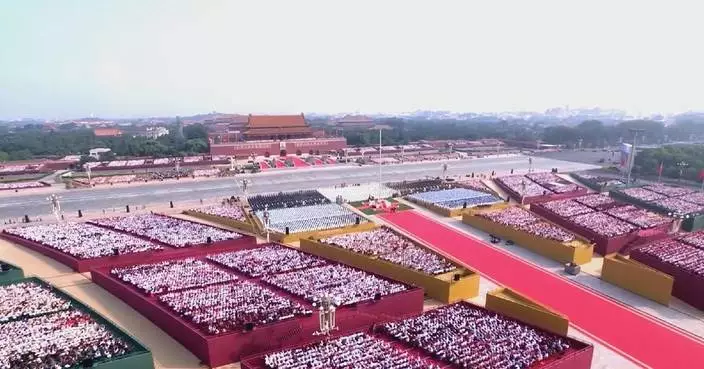
The unmanned combat equipment unveiled by China at the grand military parade in Beijing on Wednesday demonstrated the future-oriented combat ideology of the Chinese People's Liberation Arny, which aims at future battlefields and integrates reconnaissance and strike, as well as offensive and defensive capabilities in unmanned operations.
At the grand military parade commemorating the 80th anniversary of the victory in the Chinese People's War of Resistance against Japanese Aggression and the World Anti-Fascist War, unmanned combat equipment for land, sea and air operations of the unmanned combat group was showcased in a concentrated manner.
Of the unmanned combat equipment unveiled this time, the unmanned land-based combat formation included unmanned vehicles that can carry out various tasks such as reconnaissance, assaults, mine and bomb defusing and removal, and squad assistance.
"This is the unmanned reconnaissance and assault vehicle that joined the military review this time. It adopts a tracked chassis and can handle various battlefield environments. Equipped with anti-tank guided missiles, reconnaissance modules and so on, it can carry out diverse military tasks such as unmanned close-range reconnaissance and fire strikes, and can support tank, combat vehicles and infantry units in conducting coordinated operations," said Zhu Wenjin, an officer with the land-based unmanned combat formation.
In recent years, China has carried out a large number of manned and unmanned coordinated combat drills to assist the army in the research and development of unmanned equipment and the study of unmanned equipment operation tactics and methods. With the full integration of unmanned equipment into the modern combat system, the combat capabilities of the armed forces have been continuously enhanced.
"Facing future unmanned and intelligent warfare, we have explored manned and unmanned force formation modules such as 'platform support, module embedding, and human-machine cooperation', and the capabilities of troops in reconnaissance and perception, obstacle and debris clearance, and precise strikes have been continuously enhanced. In the future, we will continue to deeply explore typical application scenarios of unmanned combat, fully integrate into the joint combat system, maximize the performance advantages of unmanned equipment, and enhance the overall combat capability," said Liu Ping, an officer with the land-based unmanned combat formation.
The unmanned maritime combat formation showcased new types of unmanned underwater vehicles and unmanned surface vehicles, as well as underwater mine-deployment systems, which are independently developed by China.
"Minesweeper ships have to frequently deal with naval mines, clearing mine obstacles and opening up navigation routes for main warships. However, there is a risk of triggering mines during mine clearance operations, and once it occurs, the cost is often huge. The new unmanned vessel can make up for the shortcomings of anti-mine ships. It can independently detect and identify suspicious underwater targets, accurately determine mine targets, and thus efficiently eliminate various types of mines, making anti-mine operations efficient and safe," said Xu Kewang, an officer with the unmanned maritime combat formation.
The Chinese navy adheres to the development of independent mine-laying and anti-mine operations in research and development, achieving simultaneous optimization of offensive and defensive capabilities.
"Compared with traditional submarines, the new-type unmanned underwater vehicle has lower construction and combat costs, and integrates reconnaissance and attack capabilities. It is part of an important force for enhancing China's coastal defense. The three types of unmanned marine combat equipment have provided strong support for the Chinese People's Liberation Army Navy to win modern naval battles," said Tan Xiuchun, an officer with the unmanned maritime combat formation.
Last came the unmanned aerial combat formation. The new models of reconnaissance-and-strike drones, unmanned fixed-wing planes, unmanned air-domination planes, and unmanned ship-based helicopters unveiled at the military parade are capable of launching undetectable strikes, making expansive coverage, and conducting autonomous coordination.
"The type of equipment here is the shipborne unmanned helicopter that joined the military review this time. It is a rising star in the rotorcraft family. Its commissioning undoubtedly adds another pair of 'eyes' for the warship to explore the sky and the sea," said Chen Zhengyuan, an officer with the unmanned aerial combat formation.
"In recent years, we have broken through the conventional mindset and continuously innovated training methods based on real combat scenarios. We have successively administered training subjects such as off-site takeoff and landing, one-station control of multiple aircraft, and relay and long-endurance training, challenging the limits of personnel and equipment. In combination with the training and exercise tasks, we have organized deep-sea long-range training and also responded to unknown sea and air conditions on multiple occasions, opening up new fields for the application of unmanned aerial vehicles in combat, and continuously improving our practical combat capabilities," said Zhang Wenchao, an officer with the unmanned aerial combat formation.
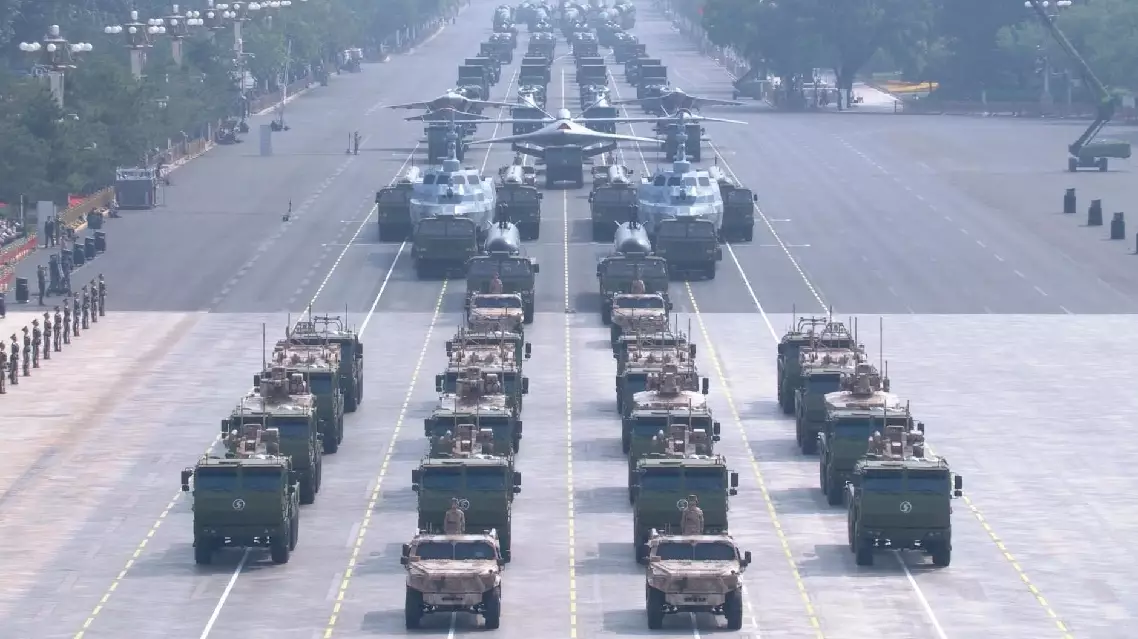
China's unmanned combat weapons designed to achieve victory on future battlefields