Skip to Content Facebook Feature Image

Trinidad and Tobago leader praises strike and says US should kill all drug traffickers 'violently'

News

Trinidad and Tobago leader praises strike and says US should kill all drug traffickers 'violently'
News

News

Trinidad and Tobago leader praises strike and says US should kill all drug traffickers 'violently'

2025-09-04 03:44 Last Updated At:03:50

PORT-OF-SPAIN, Trinidad (AP) — Trinidad and Tobago’s Prime Minister Kamla Persad-Bissessar praised a U.S. strike on a boat suspected of carrying drugs in the southern Caribbean and said that all traffickers should be killed “violently.”

U.S. President Donald Trump said Tuesday that 11 people were killed aboard the boat that had departed Venezuela, which is located near Trinidad and Tobago.

“I, along with most of the country, am happy that the U.S. naval deployment is having success in their mission,” Persad-Bissessar said in a statement late Tuesday. “The pain and suffering the cartels have inflicted on our nation is immense. I have no sympathy for traffickers; the U.S. military should kill them all violently.”

U.S. Secretary of State Marco Rubio has said that the drugs aboard the vessel were likely headed to Trinidad or elsewhere in the Caribbean.

Persad-Bissessar said that restricting illegal guns, drugs and human trafficking would decrease violence in the Caribbean region and the twin-island nation of Trinidad and Tobago, which has imposed two state of emergencies in recent months.

“Our country has been ravaged by bloody violence and addiction because of the greed of the cartels,” Persad-Bissessar said. “The slaughter of our people is fueled by evil cartel traffickers.”

Other Caribbean leaders were more reserved in their remarks.

Barbadian Foreign Minister Kerrie Symmonds told The Associated Press on Wednesday that members of Caricom, a regional trade bloc, sent a letter to Rubio asking for an open line of communication on developments, saying they want to avoid being surprised by any U.S. moves against Venezuela.

“What we want really...is a structure where we would be able to have shared information affecting U.S. assets in the region, establishing channels of communication and, importantly where possible, some consultation to maintain practical cooperation for continued mutual confidence and avoidance of misunderstandings," he said.

Symmonds also said that depending on Rubio's response, both sides could arrange a face-to-face meeting to discuss fears that the region’s long-desired designation as a zone of peace is maintained.

“What effectively we are trying to do is to work through the diplomatic channels of making sure that there are no surprises,” Symmonds said.

On Wednesday, Rubio defended the strike and warned that such operations “will happen again.”

Meanwhile, Colombian President Gustavo Petro on Wednesday questioned the U.S. operation, saying that it's possible to conduct maritime interdiction of drug shipments without attacking a vessel's occupants. He said that Colombia typically captures them, since those transporting the drugs “are not the big drug traffickers,” but rather, “very poor young people” from the region.

“Bombing the boat violates the universal principle of proportionality of force and results in murder,” the leftist president wrote on X.

Juanita Goebertus, Americas director at Human Rights Watch, said that while organized crime groups are a “huge threat” to human rights in Latin America, regional governments need to strengthen their judicial capacity to dismantle them.

“If the circumstances around this strike are exactly as the administration describes them, it would amount to an extrajudicial execution, prohibited under international law," she said.

Trump has said that the vessel targeted in the strike in international waters was operated by the Venezuelan gang Tren de Aragua. The White House didn't immediately explain how the military determined that those aboard the vessel were Tren de Aragua members.

In July, the government of Trinidad and Tobago designated Tren de Aragua as a terrorist organization, meaning that authorities can freeze any property, funds or assets owned or controlled by the gang.

Authorities have confirmed that the gang is active in the Caribbean nation, with its presence mainly in central and east Trinidad.

A high-ranking police official with deep knowledge of gang operations told the AP that Tren de Aragua’s operations are on a small scale in Trinidad. He said the group still has to contend with bigger local gangs and don't stay in certain areas when they go to Trinidad to collect money or talk business.

The official, who spoke on condition of anonymity because he feared repercussions, said authorities don't have an estimate of how many Tren de Aragua gang members operate in the twin-island nation given their constant illegal entry and departure. He said they deal mostly in drug, weapons and human trafficking.

The strike came after the U.S. announced last month that it planned to boost its maritime force in waters off Venezuela to fight threats from Latin American drug cartels.

Bert Wilkinson reported from Georgetown, Guyana. Dánica Coto contributed to this report from San Juan, Puerto Rico.
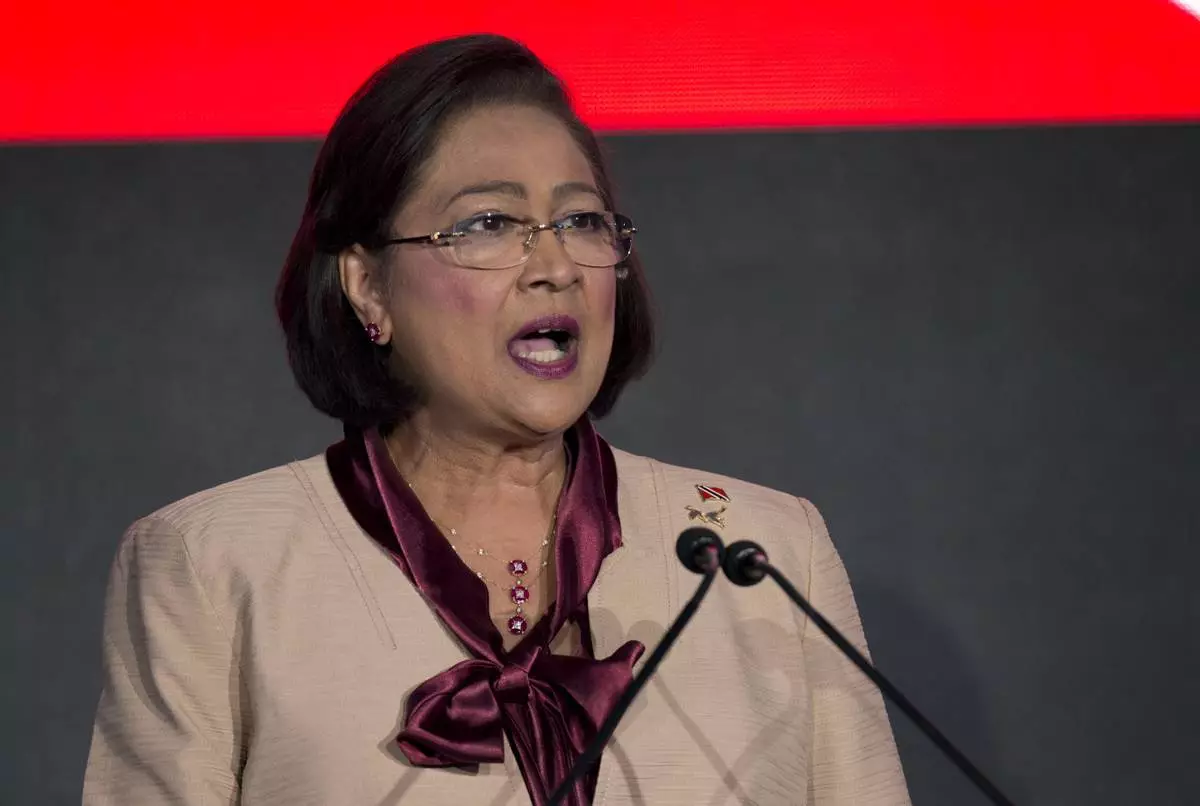
FILE - Trinidad and Tobago's Prime Minister Kamla Persad-Bissessar delivers her speech during the CEO Summit of the Americas in Panama City, April 10, 2015. (AP Photo/Moises Castillo, File)
FILE - Trinidad and Tobago's Prime Minister Kamla Persad-Bissessar delivers her speech during the CEO Summit of the Americas in Panama City, April 10, 2015. (AP Photo/Moises Castillo, File)
CARACAS, Venezuela (AP) — President Donald Trump is set to meet Thursday at the White House with Venezuelan opposition leader María Corina Machado, whose political party is widely considered to have won 2024 elections rejected by then-President Nicolás Maduro before the United States captured him in an audacious military raid this month.

Less than two weeks after U.S. forces seized Maduro and his wife at a heavily guarded compound in Caracas and brought them to New York to stand trial on drug trafficking charges, Trump will host the Nobel Peace Prize laureate Machado, having already dismissed her credibility to run Venezuela and raised doubts about his stated commitment to backing democratic rule in the country.

“She’s a very nice woman,” Trump told Reuters in an interview about Machado. “I’ve seen her on television. I think we’re just going to talk basics.”

The meeting comes as Trump and his top advisers have signaled their willingness to work with acting President Delcy Rodríguez, who was Maduro’s vice president and along with others in the deposed leader's inner circle remain in charge of day-to-day governmental operations.

Rodríguez herself has adopted a less strident position toward Trump and his “America First” policies toward the Western Hemisphere, saying she plans to continue releasing prisoners detained under Maduro — a move reportedly made at the behest of the Trump administration. Venezuela released several Americans this week.

Trump, a Republican, said Wednesday that he had a “great conversation” with Rodríguez, their first since Maduro was ousted.

“We had a call, a long call. We discussed a lot of things,” Trump told reporters. “And I think we’re getting along very well with Venezuela.”

In endorsing Rodríguez, Trump has sidelined Machado, who has long been a face of resistance in Venezuela. She had sought to cultivate relationships with Trump and key advisers like Secretary of State Marco Rubio among the American right wing in a political gamble to ally herself with the U.S. government. She also intends to have a meeting in the Senate on Thursday afternoon.

Despite her alliance with Republicans, Trump was quick to snub her following Maduro’s capture. Just hours afterward, Trump said of Machado that “it would be very tough for her to be the leader. She doesn’t have the support within or the respect within the country. She’s a very nice woman, but she doesn’t have the respect.”

Machado has steered a careful course to avoid offending Trump, notably after winning last year’s Nobel Peace Prize, which Trump coveted. She has since thanked Trump and offered to share the prize with him, a move that has been rejected by the Nobel Institute.

Machado’s whereabouts have been largely unknown since she went into hiding early last year after being briefly detained in Caracas. She briefly reappeared in Oslo, Norway, in December after her daughter received the Nobel Peace Prize on her behalf.

The industrial engineer and daughter of a steel magnate began challenging the ruling party in 2004, when the nongovernmental organization she co-founded, Súmate, promoted a referendum to recall then-President Hugo Chávez. The initiative failed, and Machado and other Súmate executives were charged with conspiracy.

A year later, she drew the anger of Chávez and his allies again for traveling to Washington to meet President George W. Bush. A photo showing her shaking hands with Bush in the Oval Office lives in the collective memory. Chávez considered Bush an adversary.

Almost two decades later, she marshaled millions of Venezuelans to reject Chávez’s successor, Maduro, for another term in the 2024 election. But ruling party-loyal electoral authorities declared him the winner despite ample credible evidence to the contrary. Ensuing anti-government protests ended in a brutal crackdown by state security forces.

Janetsky reported from Mexico City. AP Diplomatic Writer Matthew Lee in Washington contributed to this report.

FILE - U.S. President George Bush, right, meets with Maria Corina Machado, executive director of Sumate, a non-governmental organization that defends Venezuelan citizens' political rights, in the Oval Office of the White House, Washington, May 31, 2005. (AP Photo/Charles Dharapak, File)

FILE - U.S. President George Bush, right, meets with Maria Corina Machado, executive director of Sumate, a non-governmental organization that defends Venezuelan citizens' political rights, in the Oval Office of the White House, Washington, May 31, 2005. (AP Photo/Charles Dharapak, File)

FILE - Opposition leader Maria Corina Machado gestures to supporters during a protest against President Nicolas Maduro the day before his inauguration for a third term, in Caracas, Venezuela, Thursday, Jan. 9, 2025. (AP Photo/Ariana Cubillos, file)

FILE - Opposition leader Maria Corina Machado gestures to supporters during a protest against President Nicolas Maduro the day before his inauguration for a third term, in Caracas, Venezuela, Thursday, Jan. 9, 2025. (AP Photo/Ariana Cubillos, file)

Recommended Articles