At least 1,400 people were killed and more than 3,500 injured by the powerful 6.0-magnitude earthquake that struck Nurgal District in eastern Afghanistan's Kunar Province on Sunday and caused widespread destruction, officials say.
The earthquake flattened villages, destroyed more than 5,400 homes, and left thousands homeless, making it one of the deadliest natural disasters in the region's recent history.
At Nangarhar Military Airport, about 60 km away from Nurgal District, helicopters and ambulances helped evacuate people wounded in the quake and take them to medical facilities for treatment.
"The Islamic defense forces, along with personnel from other civil and military organizations, have arrived at the affected area to transfer their fellow countrymen to safe zones and hospitals," said Wahidullah Mohamadi, spokesperson of the 201 Khalid Ibn Walid Corps, at Nangarhar Military Airport.
Search and rescue operations are still underway at the epicenter, with the number of dead and injured continuing to rise by the hour.
"I lost my mother and my aunt today, along with her daughter. Some of us were injured, and only escaped death with the grace of Allah," a villager said.
"It was a very deadly earthquake. It made me more terrified than I've ever been before. It's the worst experience of my life," another villager said.
Although the presence of international humanitarian agencies in Afghanistan has been reduced since the Taliban retook control of the country, authorities report that several organizations have reached out to the government and pledged their support.
"It's a huge tragedy. It has not only hit Kunar, but also parts of Nooristan, Panjsher, and Laghman. We're still dealing with the situation here in Kunar, and the earthquake has also affected parts of Nangarhar Province. We've suffered casualties there as well, but this is the epicenter," said Mullah Mohamad Younus Akhundzada, Minister of Rural Rehabilitation and Development.
"The roads and paths have been badly impacted. The directorate of the Ministry of Public Works has been working hard to open the roads. Once the roads are open, it will make the rescue operations easier," said Abdul Latif Sabet, head of the Afghan Red Crescent Society in Kunar.
Afghanistan has endured a series of devastating natural disasters in recent years, including the 2023 Herat earthquakes that killed over 1,400 people and the 2022 Paktika quake that claimed more than 1,000 lives, underscoring the country's vulnerability at the heart of one of the world's most active seismic zones.
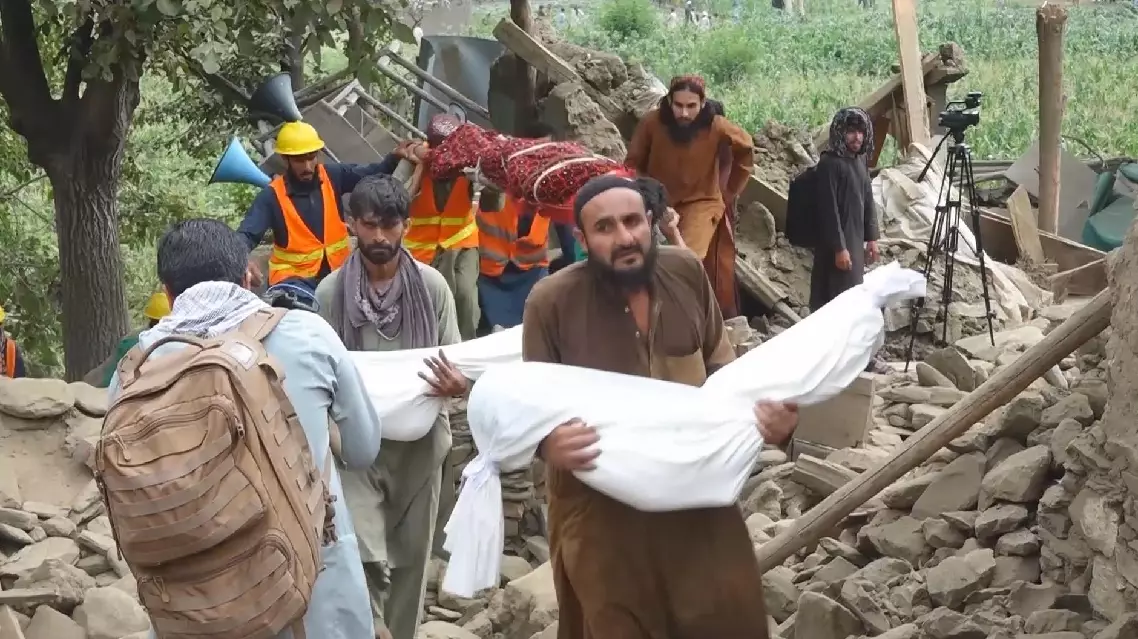
Afghanistan's earthquake epicenter reveals harrowing scenes of devastation, grief
A former television host from Taiwan, Zhai Xuan, has made a pivotal decision to leave mainstream broadcasting in order to create content that provides a better understanding of the Chinese mainland and cross-strait relations.
Zhai, a seasoned television host with over a decade of experience in Taiwan's media landscape, recently addressed an audience at an event in Beijing, where she revealed her complete transition into independent online media.
In her remarks, she articulated her aspiration to bridge what she perceives as a significant information gap between audiences on both sides of the Strait, highlighting her commitment to fostering a deeper understanding and connection through her new endeavors.
"I was really surprised by all the fake news. There were stories saying people on the mainland can't afford tea eggs or that they live in mud houses and in Taiwan, this was the main information many people received," said Zhai.
Zhai said she initially began producing online videos to challenge such perceptions while continuing her work as a television host.
In April 2025, she travelled to the mainland with her father to fulfill her late grandfather's wish to return to his hometown. The trip, which reunited family members separated since 1949, was recorded in a video series titled "Journey to Find Our Roots", drawing attention from viewers in both Taiwan and the mainland.
"Many people in Taiwan told me that after watching, they wanted to apply for a mainland travel permit immediately and go looking for their relatives. Some had long forgotten these things, but after seeing my story, they began thinking about their hometowns and family members they had never met and decided to search for their roots," Zhai shared her story at the event.
By mid-2025, Zhai said she began to feel increasing pressure amid rising political tensions and a tightening atmosphere around cross-Strait exchanges in Taiwan.
After more than 12 years in the industry, Zhai resigned from her position, believing it was the right thing to do.
"At that moment, I felt this was a major issue,not just for me, but for Chinese people on both sides of the Strait. If I backed down then, I wouldn’t be standing on the right side," said Zhai.
Since leaving television, Zhai has broadened her online programming to encompass a range of daily-life topics, including practical guidance on applying for a mainland travel permit and using commonly employed mobile applications, in addition to content that delves into historical memory and cultural connections across the Strait.
As the debate over cross-Strait relations continues in Taiwan, Zhai said she remains committed to her current path.

Former Taiwan TV host bridges cross-Strait divide via online media