The international guests invited to China's V-Day commemorations expressed immense pride in attending the events, vowed to carry on the spiritual legacy of their ancestors who assisted China in the war, and reaffirmed their commitment to promoting cooperation and cultural exchanges.
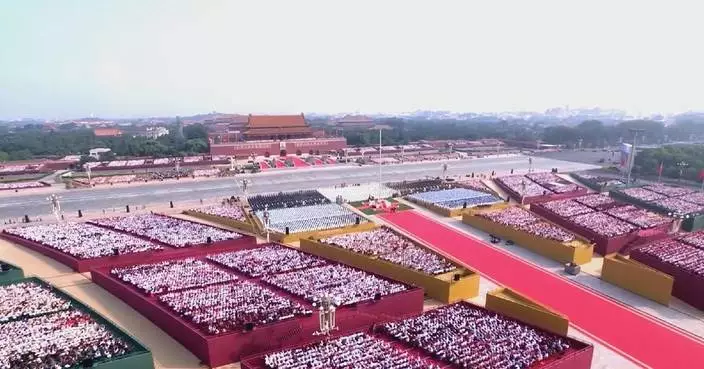
The climax of their stay in China was witnessing the military parade on Beijing's Tiananmen Square on Wednesday, marking the 80th anniversary of the victory in the Chinese People's War of Resistance against Japanese Aggression and the World Anti-Fascist War.
In interviews with China Central Television (CCTV) ahead of the grand event, international guests recalled what their ancestors' wartime heroism and stressed the value of learning from history.
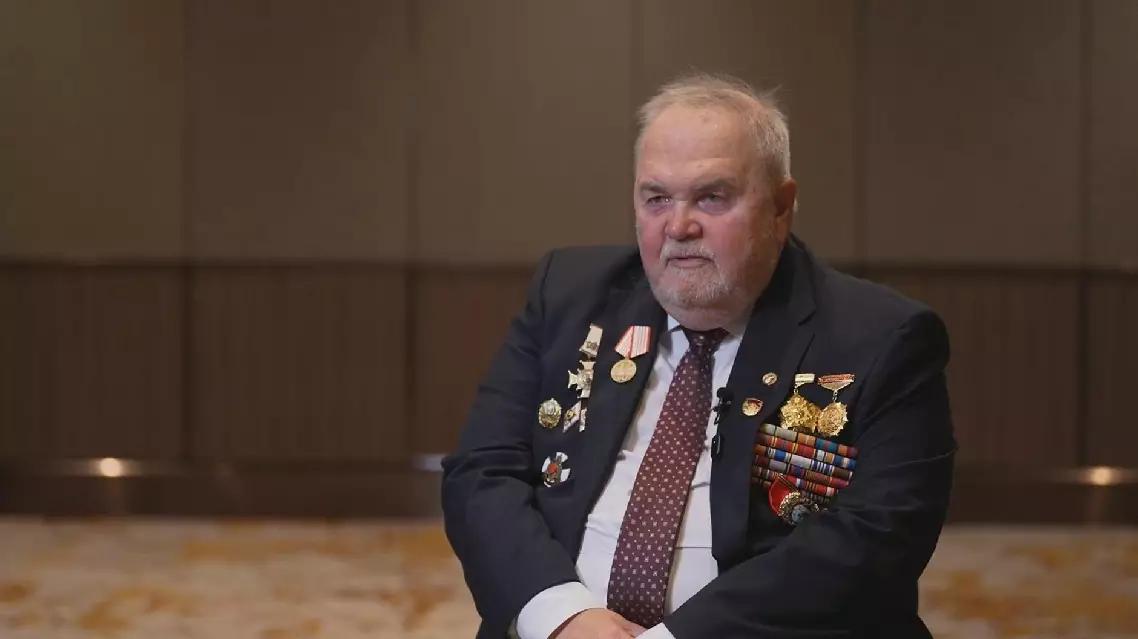
"[We] should learn from history, love our country, and respect the contributions made by our ancestors," said Nikolai Vladimirovich Chuikov, grandson of the former Soviet Union's Marshal Vasily Ivanovich Chuikov, who came to China to assist the Chinese people in fighting the war as a military leader.
Another guest invited to the commemorations is Peter Jarvis, grandnephew of British journalist George Hogg, who courageously exposed Japanese wartime atrocities and rescued Chinese youth during his time in China. He died in northwest China at the age of 30, less than a month before the end of the war.
In addition to his reporting, Hogg also established the Bailie School in Shuangshipu, northwest China's Shaanxi Province, to help cultivate Chinese talents.
"I'm very proud to represent George Hogg's family at these events. And I know that many Chinese people helped the allies during the war as well. So, there was a lot of mutual help and assistance. He (Hogg) didn't set out to do this to gain fame. When he saw the conditions that people were living under and their bravery, he decided to devote what ended up being the rest of his life to China and its people. So, the Chinese contribution is largely unknown in the UK, which is a great shame. And I think it's always important to look back in history and see what we can learn. It is a turbulent time in the world at that moment. So, I'm hoping a big anniversary like this will help people across the whole world reflect." said Jarvis.
During wartime, many doctors worldwide provided medical aid to those in need in China. Indian doctor Dwarkanath Kotnis had been one of them.
Amid the chaos of war, Kotnis saved countless Chinese civilians and soldiers, and helped train batches of medical personnel, until he succumbed to illness from overwork at the young age of 32.
His grandnephew, Mangesh Rajan Borkar, said he was told many stories about his uncle when growing up.
"One of the stories that fascinates me a lot is that he learned the Chinese language, while he was on a ship to China. And he wrote a book on surgery in the Chinese language so that the young Chinese doctors could learn how to perform war surgeries. And he was able to save over 800 people in Hebei Province while working 72 hours at a stretch," said Borkar.
Borkar highlighted his uncle's profound spirit of internationalism and selflessness, as Kotnis gave up his personal ambitions and left his family to join China in the war.
"It will be passing tributes to various martyrs of the world, including Dr. Kotnis, Dr. (Norman) Bethune, who sacrificed their lives, and other unsung war soldiers who fought for China during the war," added Borkar.
French doctor Jean-Jerome Augustin Bussiere practiced medicine in China from 1913 to 1954, saving many lives. During the war, he also risked his life to establish "the hump route by bike" to transport medicines for the Eighth Route Army secretly.
When discussing his father and the commemorations in Beijing, Jean-Louis Bussiere, a renowned French cardiologist, emphasized the importance of cherishing peace.
"Our responsibility to remember requires us to pass on to our children and to young people in all countries the courage and self-sacrifice of the resistant fighters," said Jean-Louis Bussiere.
Michael Lindsay, a British economist and radio expert, arrived in China aboard the same vessel that carried Canadian surgeon Norman Bethune some 87 years ago and went on to make great contributions in the Chinese people's fight against Japanese aggression.
During the war, Lindsay built hundreds of radio stations and broadcast news about Chinese attacks behind enemy lines in English to the rest of the world. Additionally, he helped improve radio communication systems, cultivated technical talents, and risked his life to deliver medicines and supplies to the Eighth Route Army.
His son, James Lindsay, attended the commemorations in Beijing.
"My father was at Yenjing University in 1937. And he saw how badly the Japanese were behaving. And he also see that only the Communist guerrillas were being effective against the Japanese. And he also saw the Communists had the trust of people in the countryside. So, he resolved he's going to help fight the Japanese," said James.
James Lindsay highlighted the importance of remembering the history, particularly in today's world.
"Younger people are tending to forget how awful war is. They haven't experienced it and the disruption it causes. At one time, we had a feeling that the world will get better and better. But we can see the world tensions happening. Young people have to be aware, they've got to be active for peace," he said.
During the World Anti-Fascist War, China tied down and fought the bulk of Japan's forces, eliminating more than 1.5 million enemy troops and preventing Japan from allocating more troops to the Pacific theater.
China suffered a total of 35 million military and civilian casualties, accounting for a third of the total casualties of all the countries in World War II.
Int'l guests express pride in joining China's V-Day events, hope for peace and more exchange