
Skip to Content Facebook Feature Image

Daughter of Nazi officer who stole 'Portrait of a Lady' and her husband charged with cover-up

News

Daughter of Nazi officer who stole 'Portrait of a Lady' and her husband charged with cover-up
News

News

Daughter of Nazi officer who stole 'Portrait of a Lady' and her husband charged with cover-up

2025-09-05 04:19 Last Updated At:08:30

MAR DEL PLATA, Argentina (AP) — Prosecutors in Argentina on Thursday charged the daughter of a fugitive Nazi official with trying to hide an 18th-century painting from authorities following revelations that it had been stolen from a Jewish art dealer during World War II.

The federal prosecutor in charge of the case announced the cover-up charge a day after Patricia Kadgien, one of the daughters of high-level Nazi officer Friedrich Kadgien, handed “Portrait of a Lady” by Italian artist Giuseppe Ghislandi to the Argentine judiciary eight decades after it was stolen.

The fate of the work remains unclear, pending a decision in the case. The heir of Jacques Goudstikker — the Dutch-Jewish art collector who owned the painting before Nazis confiscated his world-famous inventory — has made a legal claim to get the painting back, her lawyers have said.

Goudstikker died in a shipwreck in 1940 while fleeing the Netherlands as German troops advanced. He sold his collection, which included Rembrandts and Vermeers, under duress and far below market price. At least 1,100 stolen works from his gallery remain missing.

The Argentine court has asked that the painting be displayed at the Holocaust Museum in Buenos Aires ahead of any further transfer abroad. The museum did not immediately respond to a request for comment.

Patricia Kadgien, 59, and her husband, Juan Carlos Cortegoso, 62, have been under house arrest on suspicion of concealing the painting since police raided their home on Monday for the second time in as many weeks without finding “Portrait of a Lady.”

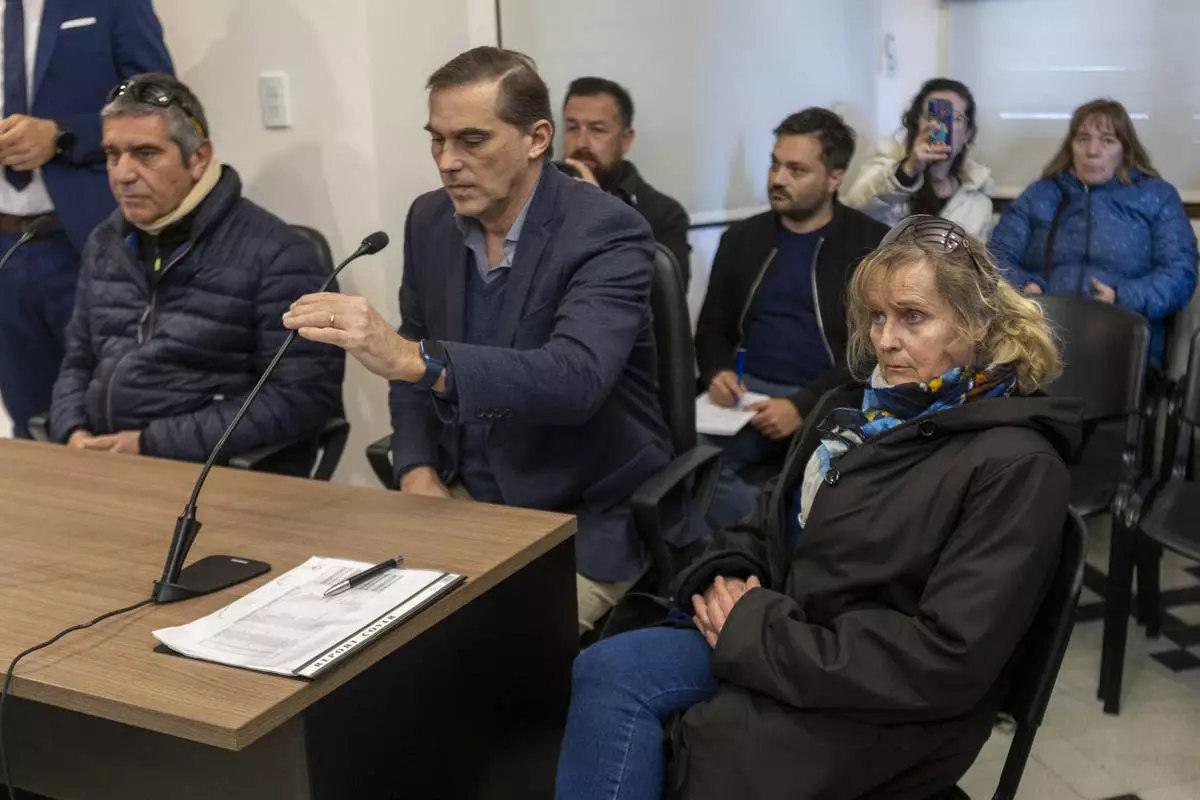
Kadgien, with disheveled dirty-blond hair and sunglasses on her head, wore a look that mixed concern and puzzlement as she listened to Prosecutor Carlos Martínez in a jam-packed courtroom. Martínez said that Kadgien's and her husband's efforts to hide the painting over several days following its sudden appearance in a real estate listing amounted to obstruction of justice.

Cortegoso gazed straight ahead, his arms crossed and a stern expression on his face.

After the hearing the couple was released from house arrest but barred from traveling abroad and required to notify the court whenever they leave their registered address.

Photos of the painting hanging in Kadgien’s living room in Mar del Plata surfaced last month for the first time in eight decades in an online real estate advertisement.

Dutch journalists investigating Kadgien’s past in Argentina – where he took refuge after the collapse of the Third Reich – spotted “Portrait of a Lady” hanging above a green velvet couch in the living room during a 3D tour of the house for sale.

After recognizing it as the same portrait listed as missing in international archives of Nazi-looted art, the newspaper Algemeen Dagblad published an exposé on Aug. 25 that grabbed headlines around the world.

Alerted by international police agency Interpol, Argentine authorities raided the house and other properties belonging to Patricia Kadgien and her sister Alicia, seizing a rifle, a .32-caliber revolver and several paintings from the 19th-century that they suspect may have been similarly stolen during WWII.

But police couldn’t find “Portrait of a Lady.” They found scuff marks and a pastoral tapestry on Patricia Kadgien's living room wall where the portrait had been photographed.

The real estate ad, first posted in February, was swiftly taken down. Prosecutors on Thursday said that security footage showed people removing the “for sale” sign from Kadgien’s front yard as media scrutiny intensified last week.

In presenting the charges, Martínez told the court that the couple was “aware that the artwork was being sought by the criminal justice system and international authorities” but nevertheless went to lengths to hide it.

“It was only after several police raids that they turned it in," he said.

With the defendants under house arrest on Monday, their lawyer, Carlos Murias, filed a petition with a civil court in Mar del Plata asking that Kadgien be allowed to auction the painting.

The court rejected the request, arguing that it lacked jurisdiction given the painting's provenance.

Prosecutor Martínez told reporters on Thursday that his office was informed by the Federal Bureau of Investigation that Marei von Saher, the heir to art dealer Goudstikker, lodged a legal claim to “Portrait of a Lady” at the bureau’s New York office.

The FBI declined to comment.

DeBre reported from Buenos Aires, Argentina.
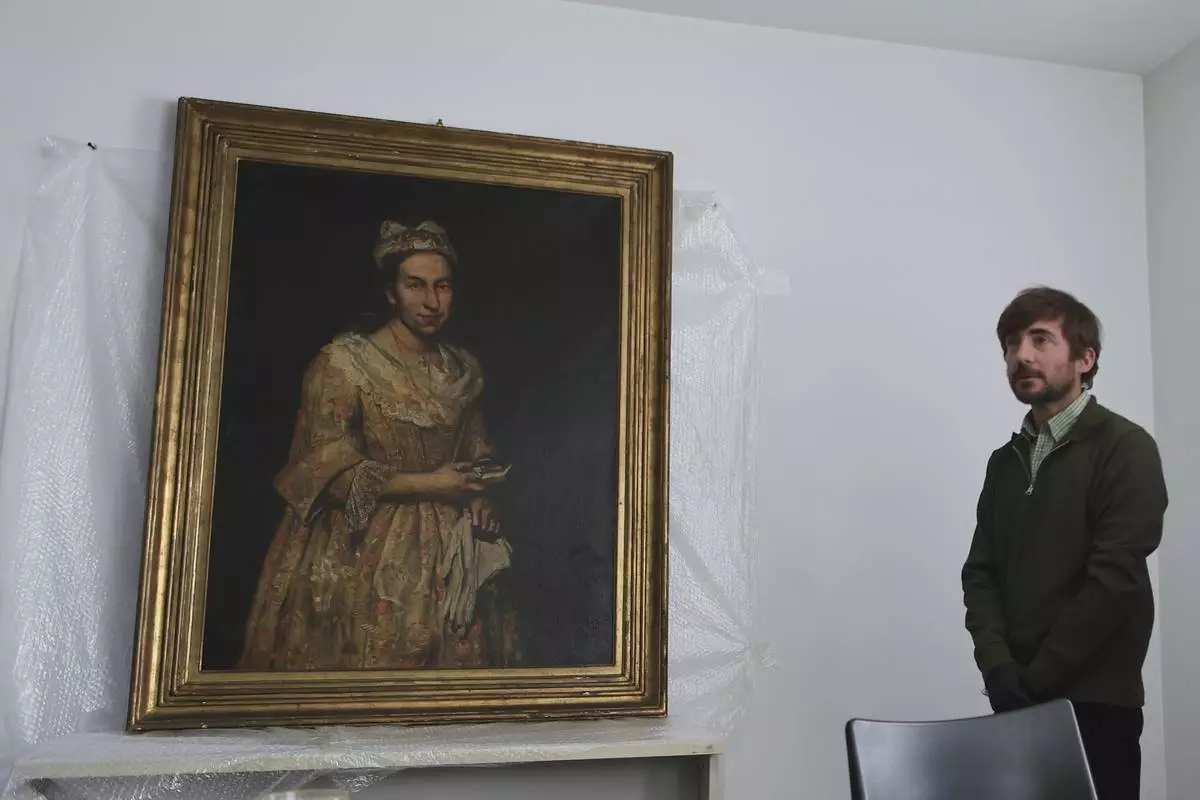
Giuseppe Ghislandi's 18th-century painting "Portrait of a Lady," reportedly stolen by a Nazi officer during World War II and discovered in the home of his daughter after appearing in a real estate listing, is displayed during a press conference by Prosecutor Daniel Adler in Mar del Plata, Argentina, Wednesday, Sept. 3, 2025. (AP Photo/Christian Heit)
Giuseppe Ghislandi's 18th-century painting "Portrait of a Lady," reportedly stolen by a Nazi officer during World War II and discovered in the home of his daughter after appearing in a real estate listing, is displayed during a press conference by Prosecutor Daniel Adler in Mar del Plata, Argentina, Wednesday, Sept. 3, 2025. (AP Photo/Christian Heit)

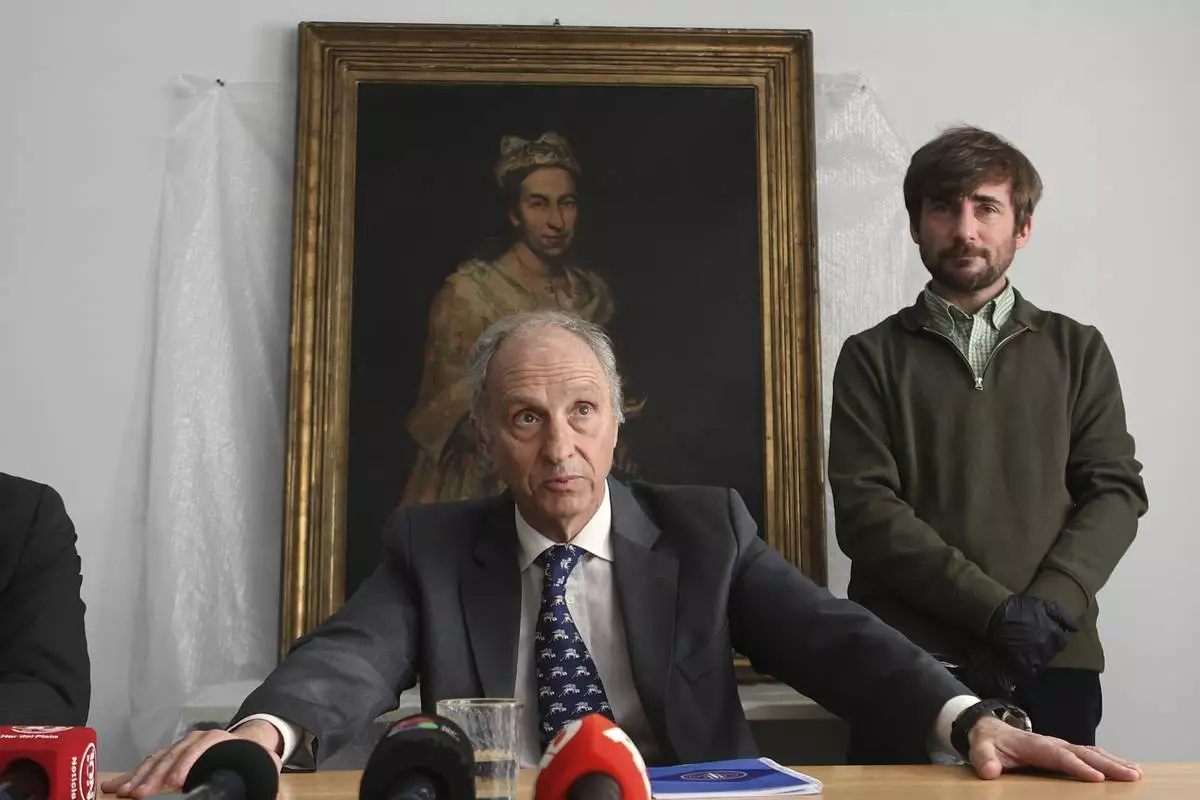
Prosecutor Daniel Adlers gives a press conference in front of Giuseppe Ghislandi's 18th-century painting "Portrait of a Lady," reportedly stolen by a Nazi officer during World War II and discovered in the home of his daughter after appearing in a real estate listing, in Mar del Plata, Argentina, Wednesday, Sept. 3, 2025. (AP Photo/Christian Heit)
Prosecutor Daniel Adlers gives a press conference in front of Giuseppe Ghislandi's 18th-century painting "Portrait of a Lady," reportedly stolen by a Nazi officer during World War II and discovered in the home of his daughter after appearing in a real estate listing, in Mar del Plata, Argentina, Wednesday, Sept. 3, 2025. (AP Photo/Christian Heit)

Patricia Kadgien, right, one of the daughters of fugitive Nazi official Friedrich Kadgien, and her husband, Juan Carlos Cortegoso, left, attend a court hearing in the case of the theft of the 18th-century Italian "Portrait of a Lady," which was taken from a Jewish collector during World War II, in Mar del Plata, Argentina, Thursday, Sept. 4, 2025. (AP Photo/Christian Heit)


Patricia Kadgien, right, one of the daughters of fugitive Nazi official Friedrich Kadgien, and her husband, Juan Carlos Cortegoso, left, attend a court hearing in the case of the theft of the 18th-century Italian "Portrait of a Lady," which was taken from a Jewish collector during World War II, in Mar del Plata, Argentina, Thursday, Sept. 4, 2025. (AP Photo/Christian Heit)

WINDSOR, England (AP) — King Charles III is clearly thinking about his legacy.

In his new film, “Finding Harmony: A King’s Vision,” Charles delivers a simple message — that humanity needs to restore the balance between man and nature if it hopes to solve global warming and many of the other problems facing the world today. Helping spread that gospel, he hopes, will be his legacy.

“It all boils down to the fact that we are actually nature ourselves, we are a part of it, not apart from it, which is really how things are being presented for so long,’’ Charles says in the closing moments of the documentary before turning to Shakespeare. “Maybe, by the time I shuffle off this mortal coil, there might be a little more awareness … of the need to bring things back together again.’’

Charles and Amazon Prime unveiled the film on Wednesday at Windsor Castle, near London, ahead of a red-carpet premiere attended by celebrities including Kate Winslet, who narrates the film.

The film spells out the king’s philosophy that humans will only thrive if they learn to work with nature, not against it, because they are as much a part of the natural world as animals, insects and trees. Charles first addressed these ideas in his 2010 book “Harmony: A New Way of Looking at Our World.”

It also gives him the chance to confront those who have lampooned him as a dilettante flitting aimlessly from one cause to another with no rhyme or reason. On the contrary, the film argues, climate change, urban planning, sustainable agriculture, traditional crafts and fostering understanding between religions — causes to which the king has devoted much of his adult life — are inter-related issues that must be dealt with to create sustainable communities.

Charles, 77, was “haunted” by press coverage that mocked him for a 1986 TV interview in which he said he talked to his plants, Winslet says in the narration, accompanied by images of critical newspaper headlines.

“Those criticisms really upset him. He got treated very unfairly, seen very unfairly, and those of us that knew him better were quite upset by that,’’ Ian Skelly, co-author of the king’s 2010 book. “It was difficult to know how to respond, but I really felt for him.”

Charles has been campaigning on environmental issues since at least 1971 when he gave his first speech on conservation while still an undergraduate at the University of Cambridge. He has since started a successful organic food firm and helped build a sustainable village in western England.

Environmentalist Tony Juniper, who worked with the king on both the film and book, believes the king is uniquely qualified to deliver his message because he began speaking out on environmental issues long before they were popular and because he continues to do so, even as other world leaders shun environmental protection in favor of energy security and economic growth.

“I do feel as though the world is now hungry for some new big ideas,’’ Juniper said. “And I do hope that one of those big ideas that people would like to consider as we face into these multiple challenges of the 2020s and beyond is the idea of harmony.”

While Charles first addressed the idea of harmony 16 years ago, he is returning to the topic partly because the growth of streaming platforms like Amazon Prime give him a chance to reach new audiences worldwide.

But the king also wants to shift the focus back to an issue he hopes will define his legacy after two years in which the media, and the public, were distracted by other matters, said Ed Owens, author of “After Elizabeth: Can the Monarchy Save Itself?”

First there was a cancer diagnosis, which forced him to step away from public duties for several months in early 2024 and raised nagging questions about his health. Then there were the continuing tensions with his younger son, Prince Harry, and the scandal surrounding his brother Andrew’s links to the convicted sex offender Jeffrey Epstein.

With Charles apparently past the worst of his cancer treatment and Andrew stripped of his royal titles, now may be the time to turn the page.

“He wants to set out what his legacy is as a monarch — as a significant member of this Windsor family for going on 80 years,’’ Owens said. “This is about him giving us a clear indication of what he thinks matters in terms of his public image and persona, what he wants us to take away from him as his defining characteristics.”

The documentary — “Finding Harmony: A King’s Vision” — will be available on Amazon Prime from Feb. 6.

FILE -Britain's King Charles III waves as he arrives for a visit to University College Hospital Macmillan Cancer Centre in London, Tuesday, April 30, 2024. (AP Photo/Kin Cheung, File)

FILE -Britain's King Charles III waves as he arrives for a visit to University College Hospital Macmillan Cancer Centre in London, Tuesday, April 30, 2024. (AP Photo/Kin Cheung, File)

Recommended Articles