Skip to Content Facebook Feature Image

Cork won a rare Trump tariff exemption thanks to lobbying on both sides of the Atlantic

News

Cork won a rare Trump tariff exemption thanks to lobbying on both sides of the Atlantic
News

News

Cork won a rare Trump tariff exemption thanks to lobbying on both sides of the Atlantic

2025-09-05 22:20 Last Updated At:22:30

RIO FRIO, Portugal (AP) — U.S. winemakers have something to celebrate: the corks they’re popping aren’t subject to tariffs.

Cork comes from the spongy bark of the cork oak tree, which is primarily grown and harvested in the Mediterranean basin. The framework trade agreement between the United States and the European Union singled out the material as an “unavailable natural product.”

More Images
Slabs of bark lie scattered around a cork tree just after being peeled off the tree, in Rio Frio, Portugal, Thursday, Aug. 28, 2025. (AP Photo/Armando Franca)

Slabs of bark lie scattered around a cork tree just after being peeled off the tree, in Rio Frio, Portugal, Thursday, Aug. 28, 2025. (AP Photo/Armando Franca)

Workmen peel off the bark of cork trees, in Rio Frio, Portugal, Thursday, Aug. 28, 2025. (AP Photo/Armando Franca)

Workmen peel off the bark of cork trees, in Rio Frio, Portugal, Thursday, Aug. 28, 2025. (AP Photo/Armando Franca)

A worker uses a steel axe to gently pierce the bark of a cork tree so it can be peeled off, in Rio Frio, Portugal, Thursday, Aug. 28, 2025. (AP Photo/Armando Franca)

A worker uses a steel axe to gently pierce the bark of a cork tree so it can be peeled off, in Rio Frio, Portugal, Thursday, Aug. 28, 2025. (AP Photo/Armando Franca)

Workers peel of the bark of a cork tree in Rio Frio, Portugal, Thursday, Aug. 28, 2025. (AP Photo/Armando Franca)
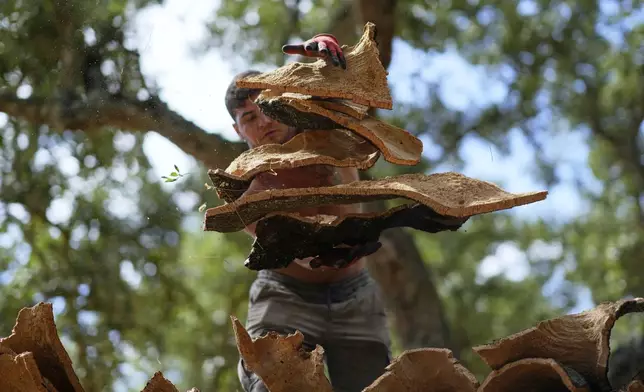
Workers peel of the bark of a cork tree in Rio Frio, Portugal, Thursday, Aug. 28, 2025. (AP Photo/Armando Franca)

A worker atop a flatbed trailer catches slabs of bark thrown to him and recently peeled off a cork tree, in Rio Frio, Portugal, Thursday, Aug. 28, 2025. (AP Photo/Armando Franca)

A worker atop a flatbed trailer catches slabs of bark thrown to him and recently peeled off a cork tree, in Rio Frio, Portugal, Thursday, Aug. 28, 2025. (AP Photo/Armando Franca)

So as of Sept. 1, cork joined a handful of other items, including airplanes and generic pharmaceuticals, that are exempt from a 15% U.S. tariff on most EU products.

The cork carve-out was vital for Portugal. The European country is the world’s largest cork producer, accounting for about half of global production.

Portuguese diplomats lobbied for the exemption on both sides of the Atlantic. Patrick Spencer, the executive director of the U.S.-based Natural Cork Council, raced from Salem, Oregon, to Washington, in June to explain cork’s origins to U.S. trade officials and to seek a tariff reprieve. The Wine Institute, which represents California vintners, said that it also pushed for the special dispensation.

Spencer said that he was thrilled when a summary of the U.S.-EU agreement released in August mentioned cork.

“It was a great day in our neighborhood,” said Spencer, a self-described “cork dork."

It’s unclear if cork is unique or if other natural products will be exempt from U.S. tariffs in future trade agreements. The U.S. Department of Commerce and the White House didn't immediately respond when The Associated Press asked about tariff exemptions.

It’s not even clear if the tariffs that U.S. President Donald Trump put on imports from the EU's 27 member nations and almost every country will remain. Late last month, a U.S. appeals court ruled that Trump had no right to impose his sweeping tariffs, although it left them in place while his administration appeals to the U.S. Supreme Court.

But if the tariffs stay in place, cork may signal other exemptions to come. U.S. Commerce Secretary Howard Lutnick indicated during a July interview with CNBC that natural products like mangoes or cocoa may be free from tariffs

The U.S. is the second-largest market for Portuguese cork after France. In 2023, the U.S. imported $241 million worth of cork from Portugal; just over 70% of it came in the form of stoppers for wine, spirits, olive oil, honey and other liquids, according to the Natural Cork Council, a trade group.

Cork has other applications too. NASA and SpaceX have used it for thermal protection on rockets. Cork crumbles are also used as infill for sports fields and inserted into concrete on airport runways to help absorb the shock of plane landings.

Even though California has a similar climate to the Mediterranean, the U.S. has never developed a cork industry. There was an attempt to start one during World War II, and around 500 cork oaks from that period remain on the campus of the University of California, Davis.

But the effort evaporated when the war ended. The problem is that it takes 25 years for a cork tree to produce its first bark for harvesting, and the initial yield typically isn’t high quality. After that, it takes the tree about nine years to grow new bark.

“Americans are not patient enough to wait for a tree that takes 25 years to give its first harvest,” said António Amorim, the chairman and CEO of Portugal’s Corticeira Amorim, one of the world’s largest cork companies.

Cork harvesting is also an extremely specialized skill, since cutting into a tree the wrong way could kill it. Cork harvesters are the highest paid agricultural workers in Europe, Spencer said.

Amorim, which exports cork to more than 100 countries, has more than 20 million cork trees spread over 700,000 hectares (1.7 million acres) of woodland.

On a recent day at Amorim’s Herdade de Rio Frio, a farm 40 kilometers (25 miles) southeast of Lisbon, crews zig-zagged across the thin, pale grass between scattered cork trees, kicking up dust.

The quiet woodland echoed with the gentle thud of the workers’ axes. They gently pierced the bark, feeling for the thickness of cork that could be peeled off without harming the trunk. The Portuguese have harvested cork this way for more than 200 years.

The tree bark came off in featherweight slabs that the workers, their hands black from the oaks' natural tannins, tossed onto a flatbed truck. It would go to factories to be cut into strips and fed into a machine that punches out stoppers.

Once the trees were bare, a woman painted a white “5” on the orange-colored trunks, signaling they were stripped in 2025. Herdade de Rio Frio's cork oaks, which are native to Portugal and can resist frequent droughts and scorching summer temperatures, were planted more than a century ago.

Cork’s sustainable harvesting process and its biodegradability are two reasons that many U.S. winemakers have returned to plugging bottles with it after experimenting with closures made of aluminum, plastic and glass. In 2010, 53% of premium U.S. wines used cork stoppers; by 2022, that had risen to 64.5%, according to the Natural Cork Council.

Cork taint, which gives wine a funky taste and is caused by a fungus in natural corks, was a big problem in the 1990s, and it pushed many vintners into aluminum screw caps and other closures, said Andrew Waterhouse, a chemist and director of the Robert Mondavi Institute of Wine and Food Science at the University of California, Davis.

The cork industry has largely solved that problem, Waterhouse said. In the meantime, the wine industry came up with new technology, like screw caps that can mimic cork in the amount of oxygen that they let into a bottle over time.

Many wineries, including Trump Winery in Virginia, now use both screw caps and natural corks. Waterhouse said that screw caps generally make more sense for a wine like rosé, which isn’t intended to age, while cork is the standard for aging wines.

“If you say, ‘Has this wine aged properly?,’ what you mean is, ‘Was it in a glass bottle with a cork seal in a cool cellar?’ Under any other conditions, it didn’t age the same,” Waterhouse said. “We’re always trapped by history.”

Dee-Ann Durbin reported from Detroit.

Slabs of bark lie scattered around a cork tree just after being peeled off the tree, in Rio Frio, Portugal, Thursday, Aug. 28, 2025. (AP Photo/Armando Franca)

Slabs of bark lie scattered around a cork tree just after being peeled off the tree, in Rio Frio, Portugal, Thursday, Aug. 28, 2025. (AP Photo/Armando Franca)

Workmen peel off the bark of cork trees, in Rio Frio, Portugal, Thursday, Aug. 28, 2025. (AP Photo/Armando Franca)

Workmen peel off the bark of cork trees, in Rio Frio, Portugal, Thursday, Aug. 28, 2025. (AP Photo/Armando Franca)

A worker uses a steel axe to gently pierce the bark of a cork tree so it can be peeled off, in Rio Frio, Portugal, Thursday, Aug. 28, 2025. (AP Photo/Armando Franca)

A worker uses a steel axe to gently pierce the bark of a cork tree so it can be peeled off, in Rio Frio, Portugal, Thursday, Aug. 28, 2025. (AP Photo/Armando Franca)

Workers peel of the bark of a cork tree in Rio Frio, Portugal, Thursday, Aug. 28, 2025. (AP Photo/Armando Franca)

Workers peel of the bark of a cork tree in Rio Frio, Portugal, Thursday, Aug. 28, 2025. (AP Photo/Armando Franca)

A worker atop a flatbed trailer catches slabs of bark thrown to him and recently peeled off a cork tree, in Rio Frio, Portugal, Thursday, Aug. 28, 2025. (AP Photo/Armando Franca)
A worker atop a flatbed trailer catches slabs of bark thrown to him and recently peeled off a cork tree, in Rio Frio, Portugal, Thursday, Aug. 28, 2025. (AP Photo/Armando Franca)
NEW YORK (AP) — It's only two weeks into the new year, and President Donald Trump has already claimed control of Venezuela, escalated threats to seize Greenland and flooded American streets with masked immigration agents.

And that's not even counting an unprecedented criminal investigation at the Federal Reserve, a cornerstone of the national economy that Trump wants to bend to his will.

Even for a president who thrives on chaos, Trump is generating a stunning level of turmoil as voters prepare to deliver their verdict on his leadership in the upcoming midterm elections that will determine control of Congress.

Each decision carries tremendous risks, from the possibility of an overseas quagmire to undermining the country's financial system, but Trump has barreled forward with a ferocity that has rattled even some of his Republican allies.

“The presidency has gone rogue,” said historian Joanne B. Freeman, a Yale University professor. She said it's something "we haven’t seen in this way before.”

Trump seems undeterred by the potential blowback. Although he doesn't always follow through, he seems intent on doubling and tripling down whenever possible.

“Right now I’m feeling pretty good," Trump said Tuesday in Detroit. His speech was ostensibly arranged to refocus attention on the economy, which the president claimed is surging despite lingering concerns about higher prices.

However, he couldn't resist lashing out at Jerome Powell, who leads the Federal Reserve and has resisted Trump's pressure to lower interest rates.

"That jerk will be gone soon,” Trump said.

Republican leaders have overwhelmingly rallied behind Trump throughout his turbulent second term. But new cracks began to appear this week immediately after Powell disclosed on Sunday that the Federal Reserve was facing a criminal investigation over his testimony about the central bank's building renovations.

Over the last year, the Justice Department has already pursued criminal charges against former FBI Director James Comey, New York Attorney General Letitia James and former national security adviser John Bolton, among other Trump adversaries.

But going after Powell, who helps set the nation's monetary policy, appeared to be a step too far for some conservatives. Fox Business host Maria Bartiromo, a fierce Trump defender, was unusually critical.

“It just feels like most on Wall Street do not want to see this kind of fight,” she said during her Monday show. “The president has very good points, certainly. But Wall Street doesn’t want to see this kind of investigation.”

The Federal Reserve plays a key role in the economy by calibrating interest rates, which Trump insists should be lower. However, reducing the institution's independence could backfire and cause borrowing costs to increase instead.

At the same time, Trump has decided to expand the United States' role in complicated foreign entanglements — a seeming departure from the “America First” foreign policy that he promised on the campaign trail.

No move was more significant than the U.S. military operation earlier this month to remove Venezuelan President Nicolás Maduro and his wife from his country. In the months leading up to the attack, Trump frequently insisted he was targeting Maduro because of his role in the drug trade. He has quickly pivoted to portraying the move as an economic opportunity for the U.S.

Trump has said the U.S. will start controlling the sale of some Venezuelan oil, and he declared that the South American nation will be run from Washington. He even posted a meme declaring himself the “acting president of Venezuela.”

Trump has also threatened the leadership of Cuba and Iran, while insisting that the U.S. will control Greenland “ one way or the other ” — a position that has raised questions about U.S. relations with European allies. Greenland belongs to Denmark, a NATO member.

“NATO becomes far more formidable and effective with Greenland in the hands of the UNITED STATES,” Trump wrote on social media on Wednesday morning. “Anything less than that is unacceptable.”

Meanwhile, Trump's immigration crackdown continues to spark confrontations in American cities. Some have turned deadly, such as when a federal agent shot Renee Good, a 37-year-old mother of three in Minneapolis.

Administration officials have said the U.S. Immigration and Customs Enforcement officer acted in self-defense, accusing Good of trying to hit him with her car. But that explanation has been widely disputed by local officials and others based on videos circulating online.

The incident came after Trump dispatched 2,000 immigration agents to Minnesota, responding to reports of fraud involving the state's Somali community.

On Tuesday, Trump said the administration was targeting “thousands of already convicted murderers, drug dealers and addicts, rapists, violent released and escaped prisoners, dangerous people from foreign mental institutions and insane asylums, and other deadly criminals too dangerous to even mention.”

The Trump administration's moves have created “chaos, confusion and uncertainty,” said Cleveland Mayor Justin Bibb, who leads the Democratic Mayors Association.

“There’s so much uncertainty across my city right now. The ICE raids in Minneapolis have really shocked the consciousness of many of my residents, and we’re trying to do everything we can to calm that concerns and quell those fears," Bibb said. “But people don’t feel like the world is getting better. People don’t feel like the economy is getting better.”

Voters across the nation will have their next chance to weigh in on Trump's leadership at the ballot box this November, when Republicans hope to retain control of Congress for the last two years of his presidency.

Democratic campaign officials in Washington are focused largely on the economy in their early political messaging. Most voters maintain a decidedly negative view on the issue, despite Trump's rosy assessment this week.

Just 37% of U.S. adults approved of how the president is handling the economy, according to a January poll from The Associated Press-NORC Center for Public Affairs Research. His economic approval, which was previously a strength, has been low throughout his second term.

“Donald Trump’s visit to Michigan puts a glaring, unflattering spotlight on how he and House Republicans have failed to address the affordability crisis," said Rep. Suzan DelBene, who leads the Democrats' House campaign arm.

But some activists are frustrated that their party's leadership isn't focusing more on Trump's unprecedented power grabs.

Ezra Levin, co-founder of the leading progressive protest group Indivisible, said he expects Trump's actions to get worse as his second and final term nears its conclusion.

“Folks at the end of last year who thought he would become a typical lame duck and limp toward a midterm loss have a framework for understanding this moment that is drastically outdated,” Levin said. “Authoritarians don’t willingly give up power. When weakened and cornered they lash out.”

Trump has repeatedly insisted he's only doing what voters elected him to do, and his allies in Washington remain overwhelmingly united behind him.

Republican National Committee spokesperson Kiersten Pels predicted that voters will reward the party this year.

“Voters elected President Trump to put American lives first — and that’s exactly what he’s doing," she said. "President Trump is making our country safer, and the American people will remember it in November.”

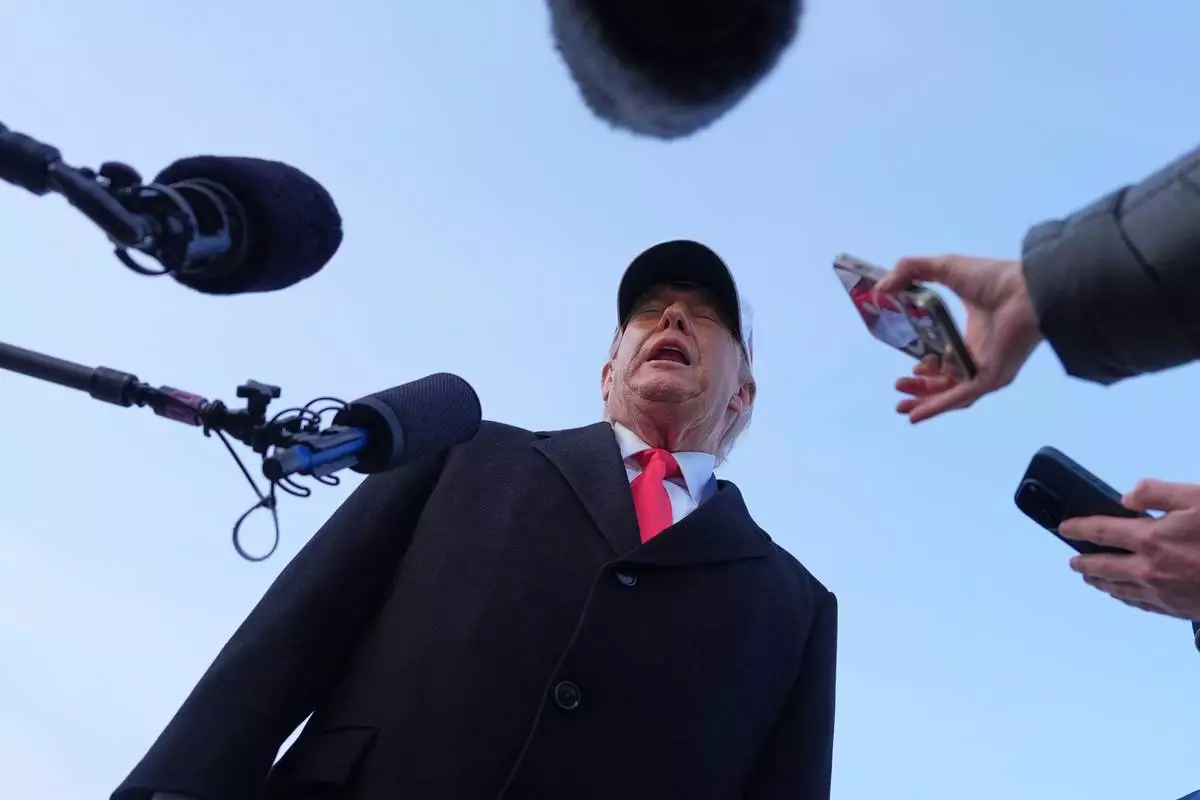
President Donald Trump speaks with reporters at Joint Base Andrews, Tuesday, Jan. 13, 2026, in Joint Base Andrews, Md. (AP Photo/Evan Vucci)

President Donald Trump speaks with reporters at Joint Base Andrews, Tuesday, Jan. 13, 2026, in Joint Base Andrews, Md. (AP Photo/Evan Vucci)

Recommended Articles