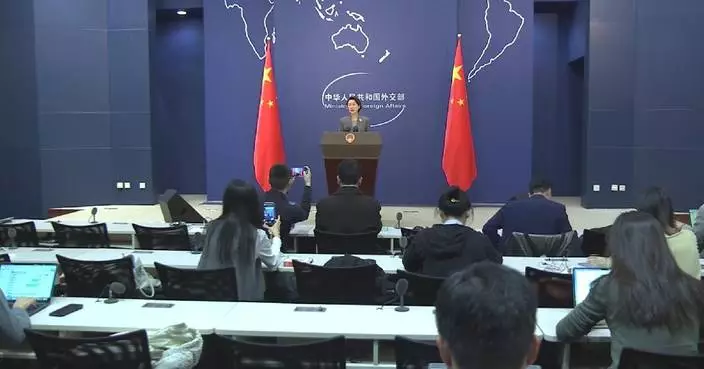
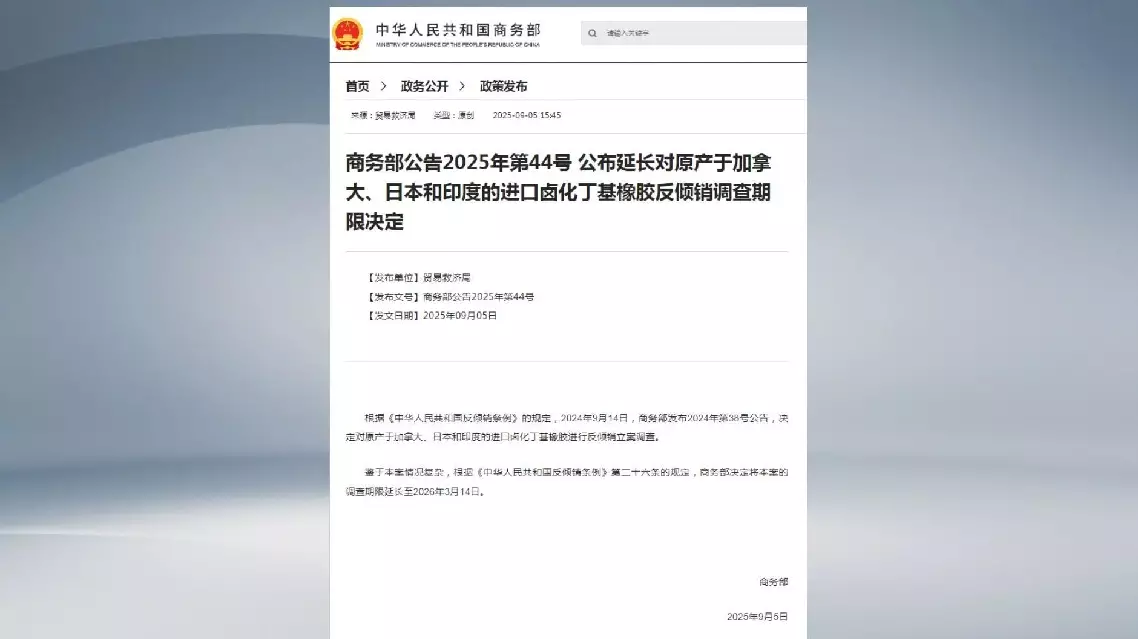
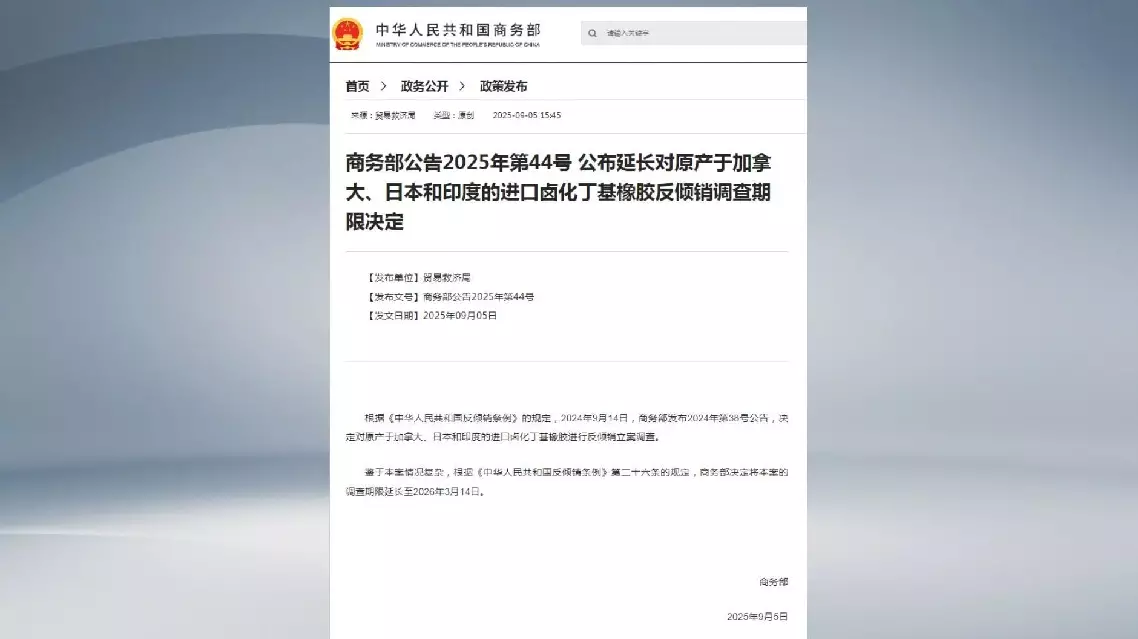
China's Ministry of Commerce announced on Friday that it will extend the duration of an anti-dumping investigation into halogenated butyl rubber imports from Canada, Japan and India.
According to the announcement, the ministry has decided to extend the investigation until March 14, 2026, given the complexity of the case and in accordance with relevant regulations.
The ministry initiated the investigation on Sept 14, 2024.
Halogenated butyl rubber is mainly used in products including airtight layers of tubeless tires, heat-resistant inner tubes, as well as medicinal bottle stoppers, shockproof pads, adhesives and sealing materials.
China extends anti-dumping probe on halogenated butyl rubber imports
China extends anti-dumping probe on halogenated butyl rubber imports
An artificial intelligence (AI) foundation model specialized for analyzing human genetic diversity was launched at Shanghai's cutting-edge Model Speed Space innovation hub on Tuesday.
Named SNPBAG, it is the world's first large model built specifically for genomic analysis, promising to precisely predict diseases and advance personalized health care.
The model focuses on single nucleotide polymorphisms (SNPs), the most common type of genetic variation among people, which influence traits such as height, intelligence and personality.
Currently, SNPBAG can be used for ancestry tracing and kinship identification. In the future, with further training, it is expected to predict disease risks at various life stages based on DNA sequences, offering higher screening accuracy than existing genetic testing methods.
"As far as we know, traditional methods examine SNPs point by point for correlations with traits like height or intelligence, without taking into account, for example, interactions between or among genes. Therefore, we need a model that can autonomously identify these complex relationships. Now, we've found such a tool that can bring close two gene expressions [of the human body] that are far away from each other and provide biological interpretations," said Tang Kun, an expert of computational biology and founder of Shanghai Feipu Intelligent Technology Co., Ltd.
Looking ahead, the model will support the development of China's sovereign genomic database, promote its domestic self-reliance, enhance AI-driven drug discovery and improve the target screening success rates by over 200 percent. It also aims to make precision health care more accessible.
"The most well-known application is non-invasive prenatal screening. Currently, only a few conditions are covered by national insurance, but there are over 20,000 rare diseases in children. We are now collaborating with Shanghai Children’s Hospital to expand screening coverage," said Lu Sitong, CEO of Shanghai Feipu Intelligent Technology.
With SNPBAG, non-invasive prenatal screening is expected to detect a broader range of rare diseases in the future. The company said it also plans to launch consumer-facing products to benefit the general public.

China launches world's first foundation model for genomic analysis