China's top academic body on Wednesday unveiled a range of major achievements in scientific archaeology and cultural heritage protection, shedding new light on technological innovation and cultural exchange in ancient China.
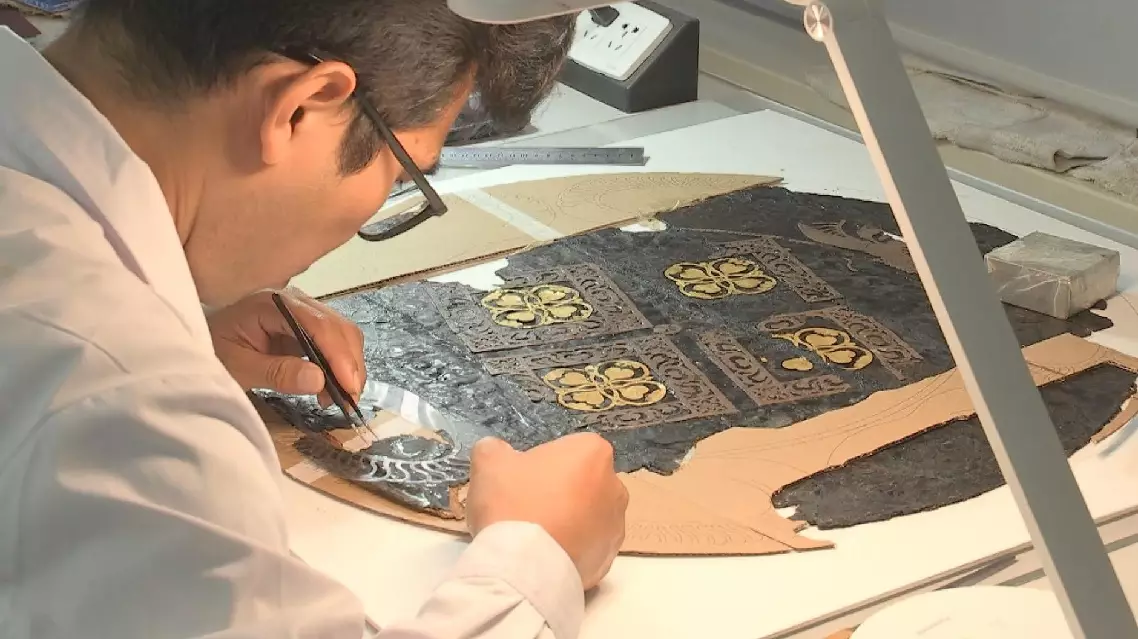
The Chinese Academy of Social Sciences announced that key artifacts unearthed from the Xuewei No.1 Tomb in Dulan, northwest China's Qinghai Province, have recently completed major conservation and restoration work after four years of effort. The tomb dates back to the Tang Dynasty (618–907).
One highlight is a gilded bronze suit of armor, the only known physical example of Tang Dynasty gold armor found in China to date.
A reconstructed model helps recreate the ceremonial appearance of the royal family of the Tuyuhun Kingdom (417-688) during the period.
A lacquerware once used to hold grapes was confirmed to be decorated with top-level techniques of the gold and silver inlaid.
Another key discovery is a fragment of resist-dyed textile, which was made no later than 750 AD through a carbon-14 dating approach, marking it as the world's earliest known physical example of this dyeing technique.
Archaeologists said the textile was likely produced in southwest China and transported to Chang'an, capital of the Tang Dynasty, and surrounding areas through tribute systems and trade networks. Additionally, archaeologists identified ancient tree remains excavated from a ruin site in east China's Zhejiang Province using dendrochronology and other scientific methods.
Dating back about 4,500 years, the remains are from an ancient bayberry tree and represent the earliest and most precisely identified example of its kind found in China. The discovery offers important clues about the diet and livelihood of people living during the Liangzhu culture period.
The academy also announced the completion and operation of an animal specimen bank. The facility houses more than 100,000 specimens collected over the past 60 years from 121 archaeological sites nationwide.
Among them are China's earliest known domesticated dog from Hebei Province and the earliest domesticated pig from Henan Province.
China unveils major archaeological discoveries