A growing number of young people from Taiwan are choosing to live and work on the Chinese mainland, drawn by cultural familiarity, economic opportunity, and supportive policies.
For many Taiwan people, the very first stop on the mainland begins in Fuzhou, capital of south China's Fujian Province, a city known for its deep cultural ties with Taiwan.
Vlogger Chen Xiao-ting, who moved from Taipei to Fuzhou, said that the shared heritage and relaxed pace in Fuzhou helped her quickly settle in the city.
"Fuzhou shares the same cultural roots with Taiwan. The atmosphere and the pace of life here are particularly comfortable. I adapted to the local life very quickly. Fuzhou gives a lot of support to young people from Taiwan who want to start a business. We decided to focus on Fuzhou's intangible cultural heritage and displays of low-carbon and environmental protection in urban areas. We prefer that our business is heartwarming and objective, and we want more people to see the real life here," said Chen.
Beyond cultural affinity, Taiwan people are increasingly drawn to mainland cities, far beyond Fuzhou, by their dynamic economies, international marketplaces, and numerous supportive policies.
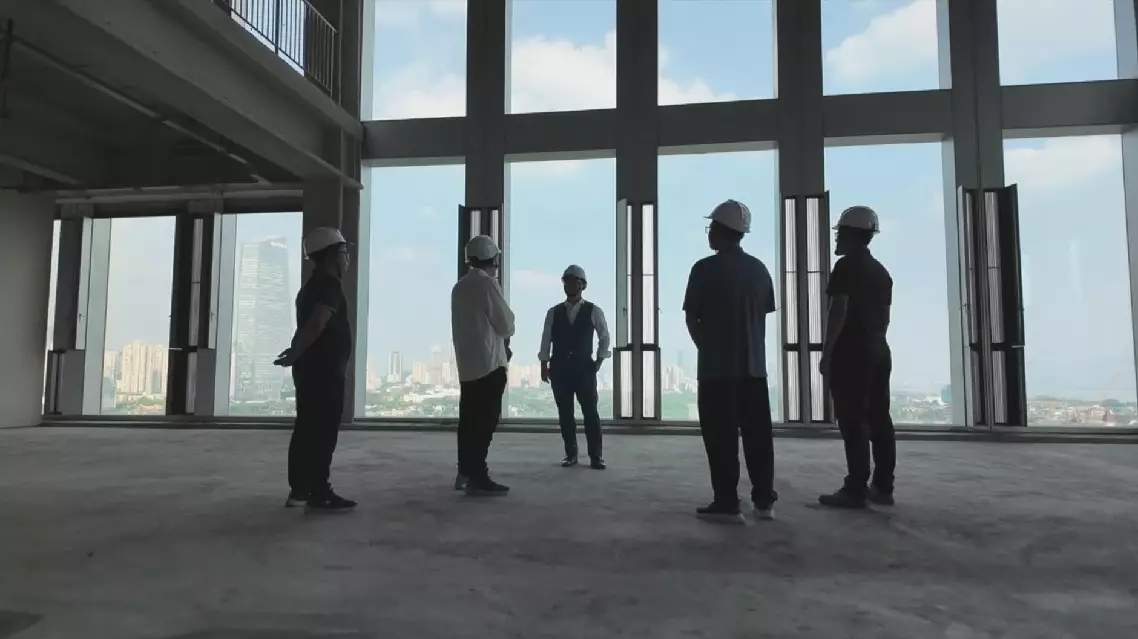
Among them is Ma Kang-wei, a Taiwan interior designer based in Shenzhen, south China's Guangdong Province. Ma said that he is attracted to Shenzhen, as there are many supporting industrial chain products, suppliers in and around the Guangdong Province.
"Shenzhen is like a pivot. It is not just a design hub. It is also the center of all sci-tech innovation. I think it's something that's hard to achieve overseas. They may have creativity, but they lack resources to bring ideas to life, and they can't interact with the supply chain at such close range," said Ma.
Despite the strained cross-Strait ties, there are always people willing to bridge the two sides, like Su Chia-yu, a flight attendant at Xiamen Airlines.
Su is part of a growing cohort of Taiwan people working in mainland's civil aviation sector. She said that her team is now the largest Taiwan group in the mainland's airline industry.
"With a dream of flying across the sky, I started a remarkable journey with Xiamen Airlines. More and more young people from Taiwan are joining the civil aviation family, together writing the story of one family across the Strait. My family fully supports me in pursuing my dream on the mainland," said Su.
Film director Huang Chao-liang is working to deepen mutual understanding through storytelling. His latest project, "Pathfinder," tells the story of a village head in Kaohsiung who helps to return the ashes of over 300 Kuomintang veterans to the mainland.
"I find a few like-minded people here. I don't have one or two brothers to help me, So I'm on my own. The name of the film is settled at 'Pathfinder' at the moment. It tells a story about a village head in Kaohsiung, Taiwan, who sends the bone ashes of more than 300 Kuomintang veterans back home in the mainland. It's a true story. They are good deeds done by Mr. Liu Te-wen over the past 20 years. I hope to devote myself to films about the two sides of the Strait, so that young people can learn more about both sides," said Huang.
Compatriots from Taiwan increasingly pursue their dreams on mainland