Skip to Content Facebook Feature Image

Guterres urges global rethink of WWII, calls China's resistance "decisive factor" in Allies' victory

China

China

China

Guterres urges global rethink of WWII, calls China's resistance "decisive factor" in Allies' victory

2025-09-06 14:18 Last Updated At:09-07 18:58

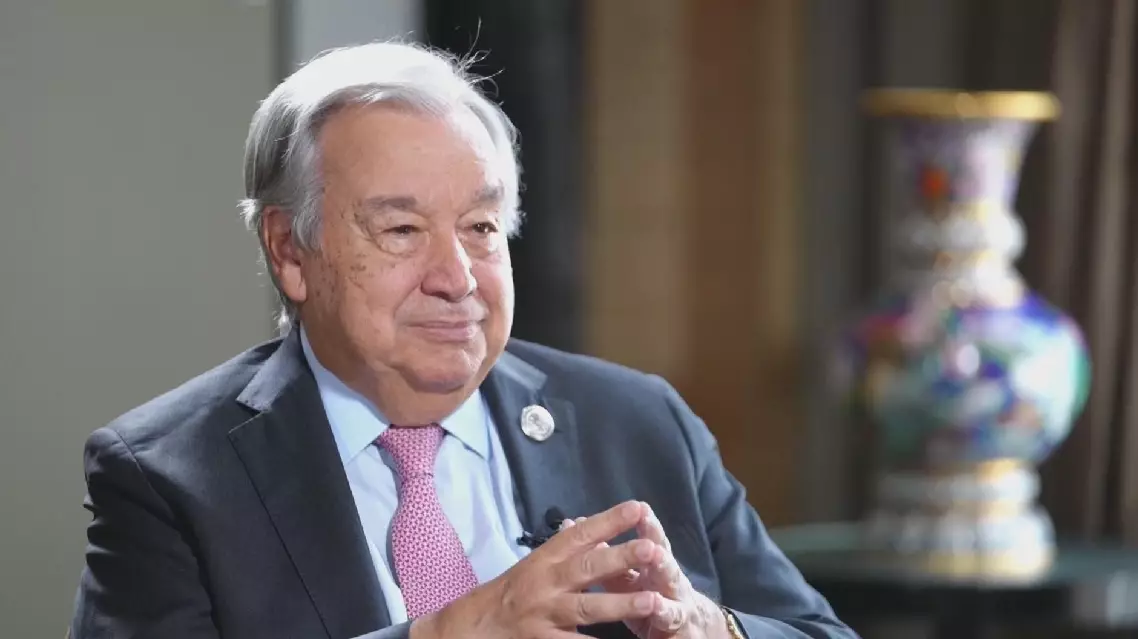
United Nations (UN) Secretary-General Antonio Guterres has called for a universal reappraisal of World War II history, noting China's 14-year resistance against Japanese aggression as a "decisive factor" in the Allies' victory, during an interview with China Media Group (CMG).

China has staged a series of commemorative events to mark the 80th anniversary of victory in the Chinese People's War of Resistance Against Japanese Aggression and the World Anti-Fascist War, including a grand military parade in Beijing on Wednesday attended by dozens of heads of state and government representatives.

In Western accounts of World War II, the spotlight often falls on pivotal moments in the European and Pacific theaters. Yet on the main battlefield in the East, the Chinese people began their resistance as early as 1931, enduring a grueling 14-year struggle against fascism and imperialism that claimed over 35 million lives.

Guterres urged a global rethink of World War II's origins and scope, emphasizing that Japan’s invasion of China in 1931 marked the true beginning of the conflict and calling for a "universal vision" of the war's history, during his visit to Tianjin for the 25th Shanghai Cooperation Organization (SCO) Summit.

"There is this idea that the World War II started in 1939 and ended in 1945. But the truth is that the beginning of the Second World War was triggered by Japan against China [with] the famous incident (the September 18th Incident) that is well known. So, to say that World War II was 1939 to 1945 is indeed a unilateral vision, and we need to have a universal vision," he said.

During the World Anti-Fascist War, China tied down and fought the bulk of Japan's forces, eliminating more than 1.5 million enemy troops and preventing Japan from allocating more troops to the Pacific theater.

China suffered a total of 35 million military and civilian casualties, accounting for a third of the total casualties of all the countries in World War II.

Guterres said that the Chinese people's resistance against Japanese aggressors was "extremely important" for the victory of the Allies.

"It's true that the resistance of China against Japan was for many years. [It was] the decisive factor of resistance against Japan and it had a fundamental contribution to weaken Japan, and that allowed for Japan to be defeated in the end of Second World War. So the Chinese contribution is a contribution that was extremely important for the victory of the Allies that include China," he said.

"As I said, one needs to look at the Second World War in its entirety and effectively. It started not very far from here (Tianjin). It started not very far from here. It ended also in the Pacific. I think this is true in many other aspects. We need to read history in a truly universal perspective, and not only in the perspective of the geographic area in which a historian belongs," said Guterres.

Leaders from more than 20 countries and the heads of 10 international organizations gathered in Tianjin for the largest-ever edition of the SCO summit, which was held from Aug 31 to Sept 1.
Guterres urges global rethink of WWII, calls China's resistance "decisive factor" in Allies' victory
Guterres urges global rethink of WWII, calls China's resistance "decisive factor" in Allies' victory
Guterres urges global rethink of WWII, calls China's resistance "decisive factor" in Allies' victory

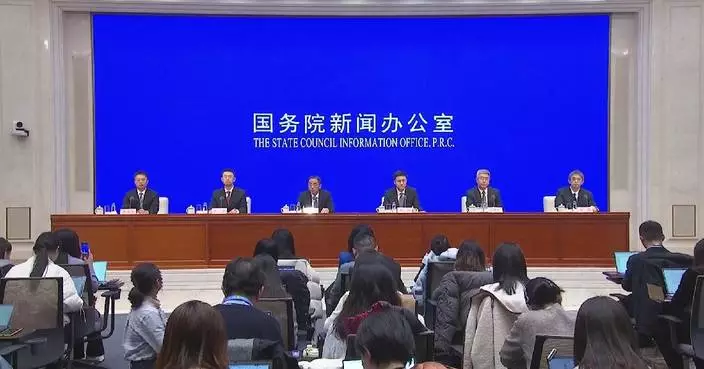
Guterres urges global rethink of WWII, calls China's resistance "decisive factor" in Allies' victory

Guterres urges global rethink of WWII, calls China's resistance "decisive factor" in Allies' victory

Guterres urges global rethink of WWII, calls China's resistance "decisive factor" in Allies' victory

A former television host from Taiwan, Zhai Xuan, has made a pivotal decision to leave mainstream broadcasting in order to create content that provides a better understanding of the Chinese mainland and cross-strait relations.

Zhai, a seasoned television host with over a decade of experience in Taiwan's media landscape, recently addressed an audience at an event in Beijing, where she revealed her complete transition into independent online media.

In her remarks, she articulated her aspiration to bridge what she perceives as a significant information gap between audiences on both sides of the Strait, highlighting her commitment to fostering a deeper understanding and connection through her new endeavors.

"I was really surprised by all the fake news. There were stories saying people on the mainland can't afford tea eggs or that they live in mud houses and in Taiwan, this was the main information many people received," said Zhai.

Zhai said she initially began producing online videos to challenge such perceptions while continuing her work as a television host.

In April 2025, she travelled to the mainland with her father to fulfill her late grandfather's wish to return to his hometown. The trip, which reunited family members separated since 1949, was recorded in a video series titled "Journey to Find Our Roots", drawing attention from viewers in both Taiwan and the mainland.

"Many people in Taiwan told me that after watching, they wanted to apply for a mainland travel permit immediately and go looking for their relatives. Some had long forgotten these things, but after seeing my story, they began thinking about their hometowns and family members they had never met and decided to search for their roots," Zhai shared her story at the event.

By mid-2025, Zhai said she began to feel increasing pressure amid rising political tensions and a tightening atmosphere around cross-Strait exchanges in Taiwan.

After more than 12 years in the industry, Zhai resigned from her position, believing it was the right thing to do.

"At that moment, I felt this was a major issue,not just for me, but for Chinese people on both sides of the Strait. If I backed down then, I wouldn’t be standing on the right side," said Zhai.

Since leaving television, Zhai has broadened her online programming to encompass a range of daily-life topics, including practical guidance on applying for a mainland travel permit and using commonly employed mobile applications, in addition to content that delves into historical memory and cultural connections across the Strait.

As the debate over cross-Strait relations continues in Taiwan, Zhai said she remains committed to her current path.

Former Taiwan TV host bridges cross-Strait divide via online media

Former Taiwan TV host bridges cross-Strait divide via online media

Recommended Articles