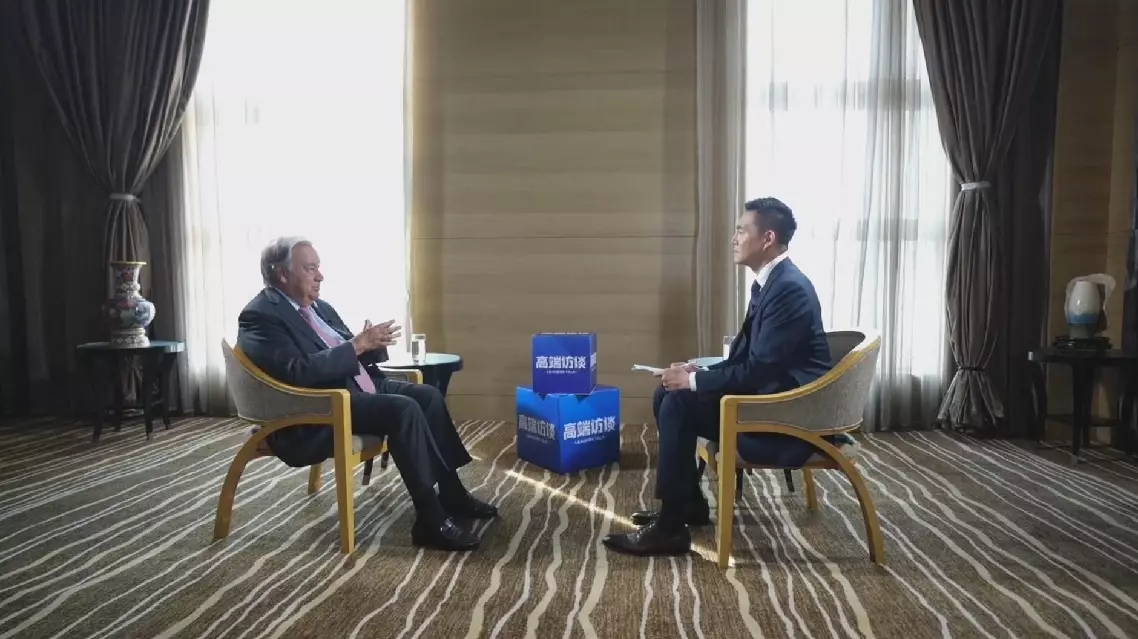
Eighty years after becoming the first signatory of the United Nations (UN) Charter, China has championed multilateralism and emerged as a driving force across the UN's core mandates, UN Secretary-General Antonio Guterres said in an interview with China Media Group (CMG).
This year marks the 80th anniversary of the founding of the UN, a milestone that also highlights China's enduring role in shaping the postwar international order. On June 26, 1945, representatives from 50 countries gathered at the Veterans Memorial in San Francisco for the signing of the UN Charter. China was the first to sign, marking a historic leap from poverty and weakness to the center of the global stage.
Japan's surrender on September 2, 1945, ended World War II. Weeks later, the UN Charter took effect, launching a new era of global governance. Today, the UN stands as the world's most representative and authoritative body, reflecting humanity's hopes for peace and progress. Speaking during his visit to Tianjin for the 25th Shanghai Cooperation Organization (SCO) Summit, Guterres praised China's active role in advancing peace, sustainable development, and human rights. He also voiced hopes for deeper collaboration in key areas such as artificial intelligence, climate action, and global peacebuilding, calling China's leadership essential to shaping a more inclusive and sustainable future.
"China has been extremely active in all the areas of the, let's say, mandate of the United Nations -- in peace and security, in sustainable development and in human rights. We are intensifying the cooperation between China and the United Nations. And I'd like to underline a few aspects. China today has an extremely important development cooperation policy, and so, when one looks at the Sustainable Development Goals, the central objective for the United Nations, the Chinese contribution is absolutely essential. On the other hand, China has had a very active engagement in mediation of certain conflicts, and again, peace is one of the central objectives of the United Nations. China has had a leading role in the transition for renewables -- a key element to fight climate change, and that is a central objective of the United Nations. So I would say that China represents today a fundamental pillar of multilateralism and a fundamental pillar of the work of the United Nations in itself," he said.
Over the past 80 years, the absence of global-scale wars has allowed the world to enjoy sustained peace. Emerging economies, including China, have risen collectively, while economic globalization has deepened, turning the world into an interconnected "global village" through expanding cross-border exchanges and cooperation.
Chinese President Xi Jinping met with Guterres in Tianjin, where Xi said that China is willing to deepen cooperation with the UN, support the UN in playing a central role in international affairs, and jointly shoulder the responsibility of safeguarding world peace and promoting development and prosperity.
Guterres said the UN looks to deepen cooperation with China in key sectors such as artificial intelligence and climate change, emphasizing China's leadership in advancing inclusive technology and renewable energy.
"I think that there are a number of areas that were identified in the Pact for the Future that was approved last year by the General Assembly of the United Nations. We identified how important cooperation is in artificial intelligence and in the digital world. Not only cooperation among developed countries or countries that have a huge capacity like China in artificial intelligence, but cooperation to allow developing countries also to be part of the benefits of artificial intelligence. On the other hand, climate, of course, is an area of extraordinary importance and we live in a moment in which the transition to renewables is demonstrating that renewables are the cheapest and the most effective way to produce energy. And again, China, has a leading role on these. On the other hand, we are pushing for a new agenda for peace. And the new agenda for peace means dialogue, means cooperation, means that different cultures and different civilizations can work together. And China has expressed, namely with the Global Initiative on Civilizations, a very clear determination in this regard. And so, if one looks at all the key aspects that are in the agenda of the activities of the UN, we have an important role for China to play," said Guterres.
The UN chief was in Tianjin for the SCO Summit, held from August 31 to September 1, where leaders from over 20 countries and heads of 10 international organizations convened for the largest SCO gathering to date.
UN chief praises China's leadership across UN mandate, key global challenges