
“People are blessed and don’t know it” sounds like a cliché, but truly grasping it is anything but easy.
China’s Victory Day parade rolled out world‑leading new weapons that left foreign political and military circles stunned, and it stirred pride across China too. Yet next to one young Iraqi’s reaction, that pride felt almost restrained.
Tears on Tiananmen
He’s in his twenties and his Arabic name is Amin Obadi, but Chinese audiences know him as Fang Haoming, a Beijing‑based correspondent for Chinese Arabic TV who took a Chinese name.

Cameras caught him covering his face in tears as the parade concluded, and when interviewed afterward he admitted he was overwhelmed, saying he couldn’t calm down for a long time and that once the doves and balloons were released, he just couldn’t stop crying.
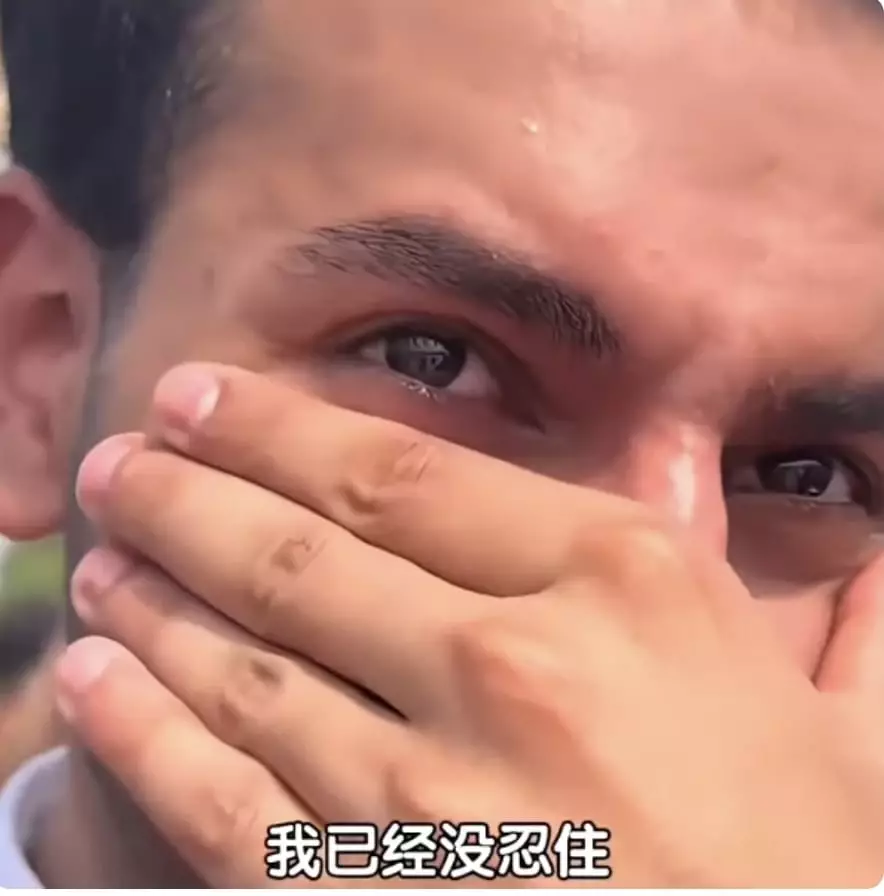
He added that he wished the Middle East could finally find peace — He especially hope people in the Middle East can live like the Chinese do.
If his own country had such military armament, he said, it wouldn’t be living under the shadow of war. And with China inviting so many partners to co‑develop, he hoped the world could become one family — just like the slogan on Tiananmen proclaims: “Long live the great unity of the world’s peoples.”
The Contrast of Peace and War
The Middle East he comes from is still riven by conflict today, and Iraq — invaded by the US in 2003, which toppled Saddam Hussein — never truly rebuilt in the 14 years that followed despite elections and a sustained American military presence.
His words inevitably summon memories of China more than a century ago, when in 1894 the Qing fought Japan with modern German‑built battleships like Dingyuan and Zhenyuan — only to see them sunk soon after hostilities began and to suffer a crushing defeat that forced the humiliating Treaty of Shimonoseki.
Who would have imagined that a century on, China would develop military capabilities that shock the world — not only far outpacing Japan, but formidable enough to counter the United States — such that if conflict erupted tomorrow in the Asia‑Pacific, it’s hard to envision America winning.
Stability Before Strength
China carved this path through brambles and hardship, and the crucial ingredient was political stability and a sound environment that allowed over four decades since 1978 to focus relentlessly on economic development — the long road to prosperity and strength.
At the parade, some fellow attendees from industry shared hard‑earned lessons about investing overseas: for lagging regions, the West once dangled preferential tariffs, and with low labor and production costs, manufacturers were lured to build plants.
But as one seasoned industrialist put it, overseas investment boils down to the “PEST” equation: P for political stability, E for economic conditions, S for social conditions, and T for industrial technology — and P trumps everything, because without stability, nothing else matters.
When Instability Burns Capital
Building a factory in a developing country easily means pouring in hundreds of millions to construct facilities and buy machinery, and only after a decade of operation — once the equipment has fully depreciated — can the investment be counted as a win.
The catch is obvious: if turmoil erupts three to five years in, the whole bet can go up in smoke.
Several industrialists pointed to Madagascar: a decade or two ago, many firms built plants there, but after the large‑scale unrest in 2009, long‑term political turbulence took hold — a HKD 300 million‑level investment was wiped out, the factory shut, and even the machinery couldn’t be recovered.
Many, having swallowed a Western narrative, judge development chiefly by “democracy and freedom,” but too often that’s just a tool to prop up pro‑US regimes, and importing such systems doesn’t guarantee long‑term political stability.
Once politics destabilize, investments vanish, scars remain, and capital doesn’t come back — as seen in recent years in Myanmar, where half the country has fallen into rebel hands and factory investors have taken painful losses.
The Air We Breathe
Political stability is like air — invisible when present, suffocating by its absence — and it brings to mind Warren Buffett’s blunt reminder at his May shareholder meeting. Asked by a Shanghainese attendee how to face setbacks, he said: “You were born in the best era China has seen in a thousand years; you waited in the womb for thousands of years and were born today — how lucky you are; don’t dwell on the bad, focus on the beauty of life.”
For Chinese born today, that good fortune is real.
Lo Wing‑hung
Bastille Commentary
** The blog article is the sole responsibility of the author and does not represent the position of our company. **

In a series of blistering statements,The Hong Kong Office for Safeguarding National Security (OSNS) has drawn a red line in the sand for anyone trying to weaponize the city’s recent misfortunes. The message is crystal clear and ominous: If you use disaster to sow chaos in Hong Kong, they will hunt you down—no matter where on Earth you try to hide.
On December 3, an OSNS spokesperson doubled down. While the HKSAR government and local citizens were racing to save lives following the tragedy at Wang Fuk Court in Tai Po, a shadow game was already in play. The office accuses a "small group of external hostile forces" of looting a burning house. Under the guise of petitioning for the people, these actors are dusting off the old playbooks from the "extradition bill protests". They are activating agents, sabotaging relief efforts, and desperately trying to reignite the "Black Riots" memories. The verdict? Their actions are despicable enough to be universally condemned.
To drive the point home, the OSNS fired off three consecutive warning shots to overseas antagonists and anti-China disruptors:
First, we solemnly warn hostile foreign forces and anti-China disrupters that their actions of creating chaos and disorder in Hong Kong are intolerable.
Second, we solemnly warn hostile foreign forces and anti-China disrupters that their actions of adding fuel to the fire will inevitably bring disastrous consequences to themselves.
Third, we solemnly warn hostile foreign forces and anti-China disrupters that the long arm of the law will catch up with them.
The OSNS is keeping receipts. Every word and every action used to disrupt Hong Kong goes on the permanent record, and culprits will be pursued for life. "Anyone who breaks the law," the office warns, there is no sanctuary. Whether you are hiding across the ocean or taking refuge in Taiwan, severe legal punishment is inevitable.
Why is the OSNS speaking up now? Read between the lines, and you see three strategic pivots.
First, this isn’t hypothetical; they believe the foreign interference is already happening. Second, the crosshairs are locked on external forces, with a pointed finger specifically at those hiding in Taiwan. And third, it’s a preemptive strike against anyone overseas dreaming of stirring up another color revolution. The warning is blunt: Distance is not a defense.
Opportunists, Grifters, and Organized Lies
Take a look at the chatter exploding across the internet, and the opposing voices generally fall into distinct camps.
First, you have the fair critics. There is plenty of commentary that, while critical of the SAR government, remains objective. These observers stick to the facts disclosed by official investigations rather than drifting into malicious fantasy. This is a natural, human reaction to a "disaster of the century." And the smart money says the SAR government will take this advice to heart and improve.
Then come the fame vampires. When disaster struck, the opportunists came out of the woodwork. Look at "internet celebrity" Kenny, arrested on December 3 after cursing the Tai Po fire victims online for having "heavy sins." It was a blatant, tasteless grab for traffic, and it landed him in handcuffs for sedition. Then there are the exiled influencers abroad, wantonly bashing the SAR government while coincidentally begging people to subscribe to their Patreon accounts. The hustle is obvious: They are monetizing misery to please their financiers.
Finally, there is the organized sedition. Beyond the grifters, we are seeing waves of calculated propaganda. These aren't just complaints; they are fabrications designed to smear the SAR government and attack the Central system. Rumor mills are churning out wild stories linking material suppliers to the families of Central leaders—plots that are total fiction. It’s as if they believe overthrowing the Central government provides immunity from fire physics. Do massive fires not happen in Western democracies? The logic is broken, but in the heat of a disaster, it’s a potent recipe for inciting public rage.
Sniper Attacks From The Shadows
The temperature on these seditious campaigns was rising fast until the Police National Security Department stepped in. Once they acted, the local noise quieted down—but the overseas attacks only intensified. It raises a suspicious question: Is there a coordinated machine working behind the scenes to sustain sniper attacks against the SAR government? The narrative is set in stone: Whatever the government does is wrong. Before a single investigator has arrived on the scene, the instigators are already screaming for heads to roll.
Here is the bottom line. The OSNS isn’t pointing fingers at external forces for sport; they are firing warning shots because they see the smoke rising. We need to be sharper than ever. Don't let external opposing forces play you for a fool, twisting a tragic fire into a tool for subverting the local government—or even the Central government itself.
Lo Wing-hung