Eighty years after the victory over fascism, China remains committed to high-quality development and shared growth, rooted in the enduring values of peace, equality, unity, and cooperation, and advocating that no one should be left behind on the path to modernization, according to a China Media Group (CMG) commentary published on Saturday.
On Wednesday, China held the grand military parade at Tian'anmen Square in Beijing to commemorate the 80th anniversary of the victory in the Chinese People's War of Resistance against Japanese Aggression and the World Anti-Fascist War, with many distinguished international guests in attendance.
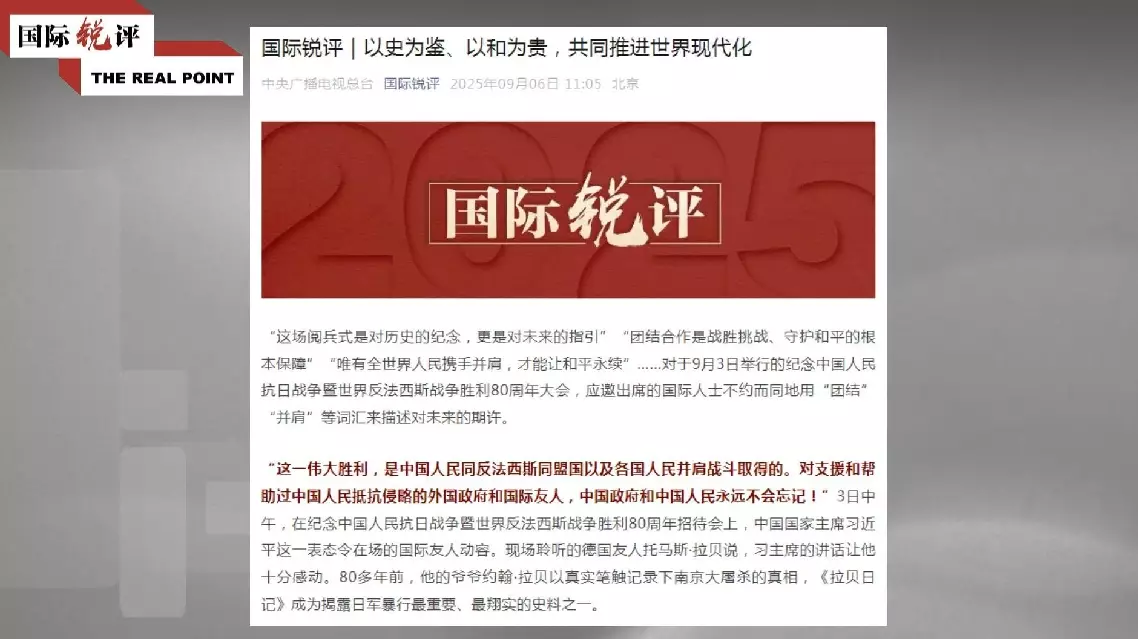
International guests emphasized the themes of "unity" and "togetherness," describing the parade as both a tribute to history and a guide for the future, and highlighting that cooperation is essential for overcoming challenges and ensuring lasting peace.
While addressing a reception commemorating the 80th victory anniversary, Chinese President Xi Jinping said that this great victory was achieved through the joint struggle of the Chinese people together with the anti-fascist allies and peoples across the world.
The Chinese government and people will never forget the foreign governments and international friends who supported and assisted the Chinese people in their resistance against aggression, Xi said.
Thomas Rabe, a German guest attending the event, said he was deeply moved by President Xi's speech. Over 80 years ago, his grandfather, John Rabe, documented the truth of the Nanjing Massacre with his own words, and "The Rabe Diary" has become one of the most important and detailed historical records exposing the atrocities committed by the Japanese army.
Amid the chaos of war, many stories of solidarity and resistance stand out, such as Soviet pilots volunteering to fight in China and the American "Flying Tigers" opening the Hump route. Notable figures such as Canadian doctor Norman Bethune and Indian doctor Dwarkanath Kotnis provided medical aid in conflict zones, while China sent troops to Myanmar and welcomed Jewish refugees.
These stories highlight that when people uphold justice and cooperate in solidarity, they will bring together a mighty force to overcome crises. The great victory in the World Anti-Fascist War was achieved through joint efforts of the people from all countries, who triumphed over evil, darkness and reaction with justice, light and progress.
Eighty years after World War II, the historical tasks for humanity have evolved. While peace and development now dominate as global themes, countries are facing rising challenges to the post-war international system with the United Nations at the core. Deficits in peace, development, security, and governance are increasing. The world must find effective ways to address these new threats and challenges.
It is sincerely hoped that all countries will learn from history, value peace, and work together to advance world modernization and create a better future for humanity, Xi noted.
President Xi's statement has resonated internationally. Dilma Rousseff, president of the BRICS New Development Bank, said that Xi's speech reflects the unified voice of those committed to peaceful development and a collective desire for global modernization. Han Yong May, executive editor of Lianhe Zaobao, emphasized that a key lesson from the victory in World War II is the importance of recognizing shared destinies and interconnectedness while pursuing self-reliance.
China is currently advancing the Chinese modernization. The modernization China pursues is not for the country alone, but for all developing countries through joint efforts.
World modernization should be based on peaceful development. Historically, some countries have achieved modernization through war and colonization, causing great suffering in developing nations. The world can no longer follow such an old path.
As the world's largest developing country, China's modernization follows a path of peaceful development. This approach is rooted in its traditional culture of valuing harmony, and demonstrates China's sense of responsibility for the future and fate of humanity as a major power.
This approach is seen as an example of peaceful development, as China has rapidly become the world's second-largest economy and increased its international influence in just a few decades.
World modernization should focus on mutually beneficial cooperation. The lessons from World War II show that winner-takes-all and zero-sum games are not viable for human development; instead, unity and win-win cooperation are essential.
Over the past decade, China has implemented the Belt and Road Initiative with over 150 countries, successfully launching key projects like railways and bridges that facilitate modernization.
This proves that when countries embrace cooperation and act in concert, a deep chasm can be turned into a thoroughfare, and a place of underdevelopment can be transformed into a land of prosperity.
World modernization should emphasize common prosperity. Currently, only over 20 countries have achieved modernization, with around one billion people, while more than 600 million are still facing hunger.
John Milligan-Whyte, chairman of the America-China Partnership Foundation, noted that today's modernization should focus not just on economic growth, but also on equitable prosperity for all, reflecting the spirit of the struggle against fascism that advocated for equality and opposition to oppression.
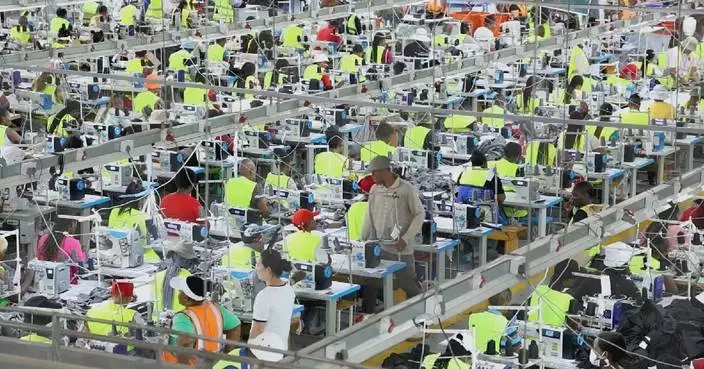
As the world's second-largest economy, China advocates for an equal and orderly multipolar world and inclusive economic globalization. It has announced various initiatives to support global development, including zero tariffs for least developed and African countries, and provided aid for over 160 nations. Through platforms like the China International Import Expo, China is dedicated to fostering shared growth with other nations while achieving high-quality development, upholding the principle that "no one should be left behind on the path to modernization."
From the fight against fascism 80 years ago to today's collaboration on modernization, the values of peace, equality, unity, and cooperation endure.
The call to "learn from history, value peace, and work together to advance world modernization and create a better future for humanity" reflects a shared hope for a better future and serves as a profound tribute to the remarkable victory achieved 80 years ago.
China remains committed to inclusive growth, modernization 80 years after victory over fascism