A senior UN official praised China's remarkable progress in air pollution control, highlighting Beijing's transformation from one of the world's most polluted cities to a global model for clean air governance, as Sunday marked the International Day of Clean Air for Blue Skies. Speaking at a Thursday event hosted by the United Nations Environment Programme (UNEP) China Office, Siddharth Chatterjee, UN Resident Coordinator in China, emphasized that air pollution remains the world's leading environmental health risk and called for shared global responsibility to ensure clean air for all.
Once among the most polluted cities, Beijing now ranks as one of the cleanest capitals, with China's efforts in air pollution control widely recognized by the international community. "So great public policies were put in place and finally it forms the right partnerships. The partnerships with society, partnership with private sector, partnership with state owned enterprises, partnership with the very companies that are polluting the place. It all came together to look at a common cause. A common cause for a better environment for children, for adults, for everybody else. So Beijing stands out as a great model of success," said Chatterjee. Over the past decade, China's GDP has increased by 69 percent, yet PM2.5 levels have dropped by 57 percent, and heavy pollution days have been reduced by 92 percent. This drastic improvement in air quality, achieved alongside steady economic growth, has drawn worldwide attention. During the event, He Kebin, an academician of the Chinese Academy of Engineering and professor at Tsinghua University, noted that the ongoing improvements in China's air quality have established a strong foundation for the future. He noted that since the launch of the Air Pollution Prevention and Control Action Plan in 2013, the average PM2.5 concentration in China has fallen from 72 micrograms per cubic meter to 29.3 micrograms per cubic meter by 2024. "We estimated that if we maintain this path toward 2060, the carbon peaking and neutrality goals could lower the national average of PM2.5 concentration from the current level of around 20 micrograms per cubic meter to below 10 micrograms per cubic meter," said He.

UN official praises China's air quality improvements as Beijing sets global example
A World Health Organization (WHO) medical epidemiologist on Sunday sought to ease public concerns over a hantavirus outbreak linked to a cruise ship, stressing that the virus is not airborne like COVID-19 and that the average person has no reason to worry.
Spain began evacuating passengers the same day from the hantavirus-stricken cruise ship MV Hondius, which had anchored earlier off the Port of Granadilla on the island of Tenerife.
The MV Hondius departed Argentina on April 1 with more than 140 passengers and crew from 23 countries on board. The ship has reported eight infections, including three deaths. Six of the cases have been laboratory-confirmed as Andes virus infections, caused by a rodent-borne hantavirus endemic to South America and the only known hantavirus strain capable of limited human-to-human transmission.
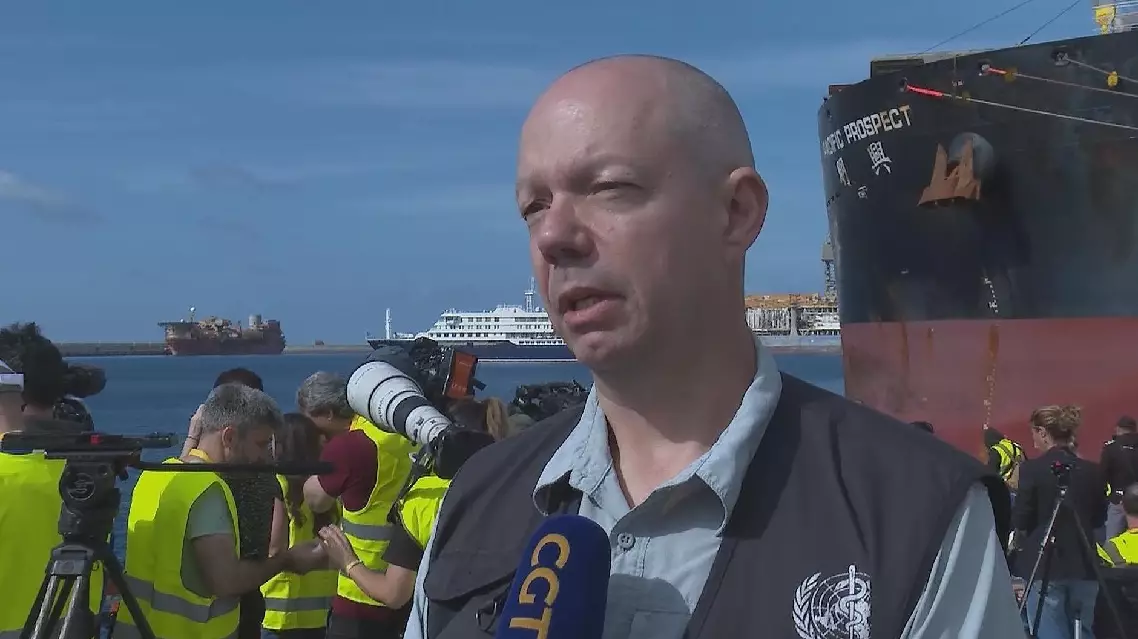
Boris Pavlin, a medical epidemiologist with the WHO, said the cruise ship affected by a hantavirus outbreak had been carefully managed by Spanish authorities and posed little risk to the general public. "This is not COVID. The average person does not need to be worried about hantavirus here in this setting. These folks are being managed very carefully, very deliberately, by the Spanish authorities; they're getting off the ship, they are getting into small boats, they are being spaced apart in the buses so there's no risk to one another. Even if one were to become symptomatic -- we know that none of them were symptomatic as they have been leaving the ship -- they're going straight to their aircraft and they're being taken to their respective national jurisdictions," he said.
Pavlin said the exact source of exposure remained under investigation, but the initial cases appeared to be linked to a pre-cruise land excursion in South America.
"From what we understand of the initial cases, there was -- as one does often on a cruise -- there was a land-side excursion before the cruise in which places were visited that are home to these specific rodents that are associated with the Andes hantavirus. These are not worldwide rodents; the long-tailed rice rat is very specific to the Andes Cordillera region of South America, and that's where people who are exposed to the rodents were. So it was in one of those places they were exposed. We don't know exactly because there are several possibilities, and I believe that the Argentinian authorities are actually even going to look at that and try to do some animal sampling to get to the very bottom of it. But that part's not unexpected at all," he said.
The official praised Spanish authorities' handling of the ship and described the response as a closely coordinated international effort.
"This has been an extremely cooperative, collegial international effort. The Spanish authorities are very diligent and deliberate about what's happening here. There's nothing that would surprise us. I think that somebody might become exposed; we want to obviously make sure that people who are coming off the ship are not newly exposed to one another as they get off and go to their respective places, and we're not seeing that," Pavlin said.
But while the immediate disembarkation process had gone smoothly, he emphasized that health officials were not letting their guard down.
"However, the contact tracing and follow-up of every person who has been in even the lightest contact with the patients will continue until a maximum incubation period. In any case, there are contingency plans should someone become ill, and we know that it doesn't just spread like wildfire, so even if they were to become ill, we don't expect a large outbreak after this," the official said.
Cruise ship hantavirus outbreak "not COVID," poses low public risk: WHO expert