The Meteorological and Geophysical Bureau (SMG) of China's Macao Special Administrative Region (SAR) issued No. 8 Signal on Sunday evening, bracing for Typhoon Tapah, the 16th of the year.
Tapah made landfall in Taishan City, south China's Guangdong Province at around 08:50 on Monday morning, but Macao will continue to be affected by the maximum wind area near its center, according to the latest update from the SMG on Monday morning.
On Monday morning, winds with sustained speed of 63 to 117 km/h was expected and the gust may exceed 180 km/h in Macao, accompanied by heavy rain, the authority said.
The SAR's Civil Protection Operations Center on Sunday evening declared an "immediate prevention stage", and a yellow storm surge warning had been in effect, adding that four emergency shelters have been opened for residents and tourists to use.
The Education and Youth Development Bureau announced that classed for secondary, primary, infant and special education will be suspended on Monday.
During the No. 8 Signal period, Macao's public transportation services, including buses, light rail, and ferries will be suspended, while four major sea-crossing bridges, including the Macao Bridge, the Friendship Bridge, and the Sai Van Bridge, will be closed, but the Sai Van Bridge's lower lane will remain open to traffic.

Typhoon Tapah triggers No. 8 signal in Macao
Smart technologies have reshaped China's ecological and environmental monitoring system, Huang Runqiu, minister of Ecology and Environment, said Thursday in Beijing on the sidelines of the fourth session of the 14th National People's Congress(NPC).
"Regarding ecological and environmental monitoring, we have been promoting the digitalization, informatization, and intelligentization of the entire monitoring process in recent years, reshaping the ecological and environmental monitoring system. For instance, in water environment monitoring and sampling, we have used intelligent drones which can quickly locate sampling points, collect samples accurately, return rapidly, and they are safe and reliable, improving work efficiency by over 70 percent. They are particularly advantageous for sampling during flood seasons and in remote areas," Huang told the press.
"In terms of environmental sample analysis, we have developed 'lights-out laboratories' in recent years. As the name suggests, these labs operate without lights and are unattended. Through robotic arms, robots, and intelligent management systems, they achieve full-process automation and intelligence from sample handover, testing, and analysis to report generation. This has significantly enhanced work efficiency, increasing it by more than eightfold compared to traditional labs. More importantly, it reduces human interference, human error, and even data falsification," he said.
Thanks to the improved ecological and environmental supervision capabilities, the number of environmental violation cases nationwide has decreased from 130,000 five years ago to 43,000 last year, representing a decline of 68 percent, Huang said.
The minister said China has already applied environmental DNA technology in the biodiversity monitoring work.
"In the field of biodiversity monitoring, monitoring aquatic organisms remains a weak point. However, significant progress has been made in recent years as we have developed environmental DNA technology. Although this chip is very small in size, it contains DNA detection information for aquatic organisms, including the finless porpoise and the Chinese sucker, from 19 state-controlled sections in the Jiangsu segment of the Yangtze River. The results showed that over the past five years, more than 20 species of aquatic organisms have increased in this river section, fully demonstrating the tangible effectiveness of the ten-year fishing ban in the Yangtze River," Huang said while showing a chip to reporters.
The 14th NPC, China's national legislature, concluded its fourth session on Thursday.
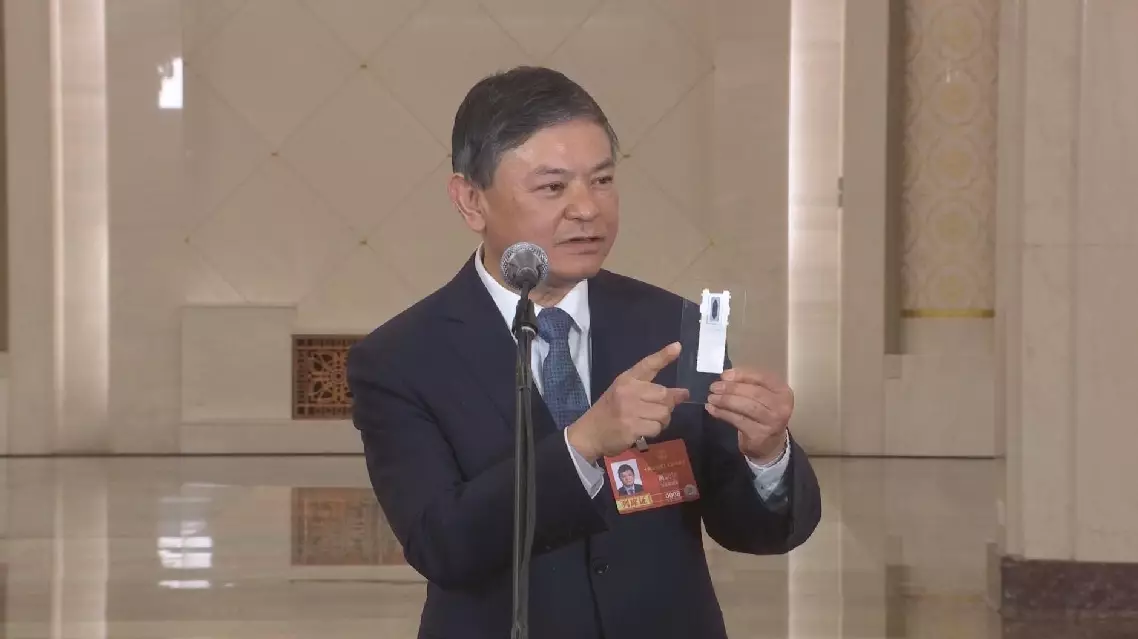
Smart technologies reshape China's ecological, environmental monitoring system: minister