Skip to Content Facebook Feature Image

Jimmy Lai’s Fortune

Blog

Jimmy Lai’s Fortune
Blog

Blog

Jimmy Lai’s Fortune

2025-09-09 19:24 Last Updated At:19:25

A person’s luck or misfortune is always a matter of perspective—without something to measure against, there’s no sense of grievance. That’s the story of Jimmy Lai’s fate.
 
The trial of Jimmy Lai has just wrapped up its closing arguments, and now everyone’s waiting for the judge’s verdict. At the very same time, I stumbled onto a story from America—one that really puts into perspective just how remarkably lucky Jimmy Lai is to be facing justice in Hong Kong.
 
America’s Instant Judgement: Sink Now, Ask Later
 
Let’s start with a chilling episode: On September 2, Trump stood at the White House to announce that the American military had attacked and sunk a drug-carrying boat from Venezuela, killing all 11 people on board. Trump’s words were clear: that was a “drug-carrying boat” and there was “A lot of drugs in that boat”. Later he added on his Truth Social platform: “Let this be a warning to anyone contemplating bringing drugs into the United States. BEWARE!”

Just one declaration from the President of the United States—labeling a Venezuelan boat as filled with drugs—and the US military launched a missile, destroying the boat and killing every soul onboard. If you go by the textbook version of Western democracy, suspected criminals should be arrested, brought before a judge, and have the evidence weighed against them. Guilt beyond a reasonable doubt, right? But here, a single presidential order turned into a death sentence—no trial, no evidence, just annihilation at sea.

Trump posts video confirming he ordered the sinking of a “drug-carrying boat” of “positively identified Tren de Aragua Narcoterrorists”.

Trump posts video confirming he ordered the sinking of a “drug-carrying boat” of “positively identified Tren de Aragua Narcoterrorists”.

Even in the US, trafficking drugs almost never ends with the death penalty. Federal laws, like the Comprehensive Crime Control Act, restrict the death penalty to the most extreme crimes—typically those where drugs and murder intertwine. Since death penalty reinstatement in 1988, only one person was executed for a drug-connected murder in 2020. There’s never been a modern case of someone executed just for trafficking.

The Eighth Amendment to the US Constitution bans “cruel and unusual punishment.” The Supreme Court also held, in Kennedy v. Louisiana, that giving the death penalty for crimes like simple drug trafficking is unconstitutional. In reality: even if a boat packed with drugs was more than enough for a conviction, executing the suspects without trial would be off the table. So, what gave Trump the right to skip the courts and go straight to killing 11, supposedly just on “intelligence”?
 
Applying “Trump Logic”: It Could Have Been Worse
 
Imagine this: By Trump’s logic, if there were an “American Jimmy Lai” who he saw as a severe threat to national security, he could’ve simply duped this guy onto a smuggling boat and obliterated it—no trial, just sunk it at sea with a missile. That’s really terrifying.
 
Compare that to how authorities handled things here: when 12 fugitives—connected to Lai’s case—tried to flee by speedboat, they were briefly sentenced on the mainland before being handed back to Hong Kong for trial. Now that’s how a system built on law and civilization is supposed to look.

Jail in Hong Kong vs. “Crocodile Devil’s Island”
 
Jimmy Lai’s son, Sebastien, and the so-called “international legal team” representing him, have been quick to claim Lai is suffering from poor health, harsh treatment, and solitary confinement—that enduring 40°C heat without AC amounts to torture. But the reality isn’t quite so dramatic—especially if you compare it to America’s way of handling detainees.
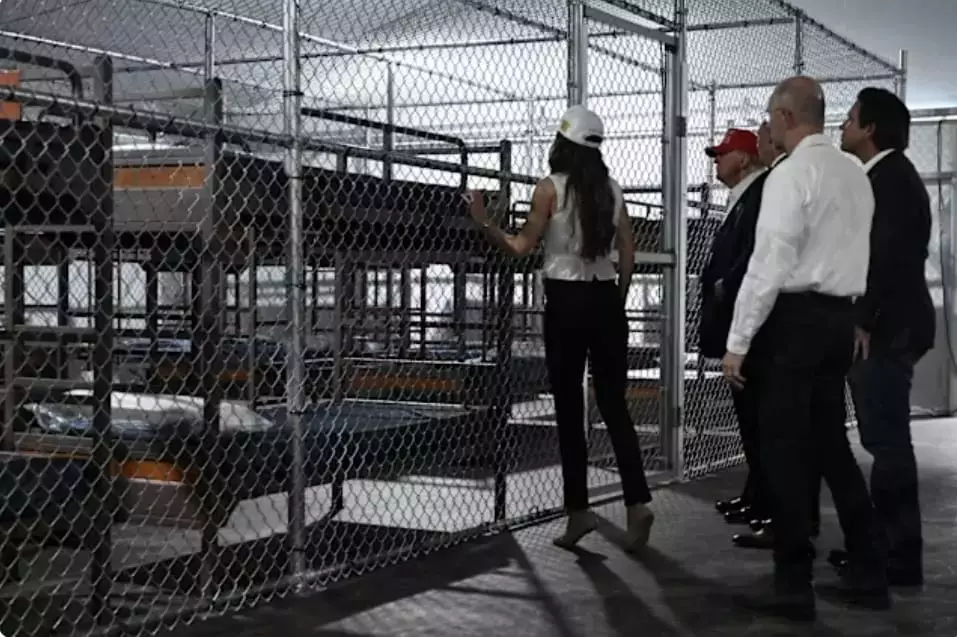
Trump (2nd left) and Homeland Security Secretary Kristi Noem (1st left) tour “Alligator Alcatraz”, inspecting the iron cages where “illegal immigrants” are detained.

Trump (2nd left) and Homeland Security Secretary Kristi Noem (1st left) tour “Alligator Alcatraz”, inspecting the iron cages where “illegal immigrants” are detained.

The US built a massive detention facility outside Miami, nicknamed “Alligator Alcatraz” because of its alligator-infested swamps. With 5,000 beds, Trump made sure the world knew it was a place to fear. He and Homeland Security Secretary Kristi Noem even did a publicity tour—showing off endless metal bunks inside vast iron cages, purposely designed to humiliate. They paraded through this intimidating compound, emphasizing the cruel environment.

Americans packed detainees—suspected illegal immigrants—into cages, row after row of beds, all to send a public message. Jimmy Lai, by contrast, actually asked for solitary confinement for his own safety—and Hong Kong’s correctional authorities agreed. His family then spun this into claims of “abuse.” Now, if Lai were a Trump critic in America and got thrown in prison, just imagine the “special treatment”: an extra-large super-cage packed with the worst kinds of criminals—murderers, drug lords, and rapists—all crammed together. Would that be “gentle treatment”?
 
Selective Outrage and Convenient Silence
 
Sebastien Lai and his overseas supporters have been lobbying so-called human rights organizations, demanding Lai’s release. But as they protest so loudly for him, where was the outrage for those 11 Venezuelans killed on that boat—executed without any legal process? Are these organizations fine with extrajudicial killings, or are they just so afraid of Trump that they roll over and play lapdog when he’s involved?
 
Bottom line: Jimmy Lai is lucky—standing trial in Hong Kong within a transparent legal system, he’s already far better off than many people elsewhere in the world.

Lo Wing-hung


Bastille Commentary

** The blog article is the sole responsibility of the author and does not represent the position of our company. **

Some people fancy themselves legal eagles. So they exploit every procedural loophole to challenge the government. The practical effect: draining public resources and burning through taxpayers' cash.

Enter Chow Hang-tung. The former vice-chair of the now-defunct Hong Kong Alliance took issue with prison dress codes. Her legal gambit hit a wall on Tuesday when High Court Judge Russell Coleman tossed the case and stuck her with the bill.

On September 6, 2024, Chow filed her judicial review application over the CSD's inmate clothing policy. Her complaint: Female inmates must wear long pants during summer unless granted special permission, while male inmates wear shorts. She also alleged that in July and August 2024, she verbally requested permission to wear shorts from CSD staff on two separate occasions—both times refused. Therefore, Chow sought judicial review of both the clothing policy itself and the Department's alleged denial of her shorts request.

Chow was previously jailed after being convicted of "inciting others to knowingly participate in an unauthorized assembly." She's still awaiting trial this year on a separate charge of "inciting subversion of state power."

Court Slams the Door Shut

The High Court judge dismissed Chow's judicial review application. In his judgment, Judge Coleman pointed out that the current inmate clothing policy—including requiring female inmates to wear long pants during daytime in summer—was formulated by the CSD under authority granted by the Prison Rules. The court was satisfied that the Department possessed professional expertise and experience in this area, had carefully weighed various factors and consulted professional opinions during the decision-making process, and conducts continuous reviews. The court ruled that Chow failed to prove the current policy discriminates against female inmates.

The CSD emphasized the importance of uniformity in inmates' clothing. Think of it like school uniforms—it helps train discipline and accommodates female inmates' emphasis on privacy, covering scars, leg hair, and so forth.

Judge Coleman also agreed with CSD Senior Clinical Psychologist Hung Suet-wai's assessment that female inmates' mental health is more vulnerable, and some female inmates are particularly sensitive with unique clothing needs. Additionally, since male staff regularly enter female correctional facilities, appropriate clothing should be provided to protect female inmates' privacy. Wearing long pants therefore allows female inmates to feel psychologically more comfortable and secure.

Regarding Chow's claim that she requested to wear shorts between July and August 2024 and was refused by the CSD, Judge Coleman found her account unconvincing.

What the Evidence Actually Shows

Observing Chow's conduct and the entire judicial review proceedings, several conclusions jump out.

1.⁠ ⁠Chow's passion for making requests

As the High Court judgment pointed out, according to CSD records, between July 2021 and September 2024—a span of 3 years and 2 months—Chow made a total of 297 requests (averaging 21 requests per month).

Yet oddly, never once did she include a request to wear shorts. During the same period, across 136 consultations with CSD doctors, she never mentioned feeling uncomfortable or overheated from wearing long pants, nor had she ever requested to wear shorts for any health-related reasons.

This clearly shows her allegation of making requests that were refused by the CSD was completely fabricated. She's simply hunting for various reasons to challenge the CSD, constantly wanting to sue the government.

2.⁠ ⁠Burning public funds on the public's dime

Chow formally submitted hundreds of requests to the CSD. Just responding to her requests already left CSD Staff exhausted. If dissatisfied, she'd complain through various channels, or even file for judicial review to challenge the Department's decisions—wasting massive CSD resources and court time.

Many people complain about lengthy scheduling delays at the High Court. These "serial filers" constantly filing lawsuits occupy precious court time.

3.⁠ ⁠Prison is not a holiday resort

Jimmy Lai's children complained that it was too hot for him in prison without air conditioning. Before the judgment, Chow's Patreon account grumbled about the inability to shower or change into fresh pants when the trousers get dirty from daily prison routine—freedoms she suggested ordinary people take for granted. They seem to treat imprisonment like a vacation, expecting various freedoms.

Prison indeed, as Chow said, has "no such freedom." If prison offered all sorts of freedoms, plus basically provided food, accommodation, and priority medical care, many people would deliberately commit crimes to go to prison.

How Prison Oversight Actually Works

I am a Justice of the Peace and regularly inspect prisons. I fully understand that to ensure inmates' rights are protected, the CSD provides various channels both within and outside the Department for inmates to voice complaints—for example, to Justices of the Peace who conduct regular visits or to the Ombudsman.

The Department has continuously implemented multiple measures to improve the detention environment within prisons. I've seen powerful fans installed in prisons. New gates and windows with better ventilation efficiency are also being installed to improve air circulation within facilities.

Hong Kong's treatment of prisoners is already very humane—unlike the United States, which sends unconvicted illegal immigrants to prisons in El Salvador with harsh conditions. That Barbie-doll-like US Secretary of Homeland Security Kristi Noem even made a special trip to pose for photos outside prison cells in El Salvador, treating inmates' privacy as nothing.

I fully support the High Court's dismissal of Chow's judicial review application and ordering her to pay the CSD's legal costs, reducing the burden on taxpayers.

Lo Wing-hung

Recommended Articles