
NEW YORK (AP) — In hardly any time at all, the footage of the horrifying moment when a bullet hit conservative activist Charlie Kirk in the neck cascaded across the internet.
Whether seeing it inadvertently or seeking it out, onlookers far from the crowd at a Utah college could be exposed to disturbingly close and potentially bloody glimpses of his shooting and the resulting chaos. It's the product of a digital-first world where the presence of smartphones and social media makes current events readily accessible and often, practically unavoidable.
And, of course, among those seeing it were kids, teens and other young people — those who live with their phones practically attached and are often far more chronically online than their parents.
It raises a question that modern-day parents are sadly having to ask more frequently: How do you talk to your kids about what's going on, what they're seeing and hearing?
It's a basic parental impulse to want to protect kids, to shield them from harsh realities or complicated situations, to think they're too young to know about the ways in which the world can be unsafe or terrible.
Yet when it comes to the actual world around us, that's not realistic, experts say. Information is EVERYWHERE.
“For parents to assume that their children are not being exposed to this is just not a good way of approaching it,” says Jodi Quas, professor of psychology at the University of California, Irvine. “Children talk at school, children overhear teachers, they overhear adults, they overhear their parents’ conversations.”
That's only exacerbated by phones, tablets and other technology that connect children to the world, even if parents try to set screen limits or parental controls.
“In this adult world, you could easily think that it’s very easy to protect yourself from this, of course you don’t have to look at it, of course, you can turn away,” says Kris Perry, executive director of Children and Screens: Institute of Digital Media and Child Development. “But what’s happening with children, especially in social media contexts, is that the algorithms are so sophisticated and the feed is so tailored to them that you should assume your child has been exposed to this event through a source that you did not choose.”
In talking to young people, parents should try to get a sense of what knowledge kids do have about the events at hand, instead of rushing in with assumptions, says Riana Elyse Anderson, associate professor of social work at Columbia University's School of Social Work.
“It could be that young people are seeing things that were actual images from the event, or it could be things that have been doctored or changed because of different editing or AI software,” Anderson says. “So it’s really important for us to get a sense of what they think they know.”
Of course, if parents are looking to reassure their kids about their safety, or talk to them about what they've seen or national events, parents should take the time to acknowledge their own feelings and thoughts first.
“Parents have to stop and take a breath and be ready — put your own oxygen mask on as they say — so that you can process your own feelings before you start talking to your child, so that you're more stable and able to listen carefully and be less reactive,” Perry says.
Parents need to remember that they are their children's role models, Quas says.
“If parents are highly agitated, parents are so distressed that they can’t regulate their own emotions, it really doesn’t matter what they say to children. Children are going to be afraid,” she says.
Kait Gillen's 10-year-old son doesn't even have a phone of his own yet, but was next to his mom at home in Virginia when the alerts of Kirk's shooting and subsequent death started alerting on her phone.
“He was visibly shaken by it and wanted to know who had done it,” Gillen says, questions that still have no answers. They talked about it for a bit, and she promised him they could talk about it more as he needed to.
She knows it's not the last of the conversation about the incident, as he talks to schoolmates and others, and it won't be the last time this type of conversation could be needed as he grows up and gets a phone of his own, joining the larger world.
“As much as I want to shield him ... he is going to be exposed to it,” she says. “And so I can’t keep him from it. But what I can do is try to give him the tools to understand and process what he is feeling.”
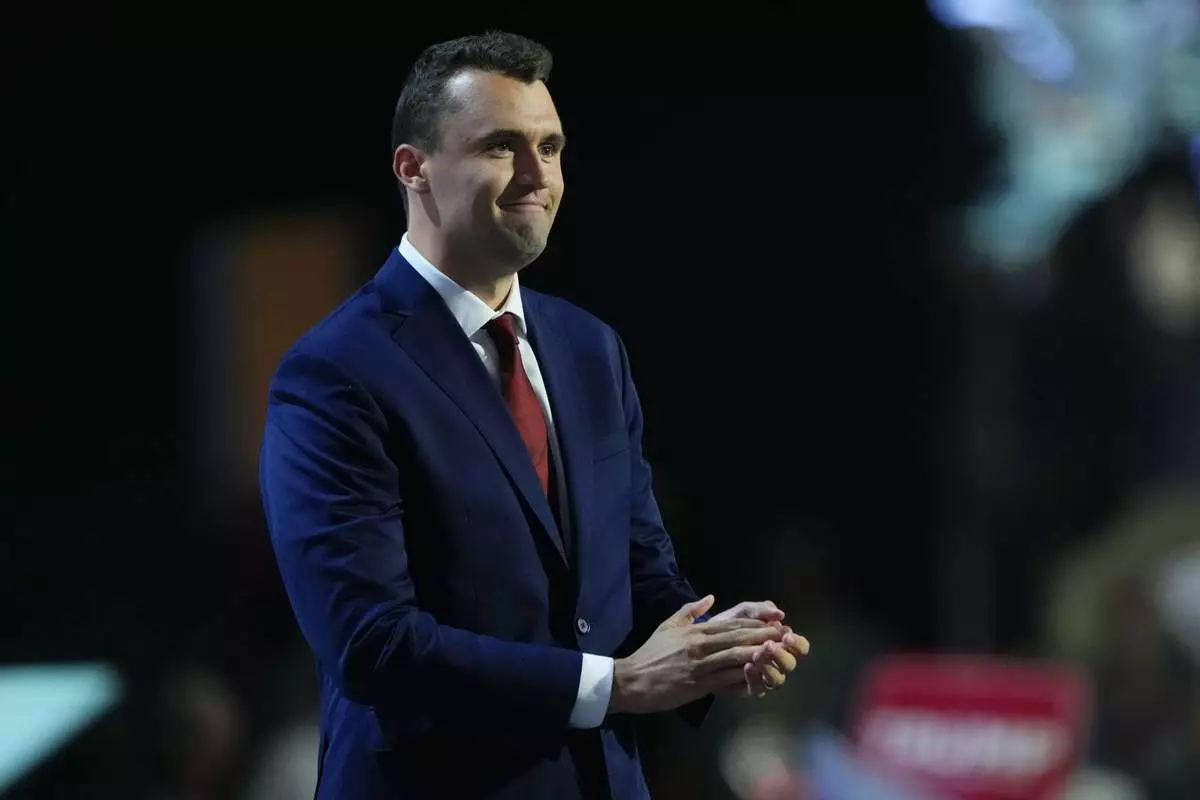
FILE- Charlie Kirk, co-founder of Turning Point USA, stands during microphone check before the start of the first day of the Republican National Convention, July 15, 2024, in Milwaukee. (AP Photo/Matt Rourke, File)

The casket containing the body of Charlie Kirk, the CEO and co-founder of Turning Point USA who was shot and killed is removed from Air Force Two at Phoenix Sky Harbor International Airport, Thursday, Sept. 11, 2025, in Phoenix. (AP Photo/Ross D. Franklin)

Sisters Clara Hetland, 4, left, Haddie Hetland, center, 9, and Audra Hetland 6, of Surprise, Ariz., spend time at a makeshift memorial set up at Turning Point USA headquarters after the shooting death at a Utah college on Wednesday of Charlie Kirk, the co-founder and CEO of the organization, Thursday, Sept. 11, 2025, in Phoenix. (AP Photo/Ross D. Franklin)