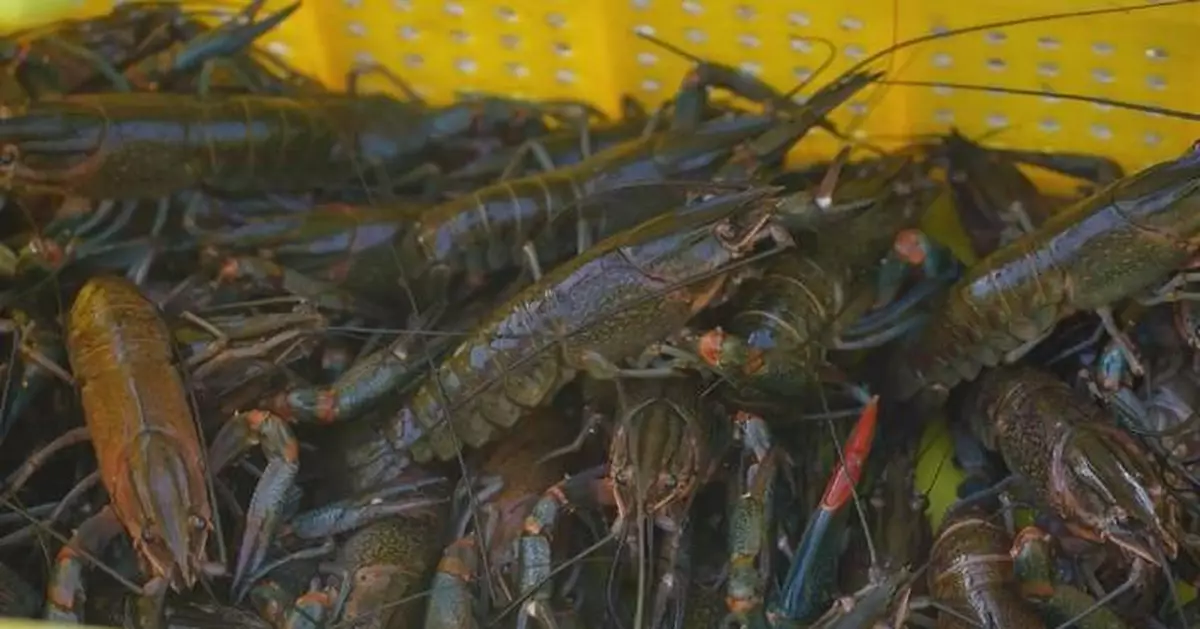
Crayfish farming is unlocking new economic opportunities in Makit County, northwest China's Xinjiang Autonomous Region, where villagers are converting desert land into profitable aquaculture ponds.
What was once desolate Gobi wasteland is now dotted with glimmering aquaculture ponds, offering local villagers fresh income and renewed hope.
The initiative began when aid teams from east China's Shandong Province introduced the bold concept of transplanting crayfish farming from China's east coast to Xinjiang's arid west.
After more than a year of repeated experiments, they succeeded in raising Australian freshwater crayfish in desert conditions. To ensure villagers could take part, the team built ponds, installed equipment, and prepared easy-to-use guides on crayfish farming.
At first, the challenges were daunting as the desert's water is extremely difficult to manage-it gets scorching hot by day, freezing by night, and the quality is hard.
The first batch of crayfish larvae saw survival rates of just 10 percent.
"We were also very anxious, so we immediately brought in a professional (aquaculture) team from Rizhao, and they simply stayed by the crayfish ponds. In Xinjiang, the water is highly saline and alkaline, and if the crayfish don't molt, they won't survive. To adjust the water quality, there was one day when we conducted more than a hundred tests, and the data filled up two whole notebooks," said Bu Xiangbing, aid Xinjiang cadre from Rizhao City, Shandong Province.
After two years of persistence, survival rates drastically improved. By 2024, Xinjiang's desert-raised crayfish were quickly sold out on the market, proving both the quality and potential of this new industry.
The farming area has now expanded to 160 mu (about 26 acres), involving over 100 local households.
For locals like Nueraihemaiti Reheman, the impact is life changing.
"After learning the skills, I bought a car. I earn 40,000 (about 5,492 U.S. dollars) to 50,000 yuan (about 6,865 U.S. dollars) a year now," he said.
"My wife and I both work here. Together we make 5,500 yuan a month," said another staff member named Abudula Abulizi.
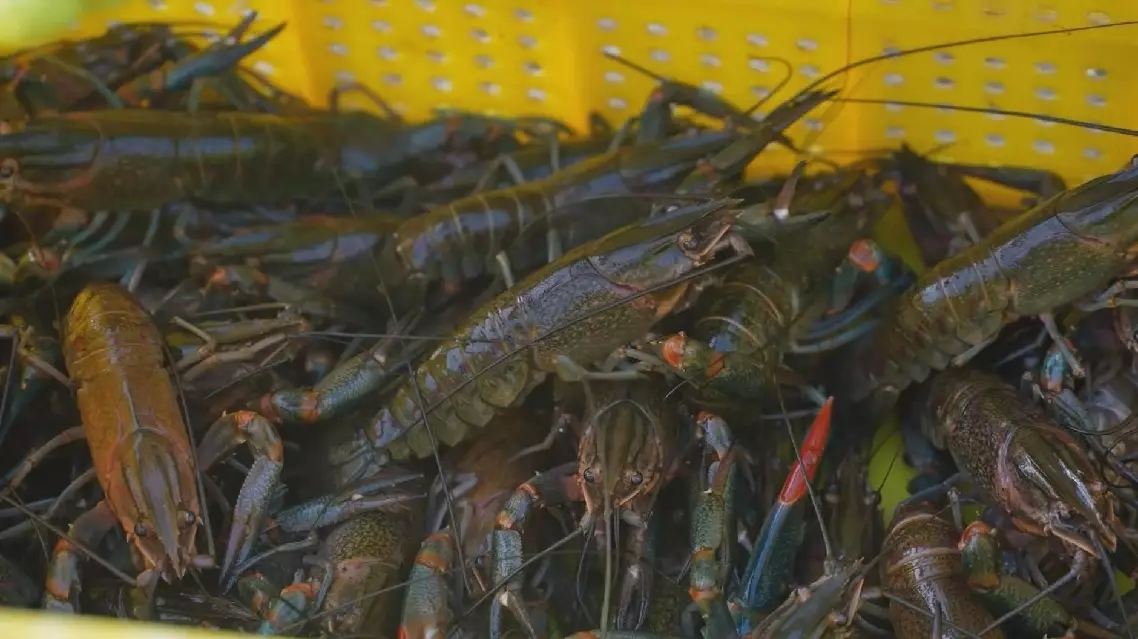
Desert crayfish farming turns barren Xinjiang land into booming industry
Displaced farming families are returning to their homeland in Gaza City, restoring fields and growing food again, though challenges like poor farming conditions and lack of supplies remain.
In parts of Gaza, farmland damaged during Israel's war on the enclave is slowly coming back to life.
Fresh vegetables are being harvested again from farmland in Gaza City's Al-Zaitoun neighborhood.
For the Al-Dahdouh family, these crops mark the return of their land to life.
The challenges have been immense. Nearly three years of war have left much of Gaza's farmland damaged or bulldozed, making the return to farming a difficult task for families trying to start again.
"When we returned after being displaced, the land was covered with piles of rubble and debris and was difficult to access. Everyone in the family worked together to rehabilitate it for farming. Thankfully, we were finally able to cultivate it again," said Wajiha Al-Dahdouh, a Palestinian farmer.
Rebuilding livelihoods and restoring a sense of normal life remains difficult after the three years of war, repeated displacement and the loss of income for many families.
"We can't afford to hire workers to help us with farming because of the high costs. We also face serious difficulties securing water for irrigation and pesticides. It has been a huge burden on us," said Iman Al-Dahdouh, another Palestinian farmer.
The Al-Dahdouh family is among around 350 farming families supported by United Nations Development Program (UNDP) with Relief Housing Units and farming assistance.
Around 1,100 families are expected to benefit in total.
"For the last three years, it has been total destruction, and people have had to leave their homelands. The families have been displaced multiple times to various locations in the midland south area of the Gaza Strip. What you see here now is life returning to the neighborhood, and UNDP supports these families through providing dignified shelters and housing solutions through what we call relief housing units," said Margunn Indreboe Alshaikh, deputy special representative of UNDP Palestine.
The initiative is part of UNDP's Neighbourhood Approach, combining housing with basic services and livelihood support.
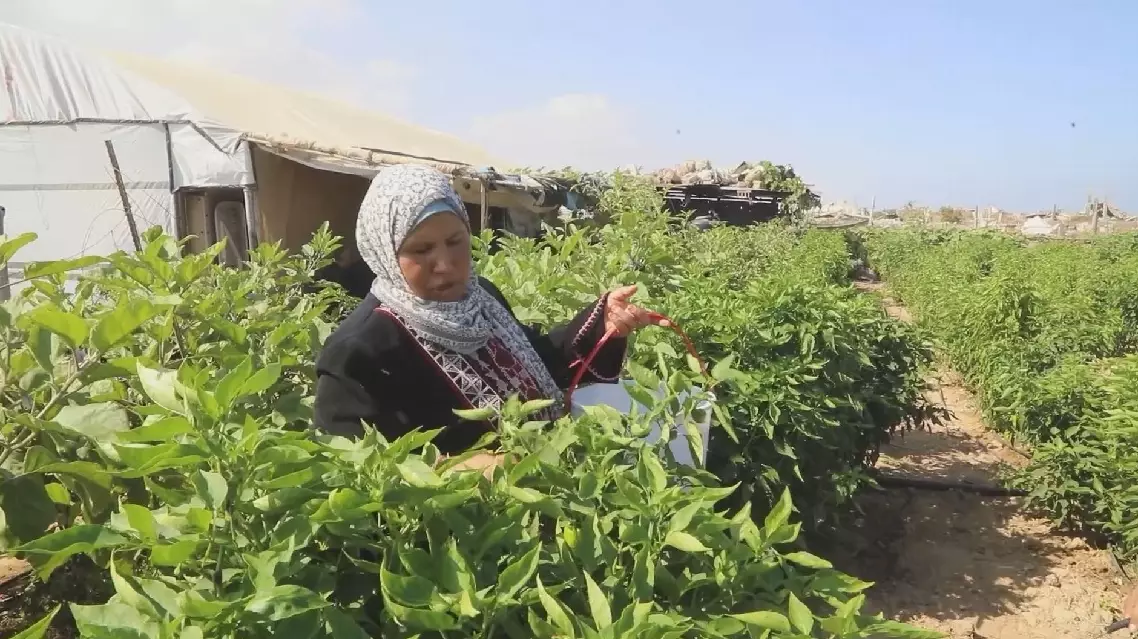
Displaced farmers arrive back in Gaza amid challenges