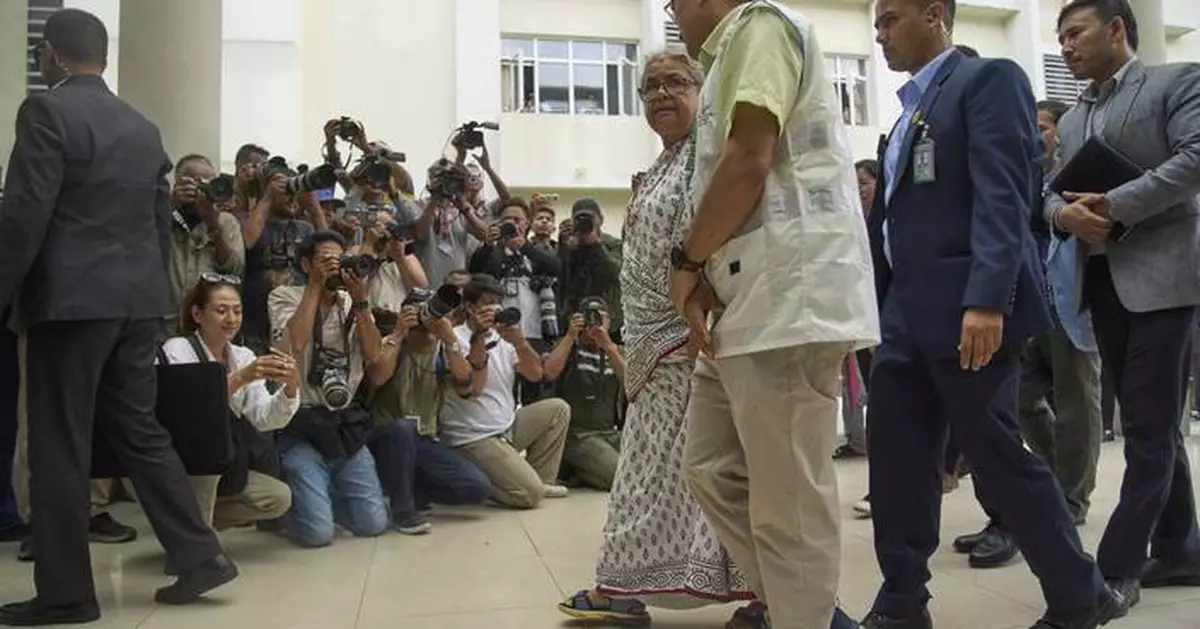
KATHMANDU, Nepal (AP) — Nepal's new prime minister took office Sunday and “urged calm and cooperation to rebuild” the Himalayan nation after days of violent protests last week left at least 72 people dead and destroyed government buildings and politicians’ homes.
Sushila Karki, the country's first woman prime minister, told top officials gathered at her temporary office that each family of slain protesters will receive monetary compensation of 1 million rupees (about $ 11,330) and assured that those injured would be taken care of, state TV reported.
Click to Gallery
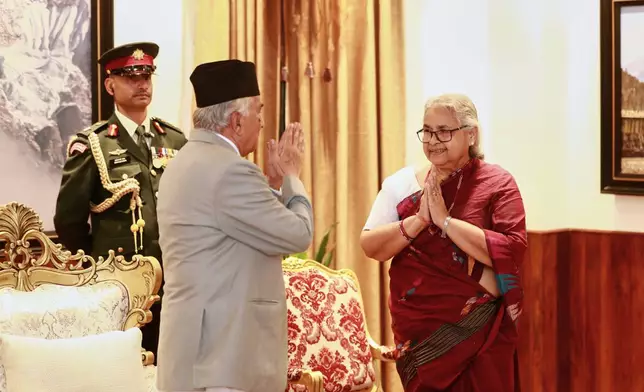
Former Supreme Court Chief Justice Sushila Karki, right, greets Nepalese President Ram Chandra Poudel after taking the oath as interim prime minister during a ceremony at the presidential residence in Kathmandu, Nepal, Friday, Sept. 12, 2025. (AP Photo/Sujan Gurung)
Former Supreme Court Chief Justice Sushila Karki attends her swearing-in ceremony as interim prime minister at the presidential residence in Kathmandu, Nepal, Friday, Sept. 12, 2025. (AP Photo/Sujan Gurung)
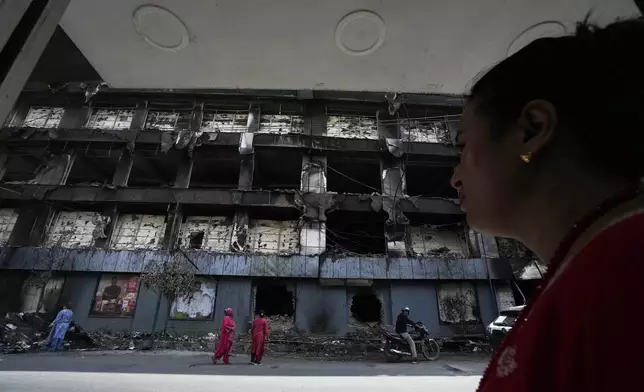
Nepalese people inspect a building of Bhatbhatini shopping center vandalized during anti-corruption protests protests sparked by a short-lived social media ban in Kathmandu, Nepal, Saturday, Sept. 13, 2025. (AP Photo/Niranjan Shrestha)
Nepal's interim prime minister Sushila Karki, center, speaks to doctor at Civil hospital as she arrives to meet people injured during anti-corruption protests sparked by a short-lived social media ban in Kathmandu, Nepal, Saturday, Sept. 13, 2025. (AP Photo/Niranjan Shrestha)
“We all need to get together to rebuild the country,” Karki said, pledging to work to get the South Asian nation back on track.
The massive demonstrations — called the protest of Gen Z — began on Sept. 8 over a short-lived social media ban. Tens of thousands of protesters took to the streets, particularly young people, angry about widespread corruption and poverty, while the children of political leaders, known as "nepo kids," seemed to enjoy luxurious lifestyles.
The protests soon turned violent, with protesters attacking the parliament building and police opening fire, and led to the resignation of Prime Minister Khadga Prasad Oli, who fled his official residence.
The actual headquarters of the prime minister, an old white-colored palace converted to an office in the capital, Kathmandu, was set on fire along with the offices of the president, the supreme court, key government ministries and several police stations on Sept. 9, a day after police shot at protesters. The businesses and houses of key families were also attacked, including several stores of a popular supermarket chain in Nepal.
Calm was restored after the army took control of the streets that night, and negotiations between protesters, the army and the president began over an interim government.
Karki, 73, was named the new prime minister on Sept. 12. She was a popular figure while serving as the court’s only female chief justice in 2016 and 2017, and was known for her stance against corruption in the government.
Fresh parliamentary elections have been set for March 5.
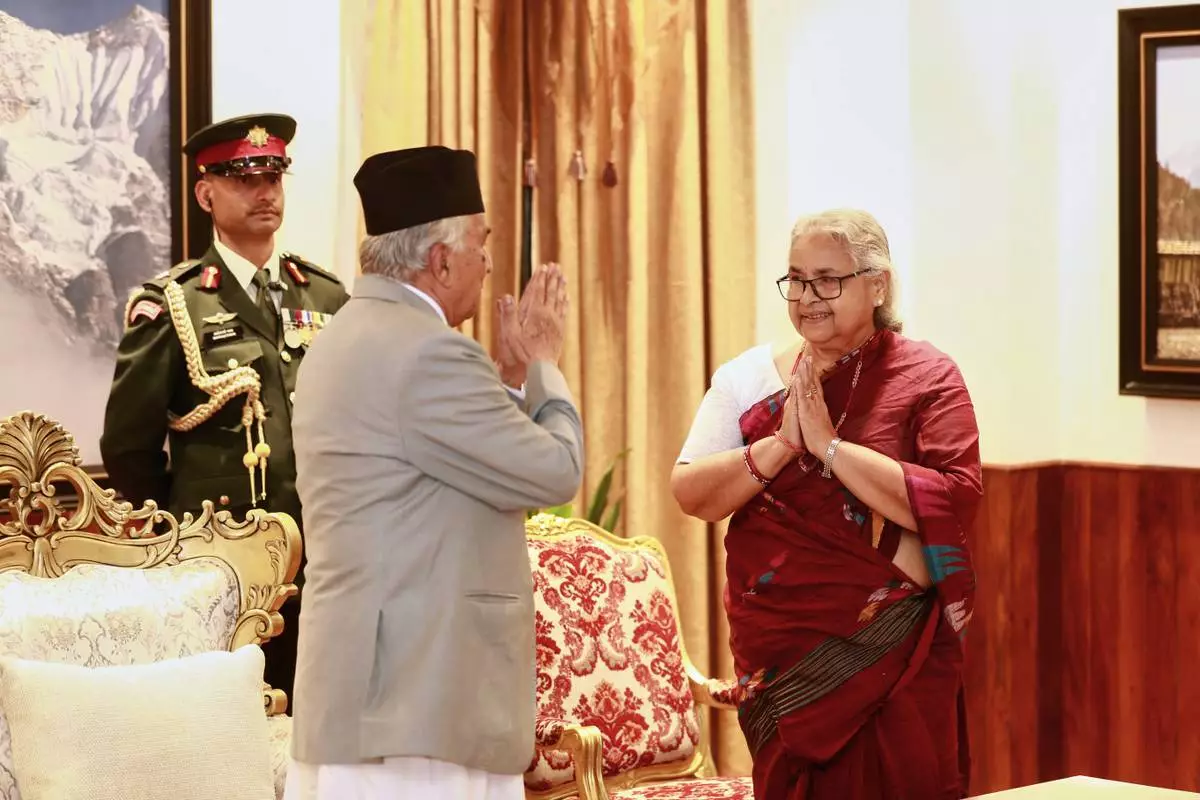
Former Supreme Court Chief Justice Sushila Karki, right, greets Nepalese President Ram Chandra Poudel after taking the oath as interim prime minister during a ceremony at the presidential residence in Kathmandu, Nepal, Friday, Sept. 12, 2025. (AP Photo/Sujan Gurung)

Former Supreme Court Chief Justice Sushila Karki attends her swearing-in ceremony as interim prime minister at the presidential residence in Kathmandu, Nepal, Friday, Sept. 12, 2025. (AP Photo/Sujan Gurung)
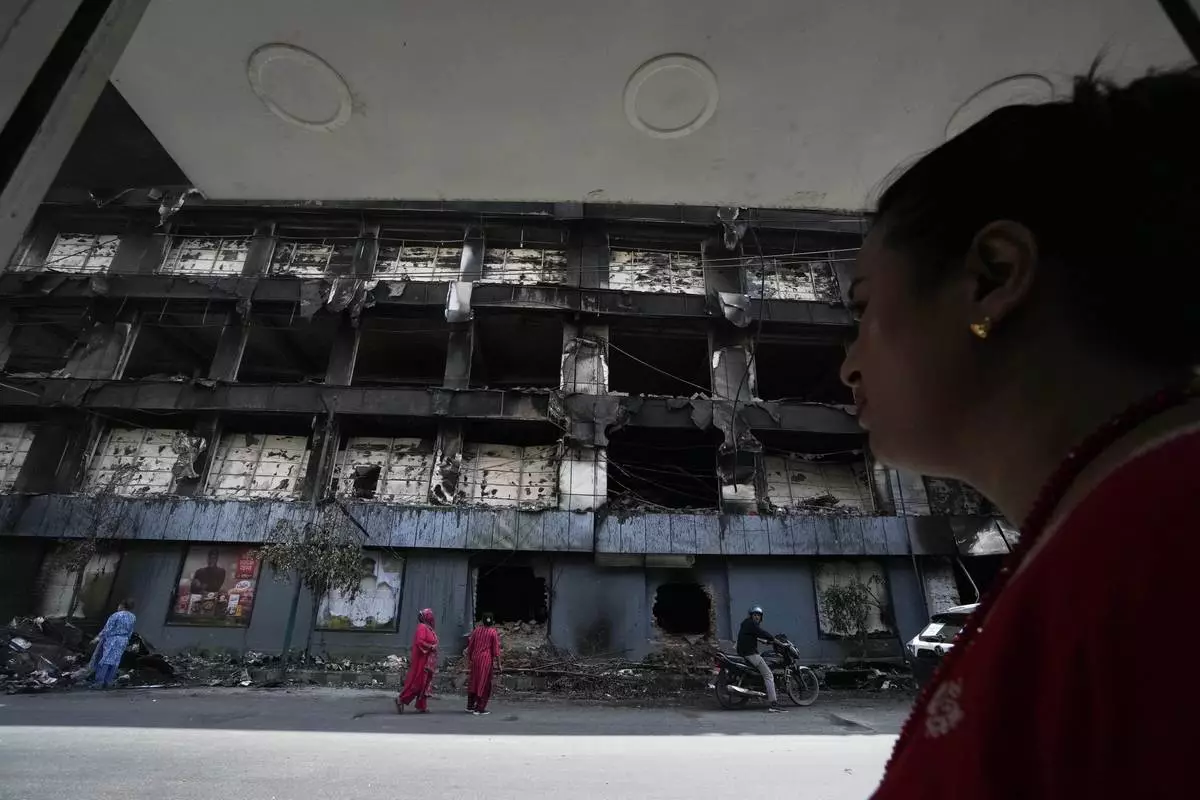
Nepalese people inspect a building of Bhatbhatini shopping center vandalized during anti-corruption protests protests sparked by a short-lived social media ban in Kathmandu, Nepal, Saturday, Sept. 13, 2025. (AP Photo/Niranjan Shrestha)

Nepal's interim prime minister Sushila Karki, center, speaks to doctor at Civil hospital as she arrives to meet people injured during anti-corruption protests sparked by a short-lived social media ban in Kathmandu, Nepal, Saturday, Sept. 13, 2025. (AP Photo/Niranjan Shrestha)
President Donald Trump posted Wednesday on social media that anything less than U.S. control of Greenland is “unacceptable,” hours before Vice President JD Vance was to host Danish and Greenlandic officials for talks.
“NATO becomes far more formidable and effective with Greenland in the hands of the UNITED STATES,” Trump wrote.
On Iran, Trump's threat to impose a 25% tax on imports from countries doing business with the Islamic Republic could raise prices for U.S. consumers and further inflame tensions in a country where inflation is running above 40%.
And as Senate Republicans face intense pressure from Trump to vote down a war powers resolution Wednesday aimed at limiting him from carrying out more military action against Venezuela, an AP-NORC poll conducted after Venezuelan President Nicolás Maduro’s Jan. 3 capture found that 56% of U.S. adults think Trump has overstepped on military interventions abroad, while majorities disapprove of how he's handling foreign policy.
The Latest:
The Washington Post says FBI agents have searched a reporter’s home as part of an investigation into a government contractor accused of sharing government secrets.
The Post says journalist Hannah Natanson had her phone and a Garmin watch seized by agents at her Virginia home.
An FBI affidavit says the search was related to an investigation into a system administrator in Maryland who, authorities allege, took classified reports home.
An FBI spokesperson declined to comment. Justice Department officials haven’t responded to an Associated Press request for comment.
Natanson covers the Trump administration’s transformation of the federal government and recently published a piece describing how she gained hundreds of new sources, leading a colleague to call her “the federal government whisperer.”
U.S. President Donald Trump has made an American takeover of Greenland a focus of his second term in the White House, calling it a national security priority while repeating false claims about the strategic Arctic island.
In recent comments, he has floated using military force as an option to take control of Greenland. He has said that if the U.S. does not acquire the island, which is a self-governing territory of NATO ally Denmark, then it will fall into Chinese or Russian hands.
▶ Take a closer look at the facts
China’s trade surplus surged to a record of almost $1.2 trillion in 2025, the government said Wednesday, as exports to other countries made up for slowing shipments to the U.S. under President Donald Trump’s onslaught of higher tariffs.
China’s exports rose 5.5% for the whole of last year to $3.77 trillion, customs data showed, as Chinese automakers and other manufacturers expanded into markets across the globe. Imports flatlined at $2.58 trillion. The 2024 trade surplus was over $992 billion.
In December, China’s exports climbed 6.6% from the year before in dollar terms, better than economists’ estimates and higher than November’s 5.9% year-on-year increase. Imports in December were up 5.7% year-on-year, compared to November’s 1.9%.
▶ Read more about how economists expect exports to impact China’s economy
Although he doesn’t always follow through, Trump seems intent on doubling and tripling down whenever possible.
“Right now I’m feeling pretty good,” Trump said Tuesday in Detroit. His speech was ostensibly arranged to refocus attention on the economy, which the president claimed is surging despite lingering concerns about higher prices.
Trump has repeatedly insisted he’s only doing what voters elected him to do, and his allies in Washington remain overwhelmingly united behind him.
Republican National Committee spokesperson Kiersten Pels predicted that voters will reward the party this year.
“Voters elected President Trump to put American lives first — and that’s exactly what he’s doing,” she said. “President Trump is making our country safer, and the American people will remember it in November.”
It’s only two weeks into the new year, and Trump has already claimed control of Venezuela, escalated threats to seize Greenland and flooded American streets with masked immigration agents. That’s not even counting an unprecedented criminal investigation at the Federal Reserve, a cornerstone of the national economy that Trump wants to bend to his will.
Even for a president who thrives on chaos, Trump is generating a stunning level of turmoil as voters prepare to deliver their verdict on his leadership in midterm elections that will determine control of Congress.
Each decision carries tremendous risks, from the possibility of an overseas quagmire to undermining the country’s financial system, but Trump has barreled forward with a ferocity rattling even some of his Republican allies.
“The presidency has gone rogue,” said historian Joanne B. Freeman, a Yale University professor.
▶ Read more about the turmoil Trump is creating ahead of this year’s votes
Nearly half of Americans — 45% — want the U.S. to take a “less active” role in solving the world’s problems, the new AP-NORC poll found.
About one-third say its current role is “about right,” and only about 2 in 10 U.S. adults say they want the country to be more involved globally.
Democrats and independents are driving the desire for the U.S. to take a “less active” role. At least half of them now want the U.S. to do less, a sharp shift from a few months ago.
Republicans, meanwhile, have grown more likely to indicate that Trump’s level of involvement is right. About 6 in 10 Republicans — 64% — say the country’s current role in world affairs is “about right,” which is up slightly from 55% from September.
About half of Americans believe the U.S. intervening in Venezuela will be “mostly a good thing” for halting the flow of illegal drugs into the country, according to a new AP-NORC poll.
And 44% believe the U.S. actions will do more to benefit than harm the Venezuelan people. But U.S. adults are divided on whether intervention will be good or bad for U.S. economic and national security interests, or if it simply won’t have an impact.
Republicans are more likely than Democrats and independents to see benefits to the U.S. action, particularly its effects on drug trafficking. About 8 in 10 Republicans say America’s intervention will be “mostly a good thing” for stopping the flow of illegal drugs into the country.
▶ Read more about the poll’s findings
Most U.S. adults — 56% — say President Trump has “gone too far” in using the U.S. military to intervene in other countries, according to a new AP-NORC poll conducted from Jan. 8-11, after Venezuelan President Nicolas Maduro’s capture.
Democrats and independents are driving the belief that Trump has overstepped. About 9 in 10 Democrats and roughly 6 in 10 independents say Trump has “gone too far” on military intervention, compared with about 2 in 10 Republicans.
The vast majority of Republicans — 71% — say Trump’s actions have been “about right,” and only about 1 in 10 want to see him go further.
▶ Read more about the poll’s findings
President Donald Trump speaks during a meeting with oil executives in the East Room of the White House, Jan. 9, 2026, in Washington, as Vice President JD Vance and Secretary of State Marco Rubio listen. (AP Photo/Evan Vucci, File)
Trump said in a social media post on Monday that he would impose a 25% tax on imports to the United States from countries that do business with Iran. The sanctions could hurt the Islamic Republic by reducing its access to foreign goods and driving up prices, which would likely inflame tensions in a country where inflation is running above 40%.
But the tariffs could create blowback for the United States, too, potentially raising the prices Americans pay for imports from Iranian trade partners such as Turkish textiles and Indian gemstones and threatening an uneasy trade truce Trump reached last year with China.
The Trump administration has offered scant details since announcing the new tariffs targeting Iran. It’s also unclear what legal authority the president is relying on to impose the import taxes. He invoked the 1977 International Emergency Economic Powers Act to justify his most sweeping tariffs last year. But businesses and several states have gone to court arguing that Trump overstepped his authority in doing so.
▶ Read more about Trump’s threat of new tariffs
The Smithsonian Institution gave the White House new documents on its planned exhibits Tuesday in response to a demand to share precise details of what its museums and other programs are doing for America’s 250th birthday.
For months, Trump has been pressing the Smithsonian to back off “divisive narratives” and tell an upbeat story on the country’s history and culture, with the threat of holding back federal money if it doesn’t.
By Tuesday, the Smithsonian was supposed to provide lists of all displays, objects, wall text and other material dedicated to this year’s anniversary and other purposes. Smithsonian Secretary Lonnie Bunch III told staff, in an email obtained by The New York Times and The Washington Post, that “we transmitted more information in response to that request.”
The White House did not respond to a request for comment, leaving it unclear whether it was satisfied with the material it received.
▶ Read more about the Smithsonian
Trump said Wednesday that anything less than U.S. control of Greenland is “unacceptable,” hours before Vice President JD Vance was to host Danish and Greenlandic officials for talks.
In a post on his social media site, Trump reiterated his argument that the U.S. “needs Greenland for the purpose of National Security.” He added that “NATO should be leading the way for us to get it” and that otherwise Russia or China would.
“NATO becomes far more formidable and effective with Greenland in the hands of the UNITED STATES,” Trump wrote. “Anything less than that is unacceptable.”
Greenland is at the center of a geopolitical storm as Trump is insisting he wants to own the island, and the residents of its capital, Nuuk, say it is not for sale. The White House has not ruled out taking the Arctic island by force.
▶ Read more about Trump’s comments
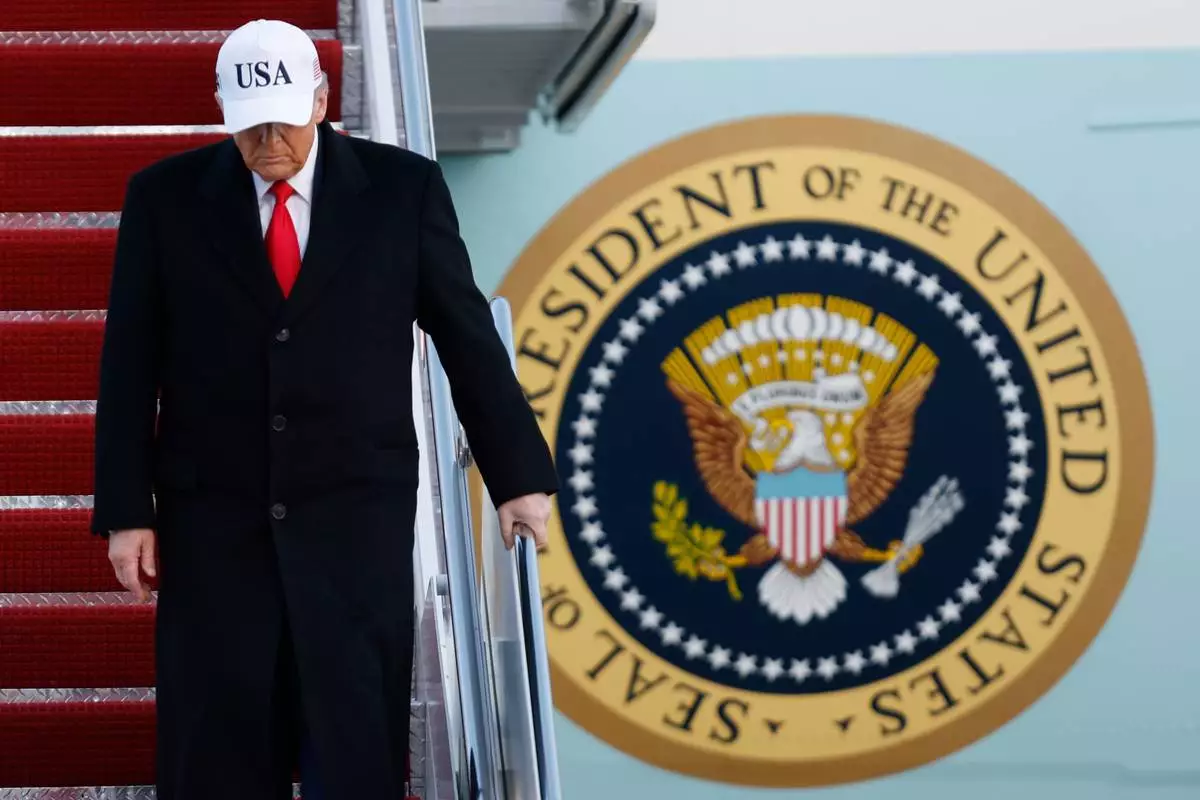
President Donald Trump walks down the stairs of Air Force One upon his arrival at Joint Base Andrews, Md., Tuesday, Jan. 13, 2026. (AP Photo/Luis M. Alvarez)